

A dog’s journey
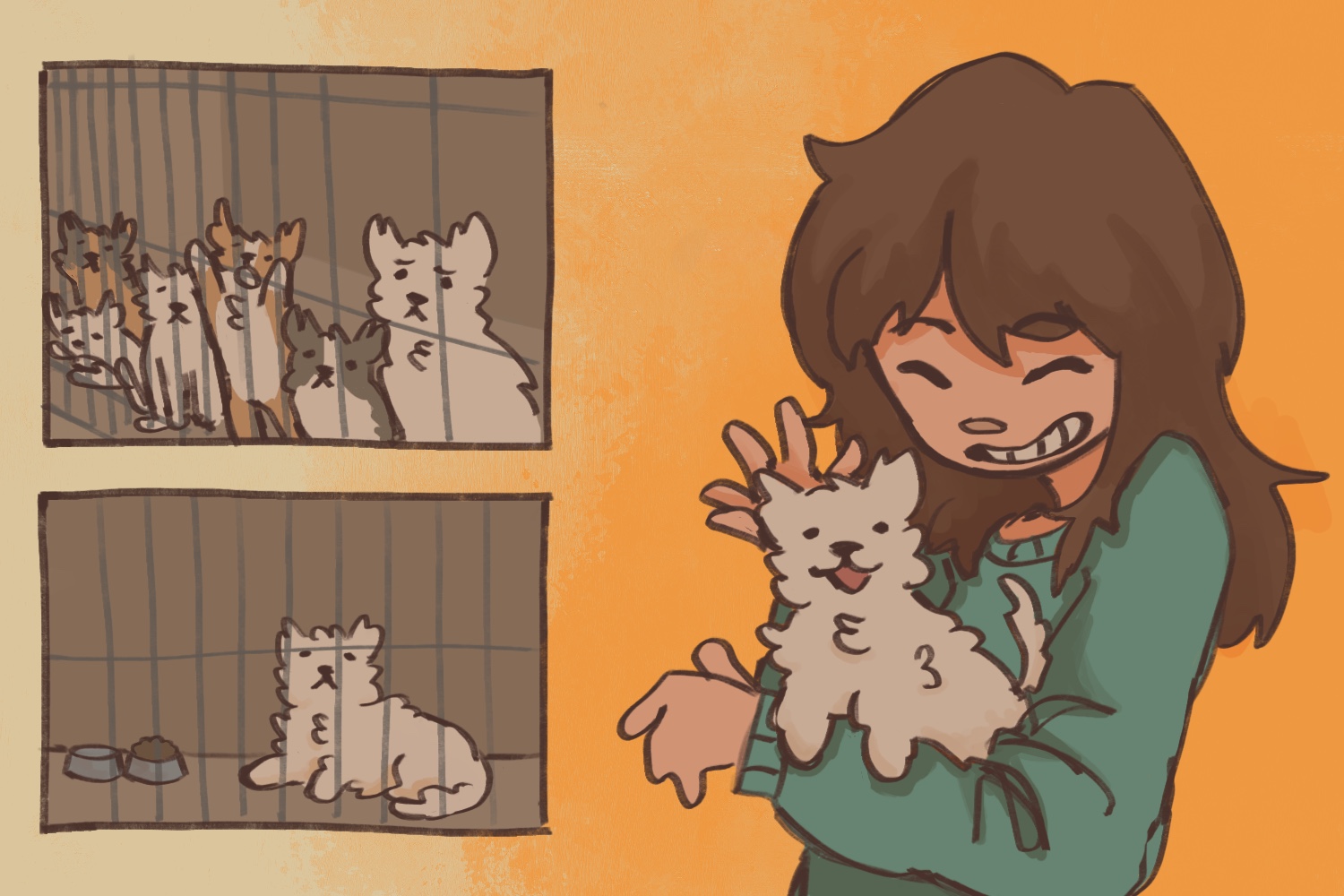
It’s a crisp Saturday morning, and barking echoes throughout a pet store parking lot. Dogs ranging from Pugs to Australian shepherds sit outside the store in makeshift enclosures. Two white Poodles, wearing dog cones that look like donuts, meander around their pen as they peek into the sea of adoring faces, hoping one might become their forever home.
This is a biweekly occurrence during adoption events organized by Doggie Protective Services (DPS), a nonprofit organization primarily based in the San Francisco Bay Area, that rescues dogs and cats throughout California.
Long before a puppy is adopted into a loving home, many dogs go through an arduous journey before even ending up in the care of organizations like DPS.
As of January 2025, an estimated 10,000 puppy mills are currently operating in the U.S., according to Humane World for Animals. Among these are about 2,072 breeding facilities that are Class A and Class B licensed by the U.S. Department of Agriculture (USDA), according to Humane World for Animals.
Puppy mills are defined by Humane World for Animals as inhumane, large-scale dog breeding facilities that prioritize profits over the health and well-being of the dogs.
Across all puppy mills, 500,000 dogs are exclusively kept for breeding, 118,122 of which are from USDA-licensed facilities, according to Humane World for Animals. Mother dogs live their whole lives neglected in cramped cages, and when a breeding dog can no longer produce litters, they are often abandoned or sold to anyone willing to buy them.
Puppies from these facilities are often born with severe genetic defects such as hydrocephalus, epilepsy, and liver shunts. Due to poor sanitation, overbreeding, and a lack of preventive veterinary care, many of these dogs live sickly lives.
“Common illnesses due to those circumstances may include malnutrition, dehydration, and parasitic or other infectious diseases. In addition, the development of any spontaneous health concerns — such as injuries, infections, inflammatory diseases, or cancers — will go untreated. This could all lead to animal suffering and even death,” said Kevin Pflaum, a veterinary behaviorist at the San Francisco Society for the Prevention of Cruelty to Animals (SF SPCA).
In terms of behavioral health, Pflaum says the biggest concern is a severe lack of early socialization.
“Essentially, puppies have a period of critical development, roughly at four to 14 weeks of age, where the brain is developing and learning about what is safe in the world or what is not. Pets that are poorly socialized in this period — such as stray animals or neglected pets in puppy-mill or hoarding situations — will be prone to high-intensity fear and anxiety disorders, which can manifest as being incredibly shy, fearful, shut down, or even highly aggressive,” Pflaum said.
These unethical breeders sell dogs through online platforms such as Craigslist, advertising puppies as being born in their homes rather than in a puppy mill. Large quantities of dogs born in puppy mills may even be legally sold to pet stores by USDA-licensed facilities, according to Humane World for Animals.
Some dogs may be lucky enough to be adopted into homes equipped to support their health needs, but others may be left abandoned when these health issues become too much of a burden on some families, among other circumstances.
“Potential reasons for abandonment include, but are not limited to: inability to care for the pet anymore due to financial or owner health limitations, needing to move and not being able to bring the pet with, or unmanageable behavioral concerns. There is also the possibility of escape or owned animals being allowed to roam,” Pflaum said.
Regardless of why a dog may be abandoned, the World Health Organization estimates that there are over 200 million stray dogs worldwide. Unfortunately, strays taken in by shelters and rescues may find the change in environment highly traumatic and stressful.
“Environmental changes may make it more challenging for dogs to trust future homes and bonds with humans. In addition, increased stress levels, secondary to these environmental changes, may predispose dogs to increased sensitivity to other stressors in the environment and increased likelihood for the development of aggressive tendencies,” Pflaum said. “This makes it challenging to acclimate these pets into loving homes and may lead to poor welfare in new living circumstances, re-abandonment, or euthanasia.”
With the cycle of neglect and abandonment prevalent across the world, organizations like DPS are working tirelessly to rehabilitate these dogs and provide them with the loving homes they deserve.
Doggie Protective Services to the rescue
As of 2024, 4.2 million animals were adopted from shelters, according to the American Society for the Prevention of Cruelty to Animals, and nearly 60 million U.S. households own at least one dog, according to the American Veterinary Medical Association. Despite this, in addition to dog adoption, many people are unaware that fostering dogs is an option.
Founded in 2001, DPS does not have a physical shelter. Instead, the organization relies on foster homes to care for the estimated 1,000 dogs it receives annually. At any given time, the organization operates anywhere from 80 to 100 fosters.
“Shelters can make for extremely challenging conditions for dogs, and many dogs will not thrive in such environments. In addition, they may have health or behavioral conditions which cannot be effectively managed. Thus, foster homes are an invaluable resource to provide interim care for pets seeking forever homes,” Pflaum said.
Carlmont senior, Sanaa Bharadwaj, who is DPS’s Lead Event Coordinator, says around 80% of DPS’s dogs are taken in from overpopulated shelters. The organization also rescues animals in danger of euthanasia and receives most dogs from shelters across California.
“If somebody finds a dog on the street, they have to take it to their local shelter, and then from there, the dog is put on a stray hold,” Bharadwaj said. “The shelter can’t adopt out the dog yet, until they’ve given enough time for — if the dog had an owner — the owner to be able to find the dog in the shelter. After that, we’ll usually take the dog from there.”
Outside of shelters, DPS takes in dogs that are surrendered to it by their owners. The organization also aids in rehoming animals from hoarding situations.
“Just recently, I think two weeks ago, there was this hoarding situation where 75 dogs were found in one person’s house,” Bharadwaj said. “That person was hospitalized, and all of these dogs needed a place to go, so they all went to different rescues. Our rescue took in 31 of those dogs, so a lot of our dogs right now are from there.”
While this specific group of dogs was not suffering from significant medical issues, many dogs that DPS receives arrive with poor dental health.
“Some of these dogs are used to eating random things that they find on the street. They’ll come with rotting teeth, so we have to schedule dentals for them,” Bharadwaj said.
Dental exams, vet visits, spay and neuter surgery, vaccinations, flea treatment, deworming, and microchipping may all be required to cater to each animal’s unique health needs. In addition to transporting dogs out of shelters and spending several weeks living in a foster home, on average, it costs $627 to prepare a dog for adoption, according to the DPS website.
As a nonprofit organization, DPS relies on donations to cover these expenses. While the rescue takes in dogs of all ages, its age range is often restricted by limited funds.
“Sometimes we’ll have a ton of puppies in the rescue and pregnant moms, and then other times we’ll have a lot of two to five-year-olds,” Bharadwaj said. “We usually don’t take as many seniors in just because they have a lot of medical needs. Those medical needs are a lot for the rescue to sustain, but we do take them in sometimes.”
Coming full circle
When Bharadwaj was seven-years-old, she and her family adopted their Cocker Spaniel, Micky, from DPS. The following year, when Bharadwaj was eight-years-old, she and her mother began volunteering at DPS events.
Since then, Bharadwaj has dedicated nine years to her volunteer work at DPS, climbing up the ladder to her current position as DPS’s Lead Event Coordinator.
To help puppies find their perfect families, DPS hosts biweekly Saturday meet-and-greet events from 12 p.m. to 3 p.m. at Pet Food Express in Palo Alto, California.
During these events, Bharadwaj oversees the high school volunteers, assigning them to different pens based on their strengths. At the front desk, she answers potential adoptees’ questions and helps conduct the adoption process.
“Once the family has been approved to adopt a dog, I help finalize those adoptions, ensuring that they have their contract signed, they’ve paid all the money, and that our team has the dog’s microchip scanned,” Bharadwaj said.
While the rescue also conducts adoptions between events, most adoptions occur at these meet-and-greets, typically resulting in the adoption of around 18 to 20 dogs per event.
After school, Bharadwaj works with the online foster team, focusing on logistics and behind-the-scenes work. This team of six functions as the backbone of DPS, directly communicating with foster families, reaching out to coordinate handoffs between fosters, and determining which dogs are eligible for adoption and need to attend events.
Thanks to Bharadwaj and her fellow volunteers at DPS, the organization has helped over 12,000 dogs and cats find their forever homes since the rescue’s foundation.
Why fostering?
From taking it on walks to socializing, having a dog is a huge commitment, lasting from 10 to 15 years. In addition to time, dogs are a substantial financial commitment, costing anywhere from $14,480 to $15,782 to raise a pup its entire life, according to the American Kennel Club.
Due to this, many animal and dog lovers may feel that dog ownership isn’t in their cards. However, fostering provides many with the joys of animal companionship and flexibility around lifestyle changes, traveling, and financial situations.
“Because my family travels a lot and we’re pretty active, we would have to put the dog in a dog hotel for a couple weeks every year,” said dog foster Adeline McCane, a freshman at Saint Francis High School. “Fostering helps a lot of dogs and you can take a break from having fosters, so it’s kind of easier.”
In addition to the benefits for people, foster homes give shy and scared shelter dogs a place to blossom.
“You’re helping them learn how to walk upstairs, working on potty training with them, crate training, and just giving them a place to come out of their shells,” Bharadwaj said.
McCane recently became a first-time foster with DPS. With the recent group of dogs DPS received from the hoarding situation, McCane and her family took in two one-year-old puppies, which the shelter named Ghost and Frankie.
Like McCane’s experience, a typical foster at DPS will take care of one to two dogs, but foster families of puppies may have up to five or six dogs. No matter the number of pups, DPS provides its fosters with all the supplies they need.
“They provided, all of the food, leashes, and crates and stuff, and we didn’t have to pay for their grooming or their neutering,” McCane said. “DPS took care of that for us, and all the people at DPS are really nice and seem to really care about the dogs.”
Since their arrival at DPS, Ghost and Frankie have warmed up to McCane and her family, and the duo enjoys frequent cuddling, pets, and trips to Starbucks to get pup cups. However, like many other foster dogs, their playful and friendly spirits weren’t always on display for all to enjoy.
“When we first brought Ghost home, he wouldn’t stop shaking and wanted to hide in his crate. Now, he follows us around like a shadow,” McCane and her family said on the DPS website. “Ghost is definitely a people dog. He absolutely loves cuddling and petting, and will climb into your lap. He likes to be held like a baby with his stomach up, and could lie with you forever.”
This was a similar story with Frankie.
“When we first got Frankie, we were worried that he would be too scared to become friendly with us. The next morning, we put him outside in a pen with our other foster Ghost, and he started playing and smiling and wagging his tail,” McCane and her family said on the DPS website.
DPS requires dogs to stay with fosters for at least two weeks and be fixed before they can be posted on the rescue’s website and adopted. While McCane admits that it will be hard saying goodbye to her new furry friends, a dog’s time with its foster family helps nurture a pup’s best qualities and is essential to finding its perfect forever home.
“The foster home is the transition phase where, in my opinion, the dog learns how to become a dog,” Bharadwaj said.
A new leash on life
Once a dog is approved to be posted on the website, how long it remains posted depends on how cute and well-behaved the dog is. Dogs such as DPS’s Maltese and Poodle mixes usually get adopted much faster than their Pit Bulls or other big dogs.
Anthony Intintoli and his family adopted their dog Aristotle from a litter that was left with DPS.
“The adoption experience was fantastic. They even let us keep him for a week before having to commit to the adoption, just in case it wasn’t a good fit. I thought that was a brilliant thing to do and eliminated our trepidation going into the process,” Intintoli said.
From being a stray to fostering and adoption, being a dog is not always about belly rubs and wagging tails. Thanks to organizations like DPS, which play a vital role in rescuing, rehabilitating, and rehoming animals, countless dogs now live happier, comfortable lives, regardless of their past.

