

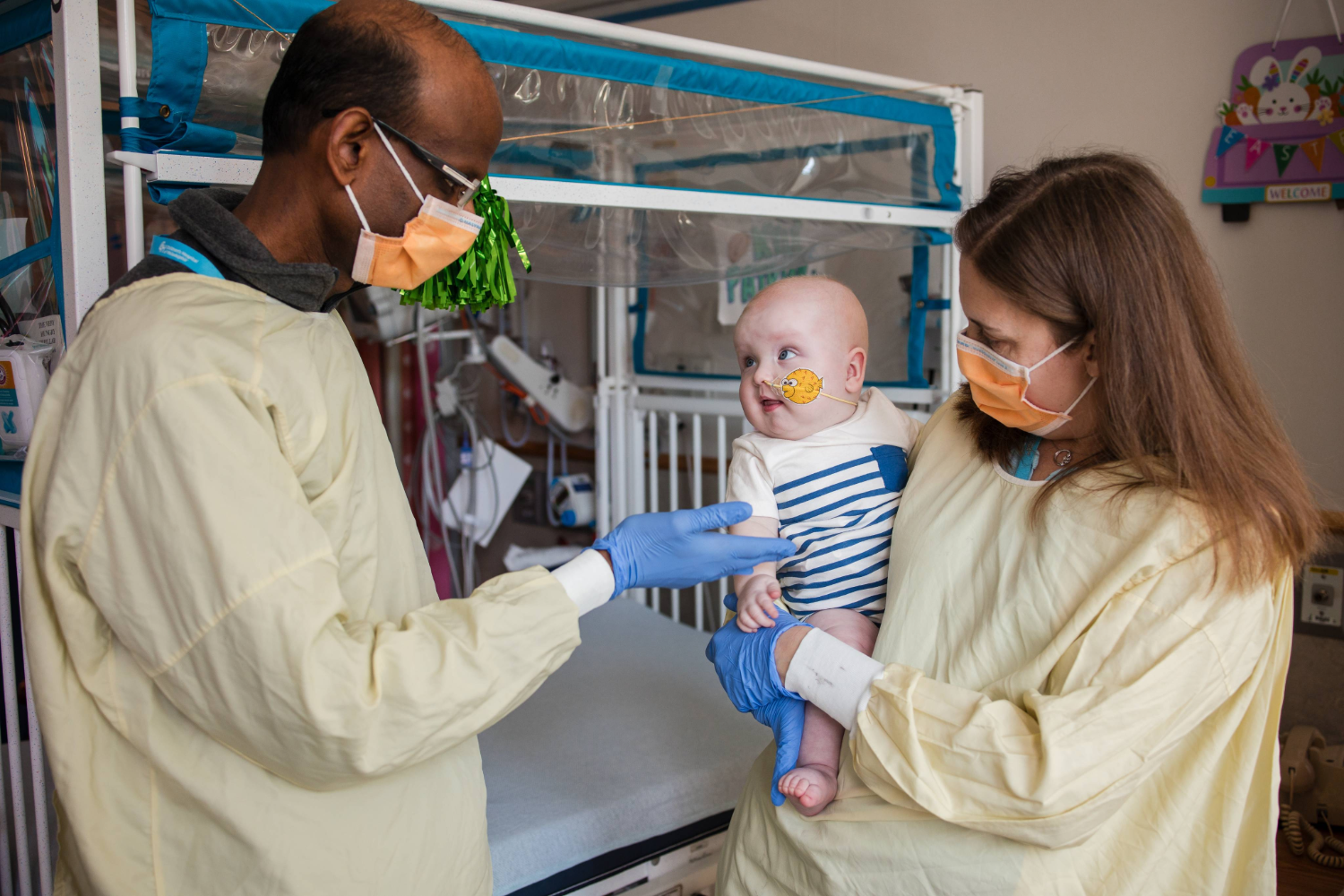
Two-day-old baby KJ Muldoon only had a few months left to live.
Diagnosed with a rare and fatal genetic disease, his life hung in the balance — the only known treatment offering little hope of survival.
So, doctors created a new one.
But some worry they’re playing God.
KJ’s story
From the moment KJ was born, doctors knew something was wrong. Unlike most newborn infants, he was unusually inactive, refused to eat, and couldn’t regulate his body temperature. In response, doctors at the Children’s Hospital of Philadelphia (CHOP) began testing immediately.
The results were worse than expected. KJ was diagnosed with severe carbamoyl phosphate synthetase 1 (CPS1) deficiency, a urea cycle disorder. Urea cycle disorders are extremely rare and prevent the body from being able to break down ammonia, leading to toxic buildups in the blood that can quickly become fatal.
At the time, KJ’s only potentially life-saving option was to get a liver transplant — not only rare, but also a risky procedure for such a fragile newborn. Even if a donor organ became available, he’d still need to be stable enough to survive the surgery, something doctors worried was unlikely.
“When we Googled CPS1 deficiency, we saw there were two likely outcomes — a liver transplant or death. We were in shock,” said Nicole Muldoon, KJ’s mother, in a CHOP press release.
Little did she know there might be a third outcome. Behind the scenes, scientists at CHOP and the University of Pennsylvania (Penn) had already been researching an experimental alternative: CRISPR, which would soon save its first baby’s life.
New hope: CRISPR
In the world of science, the term “CRISPR” holds a lot of weight. Yet, to the majority of society, it remains a mostly unknown or forgotten arrangement of letters.
“I feel like whenever I say ‘CRISPR’ around people, I kind of wait a second and see if they nod or if they’re like, ‘What’s that?’” said Phoebe Hall, a Ph.D. student at the University of California, Santa Barbara, who is doing CRISPR research.
Standing for Clustered Regularly Interspaced Short Palindromic Repeats, CRISPR, specifically the system using the Cas9 protein (CRISPR-Cas9), is a genome editing technology known for its precision and speed. It was co-developed by Jennifer Doudna and Emmanuelle Charpentier in 2012, discoveries that were awarded the Nobel Prize in Chemistry in 2020, during which it was described as “genetic scissors rewriting the code of life.”
“CRISPR is a fast, precise, and relatively inexpensive technology to edit our DNA sequence that can have real, life-changing outcomes in a very short period of time,” said Jaime Abdilla, co-director of the Biotechnology Institute (BTI) and a biotechnology instructor at Carlmont.
However, contrary to popular assumption from its recent attention, CRISPR itself isn’t a new, or even fully human-developed, system. In 1987, Yoshizumi Ishino accidentally identified it for the first time in the bacterium, E. coli, and it has existed in many microorganisms for billions of years.
“I think people have a general understanding, and it’s probably a misunderstanding, but in some ways that’s okay,” Hall said. “If you were to tell them that it’s a way to change DNA, I think that is a basic explanation that works, but I think it’s also interesting to explain that it’s a naturally occurring system that humans just figured out how to use for our purposes.”
In fact, CRISPR is present in nearly all archaea, microorganisms once considered bacteria but now noted for their evolutionary differences and approximately half of all known bacterial species. It’s their natural, adaptive immune system against their own viruses, called phages.
After surviving a viral infection, small pieces of the phage’s DNA “spacers” are stored within the bacterium’s own genome, creating a CRISPR array — a genetic record of past infections. In a way, it vaccinates itself, as a future infection of the same phage will trigger a genetic “memory” of how to destroy it. This “memory,” otherwise known as the now stored viral DNA, can be used by the bacterium to create a guide RNA — a temporary copy of part of the viral DNA — that a cutting enzyme, such as the Cas9 protein, can compare and then identify the virus with to find exactly where to cut it out, killing every instance of it and saving the bacteria.
Scientists make use of bacteria and archaea’s CRISPR system by creating their own custom guide RNAs matching the gene they want to edit, so Cas9 will cut it out to be replaced with whatever gene they want. This process is extremely cost-effective.
“A lot of people think that we invented it, but Cas9 and other Cas proteins exist naturally as bacterial defenses against viruses, so it’s just humans reprogramming those to do what we want them to do,” Hall said.
The past decade following Doudna’s research has been full of many revolutionary advances and discoveries relating to CRISPR, most notably one made in late February 2025 with KJ. For the first time, a personalized CRISPR gene editing therapy was used to successfully treat a child of his genetic disease.
“It’s one of those things where each individual development doesn’t feel that crazy, but then if you were to jump 10 years in time, who knows what that looks like,” Hall said.
Drawing new lines: Ethical debates
Despite its immense potential, editing human DNA, especially at the earliest stages of life, introduces a host of ethical and practical concerns. The same tools that could cure devastating diseases could also be misused to alter traits or make irreversible decisions on someone else’s behalf. Additionally, even with careful design, there is still the risk of off-target effects, some of which could be fatal or even more compromising than the original condition.
Yet, this debate all boils down to a deceptively simple question: should CRISPR ever be done?
“There are going to be more debates and bridges to cross about where you draw the line of what is a medical condition versus a cosmetic thing. But, in general, I’m pro-CRISPR therapies for humans that can help with genetic diseases and conditions,” Hall said.
Still, where that line gets drawn and who gets to draw it remains controversial.
“Ethical use of biotechnology has always been a hot topic,” Abdilla said. “While we can use biotechnology to create designer babies, I feel that we should be focusing on this technology to better humankind in general: allowing people to live without chronic or congenital disease, live without cancer, and have access to food and a clean environment.”
History has shown what can happen when scientific boundaries aren’t clearly defined, and CRISPR is used without limits.
Unbeknownst to many, before KJ, there were two others. In 2019, at the Second International Summit on Human Genome Editing, Chinese scientist Jiankui He announced he had created the world’s first genetically edited babies using CRISPR. Unlike KJ, however, who received treatment after birth, He edited embryos before conception, which is suspected to have caused off-target mutations in the twins later born.
His shocking and abrupt violation of the global ethical consensus has exposed a troubling lack of basic medical ethics and regulatory enforcement.
“People are being pretty careful, or, when people do something that isn’t the best, there are repercussions for them, like the person who did the illegal editing in China was arrested. But globally, some general guidelines should start to be put in place,” Hall said.
To avoid conflict, Hall suggests that these laws be a joint effort between scientists and the public.

“Scientists who work on CRISPR or have an understanding of how it works should be deciding these guidelines, but, at the same time, I wouldn’t want it to be a situation where decisions about guidelines are going completely over the general population’s head,” Hall said. “There’s always the problem of the scientific community being able to communicate what they’re up to to the general public, and when they fail at that, there becomes distrust of science and the scientific community, and I think that it would be dangerous for this to fall into that category.”
As CRISPR continues advancing rapidly, some scientists wonder whether society’s discomfort with gene editing will prove temporary. Many compare it with the early ethical concerns surrounding organ transplants, which once sparked outrage but are now widely accepted.
Yet, Hall sees the future of the technology depending largely on what its purpose becomes — on where the ethical line is ultimately drawn.
“If we really do just stay in the lane of medical therapeutics with CRISPR, like it is with organ donations, I think that it could follow a similar trajectory,” Hall said. “But if it ends up going over into cosmetics and designer babies, I don’t think that’s a good use of CRISPR, and I think that many people would agree, so then I don’t think that acceptance would follow organ donations.”
Beyond the ethics of what can and should be done, there is also the issue of who can access the technology, raising subsequent questions of fairness. If CRISPR remains costly, its life-saving treatments risk becoming breakthroughs only available to the wealthy, further deepening already existing healthcare inequalities.
Still, Hall remains optimistic that this disparity will narrow over time.
“So many people are working on it, and I feel like, when so many people are working on something, it gets more streamlined, more efficient, and more affordable,” Hall said.
But access isn’t the only other challenge.
While CRISPR draws a blurry line between what’s right and necessary, and what could be considered an overreach of science and resources, that line becomes even harder to define when the people most affected aren’t able to make the decision themselves, such as in the case of KJ.
His story has been hailed as a triumph of science and hope, met with much enthusiasm, but it also highlights one of medicine’s most profound dilemmas: the inability of patients, especially children, to provide informed consent.
“I have a friend who’s a medical student and was doing her pediatrics rotation and was saying how struck she was by how much you have to defer to the parents,” Hall said. “She said there would be situations where she could see that there was a clear answer to what they should do, but if the parents didn’t want it, they couldn’t do it.”
As a parent herself, Abdilla understands the weight of that responsibility.
“In addition to being a scientist, I am also a mom. Part of being a parent is making decisions for your child that could impact them for the rest of their lives. I cannot speak for other parents in the decision-making process for their children, but for me, it is very simple: I will do anything under the sun to make sure that my boys are healthy and have the best chance of living a long life free of pain, struggles, and suffering,” Abdilla said. “If my kids were as sick as KJ, if there was any hope that I could make them healthier and have a better future, I would make the same decision KJ’s parents made.”