


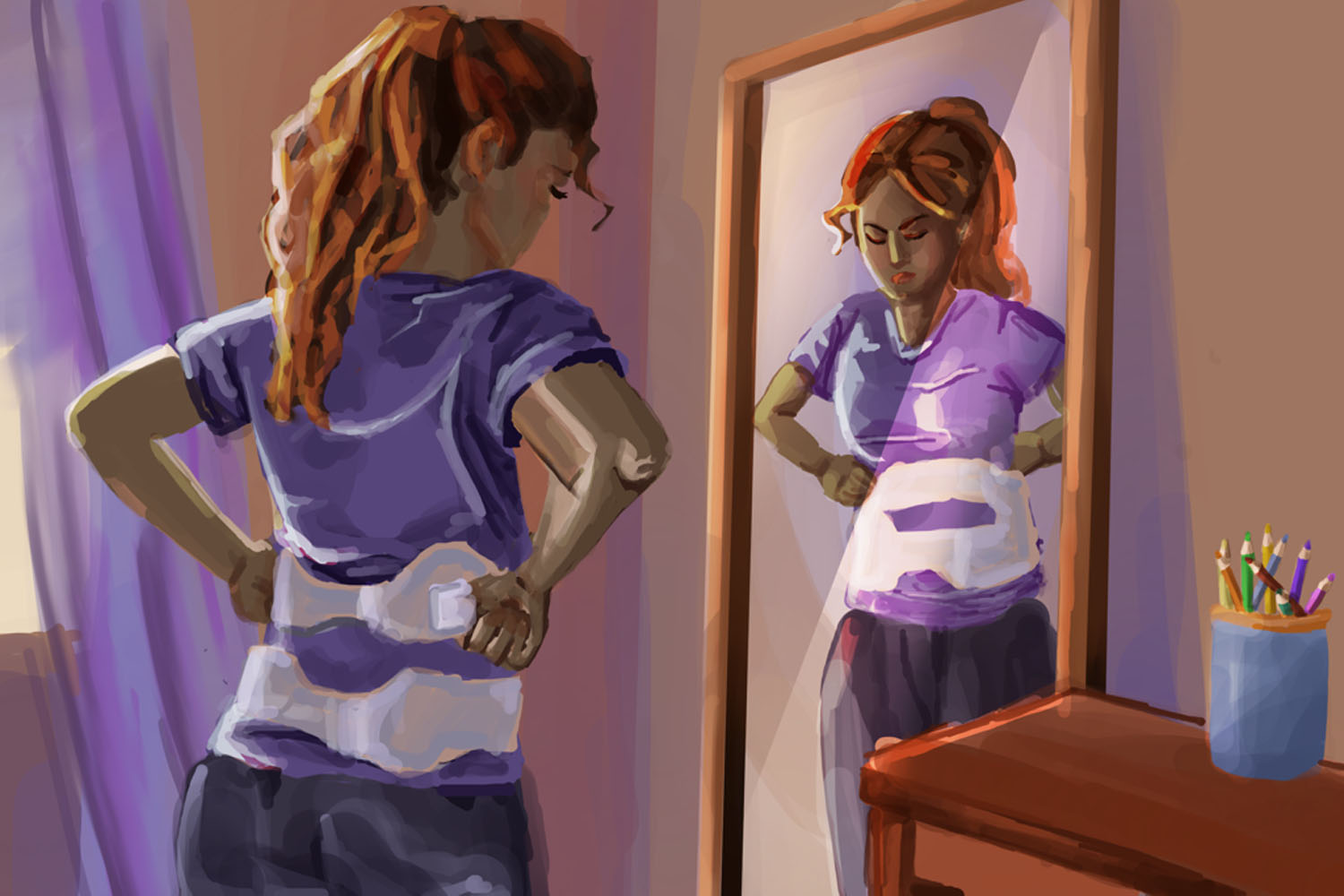
A young teenage girl reaches for the rigid plastic brace waiting on her desk. She slides it beneath her shirt, tightening the straps until they press against her ribs. It is part of her routine to prevent her spine from curving further. Before she even steps into the classroom, she’s already carrying a weight that most of her peers cannot see.
According to research published in StatPearls, across the globe, 1-3% of adolescents aged 10 to 18 have been diagnosed with adolescent idiopathic scoliosis (AIS).
“Most scoliosis is idiopathic, which means we don’t have a reason for why it developed,” said Dr. Erik McGoldrick, an orthopedic surgeon at Providence Medical Group in Eureka, California.
Despite its unclear origins, scoliosis affects more than posture. Emerging between the ages of 10 and 16, scoliosis alters how teens move and sleep, and may also affect their self-esteem. Beyond the physical discomfort that comes with AIS, many teenagers face emotional challenges like anxiety and depression.
The first signs of scoliosis often go unnoticed — an uneven shoulder, a tilted waistline, or clothing that doesn’t fit quite right. Diagnosis typically happens during a routine physical exam, sometimes catching families by surprise. If a teenager’s curve is more than 10 degrees, they have AIS, according to the University of Michigan. Teens with spinal curvatures between 25 and 45 degrees are fitted for a back brace, a treatment designed to prevent curve progression.
Life inside the brace
The brace, which is a hard plastic corrective device, can be very uncomfortable. According to Quinn Willis, a freshman at Hillsdale High School with AIS, the brace forces the individual to sit up very straight and feels significantly restricting. It limits torso movement, making simple tasks like grabbing a pencil difficult.
“When I’m in it for too long, I get a lot of pain. If it’s in the middle of a school day, I tough it out until I go home,” Willis said.
Willis first learned she had scoliosis during a routine checkup in sixth grade, when her pediatrician noticed a curve in her spine. Her curve measured in the 20-30 degree range, and like many teenagers, she was instructed to wear her brace for 18 hours a day, which meant sacrificing comfort and sometimes social time.
While most adolescents begin bracing in middle school, some start much younger. Simone Karste was diagnosed in elementary school and began wearing a brace before she fully understood what scoliosis was.
“I had no clue what it meant at first because I was pretty young, I just knew it wasn’t very good,” Karste said.
Karste wore the brace for less than a year, despite being initially instructed to wear it for several years.
“It was pretty uncomfortable, and I kept getting bruises,” Karste said.
According to Megan Glahn Castille, a certified orthotist at Align Clinic and assistant professor of orthotics at Baylor University, many families assume that bracing will cure scoliosis. However, its primary goal is to stabilize the spinal curve, and even then, success is not guaranteed.
Facing surgery
When the spinal curve exceeds 45 degrees, surgery becomes the next step. According to the Hospital for Special Surgery, fewer than 10% of these patients actually need surgery.
To determine the need for surgery, orthopedic surgeons and pediatricians use spinal X-rays to assess the severity of the curve.
“The measurement is called a Cobb angle and is used to classify the curve as mild, moderate, or severe,” McGoldrick said.
For the teenagers who undergo surgery, the experience can be physically exhausting and emotionally overwhelming. Karste, now a junior in high school, watched her curve climb into the 40-degree range by the time she reached middle school, placing her in the surgical threshold.
Karste underwent a vertebral body tethering (VBT), a surgical treatment used for growing children with AIS when bracing is no longer effective. During VBT, surgeons attach metal anchors and a flexible cord to the side of the spine that develops abnormally. As the child continues to grow, the tether helps correct the curve, and it is commonly used as an alternative to spinal fusion surgery.
However, the VBT procedure did not go as planned. Karste developed an allergic reaction to a medication she took after the surgery, and she developed bad hives and struggled to breathe. Though she switched to another medication, this one was not as strong, so she was in constant pain because of the small dosage.
Additionally, the prolonged recovery period disrupted her daily life, resulting in extended absences from school and athletic activities.
“The most challenging part was trying to get back into normal activities because I didn’t go to school for two months,” Karste said.
The emotional curve
While scoliosis is primarily considered a structural condition, its psychological effects are equally significant. According to a paper published by the National Library of Medicine, back pain, limited movement, and visible braces can all contribute to emotional distress among patients. Teens with scoliosis also often report higher rates of anxiety, depression, and sleep problems.
According to the Journal of the American Osteopathic Academy of Orthopedics (AOAO), 72% of teens diagnosed with AIS reported feeling psychologically affected by wearing a brace — increased brace wear results in a lower body image and quality of life.
“You could really tell, especially with swimming and stuff like that, where you could really see the curve,” Karste said. “I was really uncomfortable with that.”
Many teens choose not to wear their braces in public and often cover them with additional clothing, due to appearance-related stress that affects their daily life. A survey from the AOAO on teenage girls who wore braces found that treatment affected school attendance, social life, and self-image in significant ways.
“When a brace gets added on top of that, I think it’s really easy to become hypercritical of your own body,” Castille said.
According to the AOAO, teenagers with AIS also reported anxiety and anger related to spinal progression and deformity, and the possibility of surgery.
“It made me so p***** off that I had done nothing wrong, and I felt like I was being punished,” Willis said.
Though Willis’s curve initially fell within the bracing range, her angle has progressed to 48 degrees. Her doctor is now placing the possibility of surgery on the table, further elevating her emotions.
Karste and Willis’s experiences suggest that scoliosis does not just curve the spine; it reshapes a teenager’s relationship with their body, their confidence, and the world around them.
Finding balance
Even with the physical and emotional challenges scoliosis brings, many teens find strength and comfort in the people around them. Support from friends, teammates, and classmates can soften the strain that often comes with bracing, surgery, or mental health struggles.
When Castille realized how little support existed within the healthcare community to guide adolescents through the emotions of scoliosis treatment, she founded Scolios-us. In her experience working in clinics, she noticed that patients often left appointments in distress, with instructions on brace wearing but no support for navigating body-image struggles, school life, or the fear of surgery.
“It can be a little bit daunting to start a conversation more about the emotional side of scoliosis, or really think to support patients,” Castille said.
The nonprofit platform serves as an online emotional support network and educational resource for teens and children navigating scoliosis.
Since launching Scolios-us in 2016, Castille has seen firsthand how community can change the experience of scoliosis. She has watched teens grow more confident simply by meeting others who understand what they are going through.
“It’s always incredibly rewarding when we get those emails from the parents that say just how big a difference our programs have made for their kids,” Castille said.
For teens like Willis, that sense of connection and belonging is often what makes the most significant difference. Finding peers who are understanding, whether they have scoliosis or not, can turn feelings of frustration and unfairness into something more manageable. For many teens, knowing they are not alone becomes as essential as the treatment itself.
“There are so many other girls going through the same thing, and if you just find your people, they will help you, and it’s all going to be okay,” Willis said.

