

No Kings Day: Millions protest against Trump policies
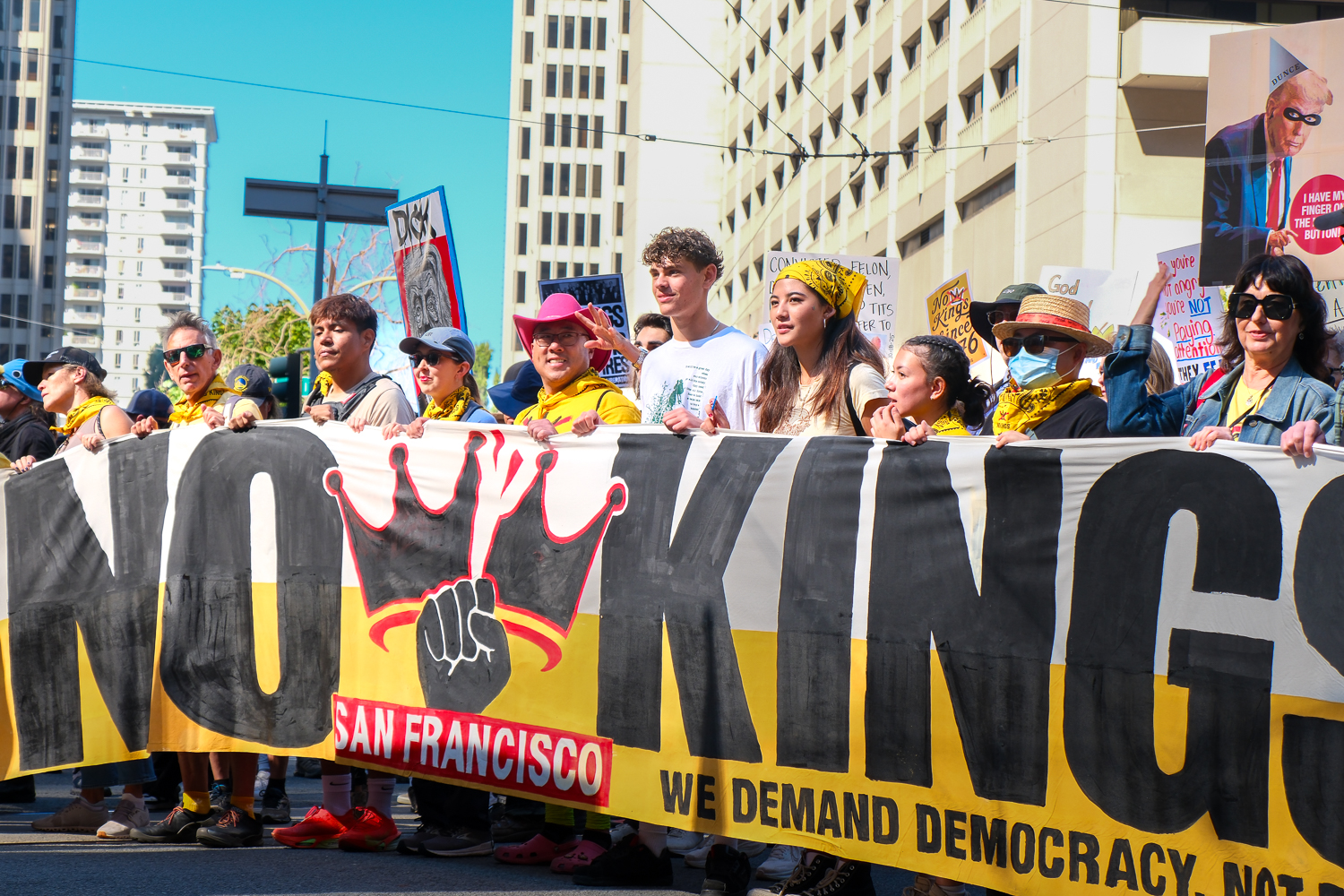
In San Francisco, protesters from across the city gathered under the banner “No Kings” to call out government corruption, defend human rights, and demand a return to accountability and democratic values.
Among them were Liz Isaacs and Kate Aks, who helped form a human banner stretching across Ocean Beach that spelled out the protest’s defining message: No Kings.
For many attendees, the event offered a way to stand together in their frustration, creating a sense of strength and purpose.
“People who are frustrated and angry and are feeling like, ‘What does this say?’ It’s nice to be in community with others who share the same kind of outrage as I do, even when I’m feeling like I can’t do anything,” Isaac said.
When asked what sparked this outrage, Karoly Dyer, a participant in the human banner, pointed to what she saw as deep contradictions in American leadership and values.
“Where is the First Amendment? Why are people being told to be quiet in very scary ways? Why is it okay for our president to be profiting off his role in our country and his family? Why is it okay that they can lie to us, they can get away with crimes, but then they have a problem with people standing up to what exactly they’re doing, and then telling them they’re wrong?” Dyer said.
According to Isaacs, that sense of disillusionment exacerbates the need for stronger political leadership that reflects the passion of the people it represents.
“We feel listless, we feel like the leaders we support need to be stronger and know that they have the support of their voters,” Isaacs said.
Aks similarly reflected that the day’s purpose went further than self-expression, saying she came to stand for others as much as for herself.
“I wanted to be here for the people who can’t be. A lot of people can’t be here – they’re working, they’re scared, they’ve been threatened. Different communities don’t feel safe, and so I think that part of being here is showing that we’re standing up for that as well,” Aks said.
Isaacs says the urgency of protest carried personal weight for her, as it is shaped by her father’s experience as a Holocaust survivor.
“When I see the pictures of the ICE agents with their masks on and just randomly asking people and stopping them for their papers, that reminds me of the stories that I heard from my dad’s childhood. It’s very triggering to think that we’re this close to something that awful here,” Issac said. “Who would have thought that in 2025, we’d be repeating history in a way that we all thought we’d never want to repeat again?”
Despite the anger and grief evident in many of the chants and speeches, hope was an overarching message of the protest. Another participant, Diane Smith, says she believes the protest could spark a broader civic awakening.
“Hopefully, this mobilizes people to start doing other things, whether it be getting more involved in their community or helping to get officials elected. Hopefully it’s the beginning of a bigger movement,” Smith said.
That future, Dyer added, depends on the next generation.
“I’m here because I want my children to see that this is how you make a difference,” Dyer said.
Among that generation was Maya Price, a Carlmont High School senior who attended with her younger sister.
“The current administration has exceeded its powers, so I think it’s important to stand up,” Price said. “Showing up to protests is a good way to get involved.”
After forming the banner, participants walked to a nearby rally, where community leaders and artists, such as Pat Plude, took the stage to enlist the audience to take a stand peacefully, yet emphatically. Many spoke cultural phrases and shared stories of activism that were interwoven with cries for action.
“May we gather, may we march and resist peacefully, may we fight strategically, and may we act with joy, without hatred or bitterness, for our methods cannot stray from the goal, a future for all, for all, rooted in love, dignity, and belonging,” Plude said to the crowd.
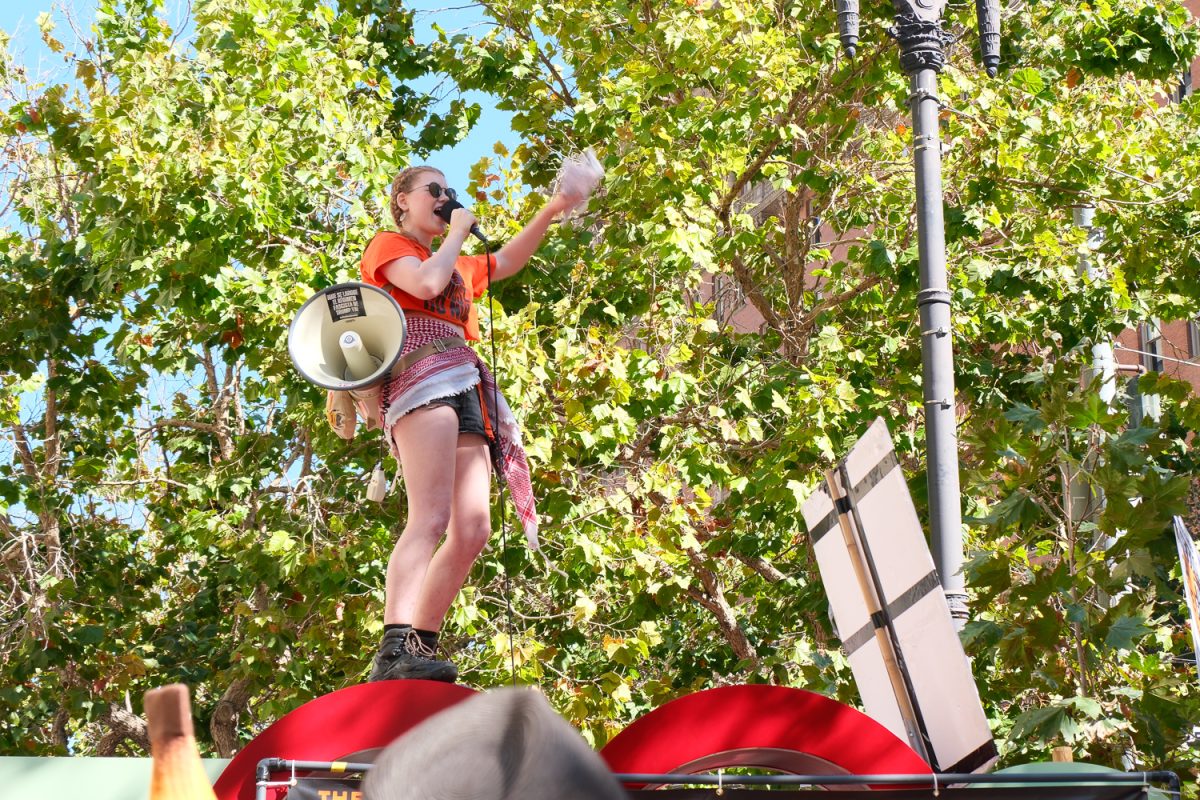
From coast to coast, Americans are taking to the streets once again, in what is planned to be the largest protest in the history of the country.
On June 14, around 5 million people took to the streets in protest against the growing authoritarian regime in the United States.
This original protest, labeled “No Kings Day” or “No Kings,” was held on President Donald Trump’s birthday, which coincided with a national military parade held in Washington, D.C., the nation’s capital, celebrating the National Army’s 250th anniversary.
“It’s kind of like calling out our government leaders who are acting kind of outside of the scope of what their power should be. They’re making kind of authoritarian decisions, as opposed to democratic decisions,” said Eli Brown, a Carlmont history teacher.
Protests in all 50 states gathered under one slogan: “No thrones. No crowns. No kings.”
“No Kings Day” was held in direct response to the Trump administration, with recent polls from August 2025 showing that Trump’s second presidency has received one of the lowest approval ratings of just 40% in recent history, with the only lower approval rating coming from his first term, which was around 36%.
Compared to other presidents, such as Biden, with 49%, Obama, with 53%, and Bush, with 56%, it is clear that the American people are unhappy with Trump’s presidency.
According to Silver Bulletin, America’s main issues with Trump are his impact on inflation, the economy, and immigration. When protestors took to the streets, these issues were much of what they fought for.
“I think No Kings has a positive impact on America, because a lot of people I know aren’t paying attention to what’s happening,” Brown said. “But protests gain steam and power as more people are paying attention to them.”
However, with more people, there is always a higher risk. Previously, during the June protests, one person in Salt Lake City was shot and killed, despite the protests aiming to be peaceful.
“There’s always that danger of something getting out of hand, someone doing something they shouldn’t have,” Brown said.
With the second round of protests happening in October of the same year, some feel as if this event is redundant and ineffective.
“The No Kings protests might not have a clear goal or objective to achieve,” said Connor Fenech, a government and economics teacher at Carlmont High School. “It’s more of a general statement. As long as people feel like, ‘Hey, we don’t like what’s going on,’ they’re going to continue to protest.”
However, while Fenech says that No Kings has no clear purpose, he points out that political protests in general have been effective, bringing attention and change to critical issues.
“If we look back in history, something like the Civil Rights Movement was pushed through primarily through the act of protests,” Fenech said. “They brought attention to problems people faced, and I think that still holds true today.”
The No Kings movement has also rippled into classrooms. Brown noted that political tensions have “added levels of stress” for his English learners, many of whom feel uncertain about government policies.
“Some people are a little fearful of speaking up, because they feel like the normal checks and balances in our country aren’t being effective like they normally are,” Brown said.
With growing fear and anger in the American people, they are beginning to take action. No Kings Day serves both as a way to protest and fight back against harmful and restrictive government policies, but also creates the opportunity to raise awareness of these issues in a peaceful but powerful manner.
“When people are voicing their opinion and are allowed to do that, that is overall good,” Fenech said. “It’s part of what makes a democracy – a place where we can speak out when something feels wrong.”


