

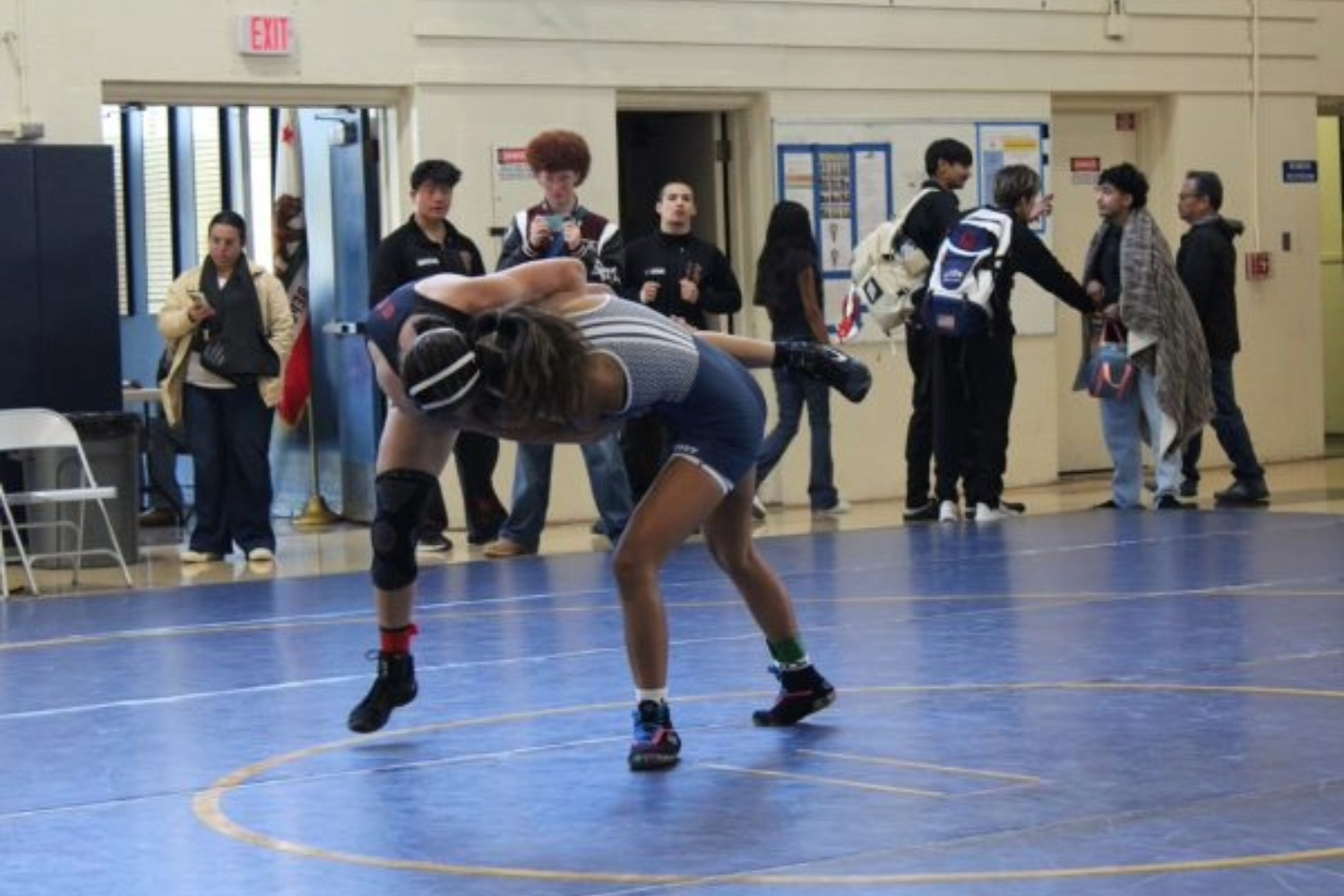
The crisp autumn air carries the faint scent of turf and sweat as the Carlmont girls flag football team warms up under the Friday night lights.
Whistles slice across the quiet field, sharp against the rustle of jerseys and soft flap of flags brushing against hips. The team lines up at the line of scrimmage, breath visible in the cold air, waiting for the snap.
A football spirals through the night sky, cutting past grasping hands before landing in the arms of a racing receiver. Her cleats skim the turf as she weaves between defenders and crosses into the endzone.
Parents erupt from the bleachers, clapping, shouting, and waving handmade signs with photos of their players. Teammates swarm her, celebrating in a tight circle of warmth on a cold night.
The cheers fade almost as quickly as they begin. Another whistle. Back to the line. Back to work.
Scenes like this were once nearly impossible for girls to experience.
When Title IX was passed in 1972, only 300,000 girls participated in high school sports; now, over 3.5 million girls participate in high school athletics, according to the National Federation of State High School Associations’ survey of high school participants from 2024-2025.
But participation grows faster than recognition. Women’s sports still receive only 15% of sports media coverage across broadcast, streaming, and digital platforms, according to the Wasserman Collective’s 2022 Report.
The gap filters down to schools like Carlmont, subtly shaping which games feel celebrated and which feel like they’re happening quietly in the background.
Finding a place on the field
For sophomore Callie Hernandez, flag football wasn’t a sport. It was a chance to finally belong to the game she’d watched her whole life.
“I’ve always grown up throwing a football around with my neighbors. I heard that they had it at Carlmont, it just sparked my interest, and I instantly knew, ‘oh my God, I have to play this,’” Hernandez said.
Hernandez’s days revolve around practice, film reviews, and squeezing homework into whatever time she has left, sometimes still in her sweaty jersey, finishing assignments at her desk.
“If you don’t plan or don’t give yourself enough time to do both, it’s not going to happen. I’ve been there with not doing my homework or not being able to go to practice,” Hernandez said.
Flag football is quick and technical, but the most challenging moments for Hernandez aren’t even the sprints or the flag pulls; they’re the glances towards the stands.
“Everyone’s families come, so that’s already a good amount of people. There could be a lot more people, but it’s still good to see some people come out,” Hernandez said.
Yet the quiet doesn’t go unnoticed. It settles in the breaks between whistles, the moments when cheers don’t quite fill the bleachers.
“If people didn’t think twice about it, I think everything would just be easier,” Hernandez said. “People would support each other easier.”
A similar quiet
The silence isn’t unique to flag football. Across campus, sophomore volleyball player Regan Simon feels it too.
Her season loops through practices, late nights, and bruised knees from weekends spent at tournaments.
“Two games a week and three practices. Monday, Wednesday, Friday I would have practice, and Tuesday, Thursday I would have games,” Simon said.
For Simon, the crowd pattern is familiar too.
“It’s not many students. It’s more likely the parents come, but besides that, it’s the other varsity that refs our games,” Simon said.
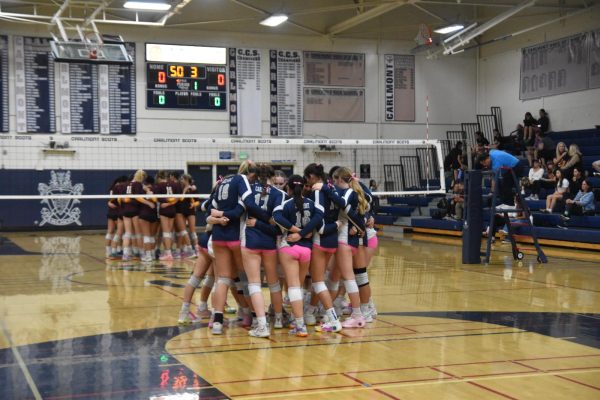
Despite this, the Carlmont student body works to encourage more support for these female athletes.
“The Associated Student Body (ASB) has been trying to get more people to come to our games,” Simon said. “But our team doesn’t get a lot of credit where it’s due.”
Researchers notice a similar gap across the nation. Professor Louise Mansfield, who studies gender inequality in sport, explains that the roots of this divide take shape early in life.
“In the playground, from the start, there is a sense of a sporty girl or a sporty person. They can do these things, and they get picked first in the teams in the playground,” Mansfield said.
Those early labels evolve into expectations of which games get talked about, whose highlights get reposted, and who gets remembered.
Shifting momentum
At Carlmont, Athletic Director Patrick Smith has watched these patterns unfold firsthand. While he believes Carlmont students and families generally show a strong spirit, he acknowledges that one sport dominates attendance.
“The only time I really notice a big difference between attendance at games is for the home football games,” Smith said. “Otherwise, I think attendance at our male and female sports is about the same. Friday night football games are unique; they’re more of a community event. People aren’t just there for football, but also for cheer and dance.”
Smith also emphasizes the school’s commitment to equity.
“With my sports leadership class, we try to announce all of our athletic games on social media,” Smith said. “We also try to provide game scores for every game.”
Still, he’s noticed momentum, especially in girls flag football.
“Our girls flag football team has had a lot of success on the field,” Smith said. “I think that’s helped with their popularity on campus and also attendance at games.”
That success matters. According to the Women’s Sport Foundation, before Title IX, only one in 27 girls played sports; today, two in five do. Progress is slow but visible.
And at Carlmont, it shows.
By the end of a long night in the Carlmont gym, Simon and the volleyball team huddle together, still sweaty, still laughing, still proud. Their voices fill the space louder than any student section ever has.
“Being a female athlete has shown me how to grow my leadership skills and resilience,” Simon said. “I can bring that into the real world.”