

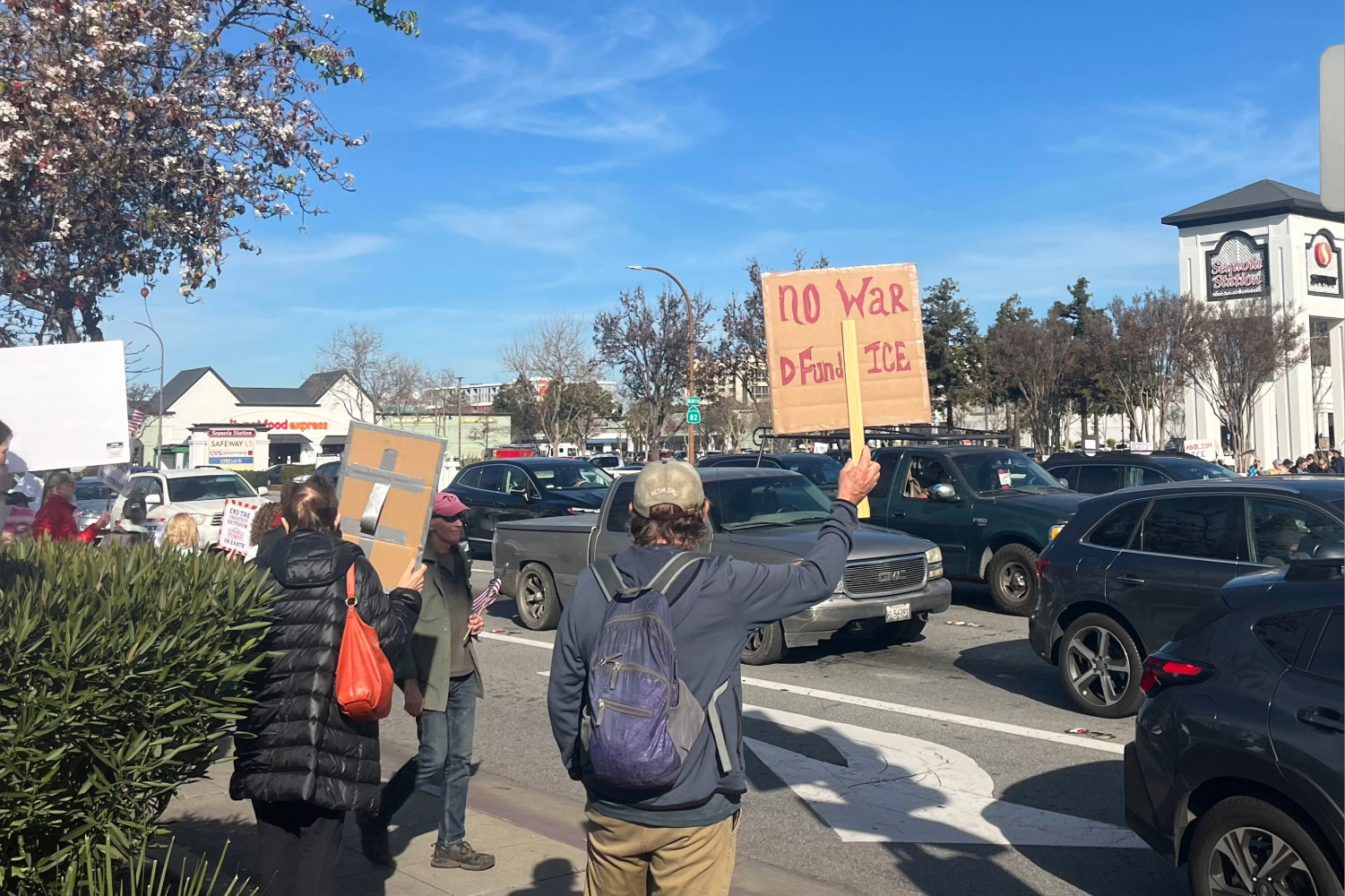
Local organizers held a “No War on Venezuela” protest in Redwood City last weekend to raise awareness and express dissent toward President Donald Trump’s aggressive policy toward Venezuela, one among a series of local anti-Trump actions this month.
“This protest is just to say to the government, ‘What’s going on right now?’ The amount of our tax money that’s going to genocide and killing so many people and separating families, it’s disgusting,” said Sophia Thibault, a senior at Sacred Heart School who attended the event.
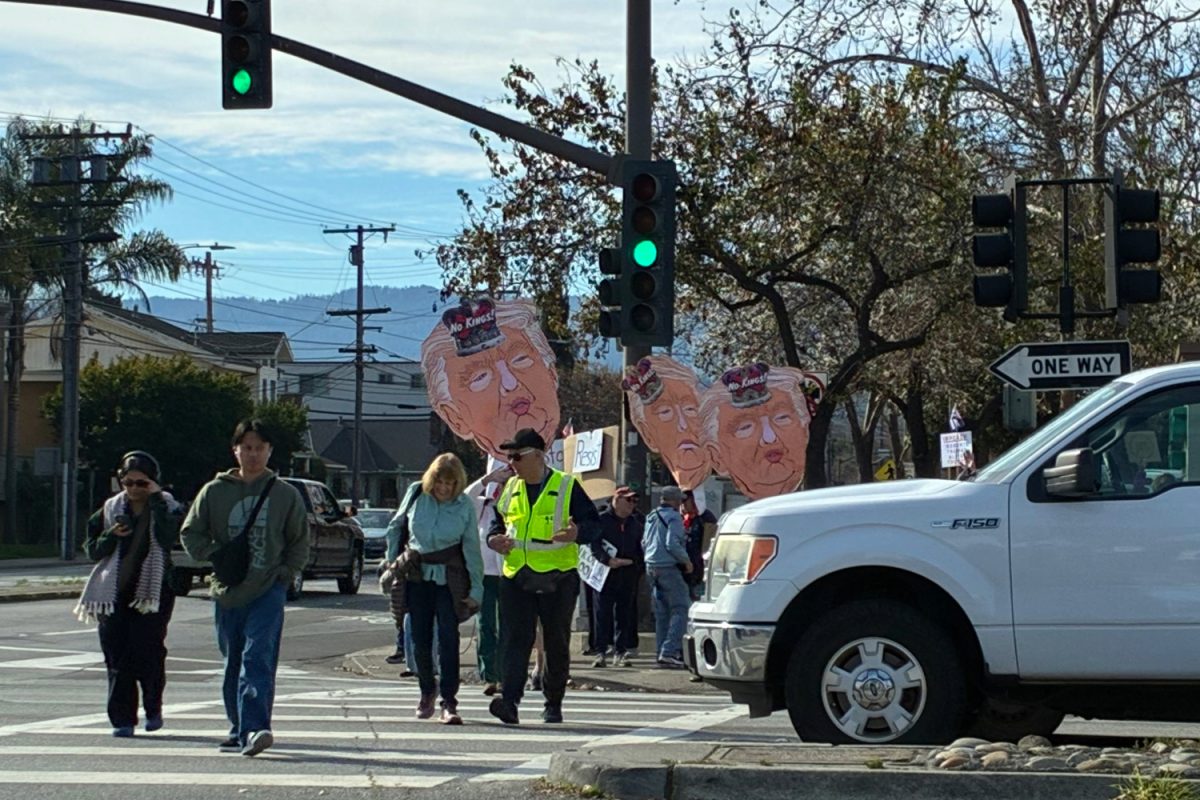
At the corner of a commercial street in Redwood City, the protestors gathered on parallel sidewalks, occasionally crossing the crosswalk, but not blocking off the road.
The protestors, primarily middle-aged and elderly white people, waved a range of related signs. Some were specific to Venezuela, advocating an anti-war stance, but many were holdovers from previous protests: anti-Immigration and Customs Enforcement (ICE), pro-democracy, anti-billionaire, or anti-Trump in general.
Many of these signs came from JoAnn Lulan’s car trunk. Lulan, the 77-year-old, blue-haired organizer and one of the leaders of Indivisible Portola Valley, was stationed by her trunk the whole time, speaking to attendees and doling out posters and ICE awareness whistle kits.
“I’ve been an activist since I was in college. The civil rights movement, the women’s movement, the Vietnam movement, the LGBTQ rights movement, on and on. And now, Trump is the biggest threat,” Lulan said. “That’s why I’m here. I periodically organize these at this intersection, El Camino and Jefferson, because I like to have people see that we’re here, especially for the people for whom it’s dangerous to be out and protesting. As an older, white, upper-middle-class woman that can afford a lawyer, I can be out here.”
In early January, a few weeks before the Venezuela protest, Indivisible Mid-Peninsula, another chapter of the grassroots organizing group that Lulan is part of, organized an “ICE Out Now” protest in the same location.
“The great thing about doing it here, where thousands of cars are driving by, is what I call honk therapy. The cars are honking their support. There are a few people who are the ‘bah humbugs,’ and I really wish they’d stop and talk,” Lulan said.
While the protest appeared to be a response to many different issues, its core was Trump’s recent directives in and around Venezuela.
“There is no reason to be at war with Venezuela except for the fact that they have the biggest oil reserve in the world. We want their oil, and we want it cheap. The reality is, Trump just let go of the biggest drug trafficker, who used to be the president of Honduras. He pardoned him. What Trump wants is power,” Lulan said.
Since September 2025, the Trump administration has authorized over 35 strikes on boats coming from Venezuela, killing over 115 people aboard despite questioning from government officials and human rights organizations. In October, Senate Republicans blocked a bill that would require congressional approval for further strikes, adding to Trump’s disregard for congressional authority on this issue. In December, Trump announced a blockade of sanctioned oil tankers around Venezuela and began raids on oil tankers.
Concerns around due process have been raised and ignored, with some scholars fearing what precedent may be set.
In early January, Trump had Venezuelan President Nicolás Maduro and his wife seized from their home to where they are now kept, in the United States, awaiting trial on drug trafficking charges.
Trump claims that Maduro is a “narcoterrorist” allowing the funneling of drugs like cocaine and fentanyl into the United States. However, experts believe that Venezuela’s role in the illicit drug trade is minor and not the real cause of Trump’s aggression. In the wake of Maduro’s removal, the United States has moved toward an energy deal that would reopen Venezuelan oil to foreign investment and has taken control of millions of barrels of oil from the country.
“Trump wants the oil that Venezuela has. I think that’s pretty clear,” said Susan Crane, a volunteer at the Redwood City Catholic Worker House who attended the protest.
Additionally, journalists and politicians have discussed a perceived “Donroe Doctrine” succeeding the Monroe Doctrine, fearing an intense return to American imperial interventions in Latin America under Trump.
Concern over Trump’s intervention in the Venezuelan economy and his truculent attitude, as well as opposition to his overall policies, spurred attendance at the protest.
“I think that people being together and feeling connected is really important. Showing up is one of the ways to let people know they are not alone. Political change comes when the people rise up and say, ‘You have to change this.’ That’s how we stopped the Vietnam War. It’s how we got civil rights and how women got to vote. That’s why queer marriage is now allowed. That was only because thousands of us were in the street. We protested and got in our congresspeople’s faces all the time,” Lulan said.
Some attendees felt that protests like this one should not be the primary mechanism of dissent, but rather a first step.
“I think what we need is a general strike. That’s what I would hope these demonstrations are headed towards, because I think we need a complete change in the way the country is going. Trump is a symptom of our country. It’s true that a lot of things he’s doing haven’t been done by other presidents, but in general, the idea of taking oil from other countries and invading other countries isn’t new. He’s just doing it a lot more openly than other presidents. We need to value people over imperialism,” Crane said.
At one point, a shopper at the nearby Whole Foods Market spoke to Lulan before driving away.
“How amazing that we met this way, and many blessings on all of you for doing this work right now,” she told Lulan.
They made plans to stay in touch.
“I think mostly the effect of this protest is just education. Telling people who live around here that we support a better government, a better democracy. And there’s so many educational posters that people have. If you read a couple of them, it shows many resources that they have against ICE and what we can do to help,” Thibault said.
Among these resources were cards with contact information for community response networks, as well as the whistle kits provided by Lulan to be used when someone notices ICE officers nearby.
“I think this country is headed towards fascism. I think it’s very important that we get out on the street, whether it’s about not going into Venezuela or not having ICE in our communities, kidnapping people on the streets, or whether it’s about just loving one another instead of waging war,” Crane said.
