


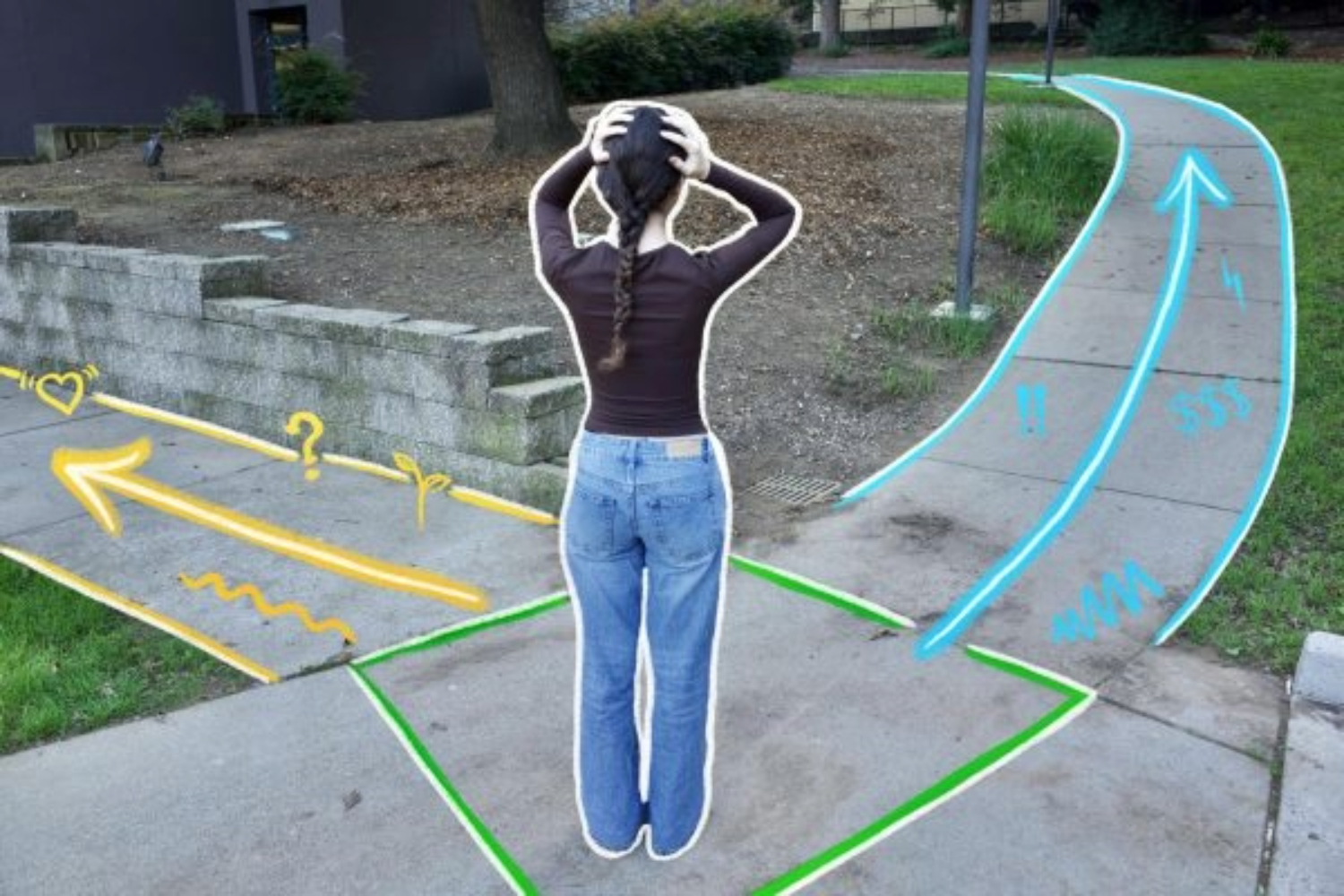
By 8 p.m., Minsun Kim was usually half-asleep. After over a decade of working in tech, late nights meant nothing but exhaustion. However, this night was different. She was wide awake in a cramped New York acting studio, fluorescent lights humming overhead, waiting for her turn in an intro acting class she signed up for on a whim.
When she finally stepped into the scene, she felt something she hadn’t felt in years: energy. For the first time, she didn’t want to go home.
“I am a morning person, so at night I’m very sleepy,” Kim said. “But the classes were at night after work, and I was able to stay awake because it was just so fun for me.”
Growing up, Kim had always wanted to pursue art. As a child, she moved from South Korea to the United States, where she majored in graphic design at Washington University in St. Louis, Missouri. Her career eventually brought her to a branding agency in New York.
Looking back, Kim remembers how deeply invested she was in her career, working in user experience for widely recognized companies such as J.P. Morgan, Shutterstock, and UNICEF. She loved the way her job combined creativity and analytical thinking.
She found community through coworkers and mentors she met along the way, and she hoped to use her skills to make a genuine impact on others.
However, the technology world didn’t feel as fulfilling after some time. As she climbed the corporate ladder, she began to resent the culture and the way her company treated its employees. Working in this field, she wasn’t making the impact she had desired. Despite achieving an administrative role and leading a technology and design team, she wasn’t satisfied.
“I was doing it because I was very good at it and I could do it very quickly, but I didn’t really have a heart in it. I didn’t feel like it was very impactful anymore,” Kim said.
The tension between who she had been and who she was becoming grew stronger. However, quitting her job on the spot wasn’t financially possible, given that she was living in New York City. Instead, she worked remotely, spent time outside of work, and even took up ballet and yoga.
Eventually, this hobby exploration led her to an introductory acting class. Performing arts, she had realized, had always been another interest of hers since childhood. As she became more involved in acting, she found that a key source of motivation was the people she surrounded herself with.
“My friends who saw my acting told me, ‘You’re not the best actor right now,’” Kim said. “But they told me they saw potential. So it was encouraging in that way.”
As she immersed herself in acting, she discovered that it gave her something tech no longer could: excitement, fulfillment, and a sense of belonging.
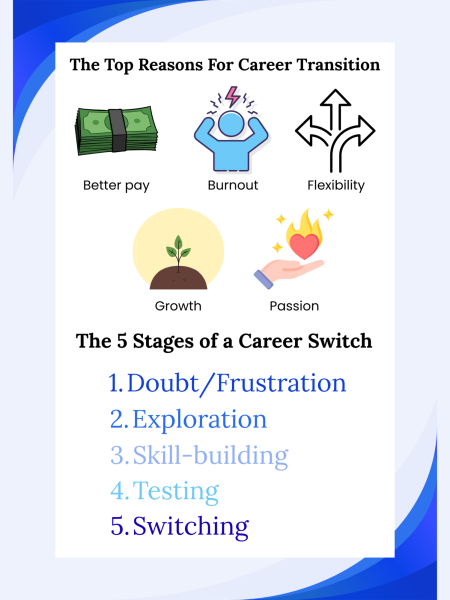
Research on “career crafting” backs this up. Workers who actively reshape their careers around meaning tend to feel more energized and less burned out, according to a study in the Journal of Business Psychology. Kim felt that shift almost immediately.
“Acting is more aligned with my identity and who I want to be around. It makes me really happy, and it makes things more interesting,” Kim said.
Though she held onto her career in graphic design, which provided her financial stability, she continued to lean into acting. The contrast made it clear which career she ultimately wanted.
Her motivation to pursue this newfound passion stemmed from the years she spent feeling disconnected and watching her sense of purpose fade. She imagined a future in which she would continually advance into corporate roles she no longer wanted. That image weighed on her more than the uncertainty of change.
In the months following her transition, Kim described the transition as a process of rebuilding through exploration. She experimented with new roles and creative work that brought her fulfillment in ways her previous career had never provided.
“You won’t know if you like it until you try it,” Kim said. “With acting, I had to try it to know if I really liked it or not.”
While Kim rebuilt her sense of purpose through acting, others found clarity in different ways. For Zoey Kim, that journey began when she realized her first career almost completely contradicted her interests. After majoring in social welfare, she entered a mobile app startup simply out of curiosity.
“I wasn’t sure what I wanted to pursue,” Zoey Kim said. “My second interest was learning computer skills, just for fun.”
Psychologists call this “vocational adaptability,” the ability to reshape one’s career identity during a transition. Research in the SA Journal of Industrial Psychology shows that individuals who stay open to experimenting, as Zoey Kim did, tend to adapt more smoothly.
She dove into coding, teaching herself Adobe tools and taking classes on HTML, CSS, and JavaScript. When she saw her work come to life on the screen, it was instantly rewarding.
However, the transition wasn’t without its challenges and uncertainties.
“I was afraid. Was it too late to start?” Zoey Kim said.
But the support she received from her husband and a close engineer friend pushed her forward. Now, working fully remote, she describes coding as something she willingly spends hours on.
Although both women successfully discovered a new pathway, Rachel Chandra, a psychotherapist who has worked with numerous clients navigating career transitions, recognized that the process can feel destabilizing.
“People feel confused and lost,” Chandra said. “Their identity is in jeopardy, which can be scary for their sense of self,” Chandra said.
Chandra emphasizes that it is vital to recognize one’s authentic desires during a transition. She uses many techniques with her clients to support their transitions.
“I visualize it as something they’re holding in their hand close to their heart. We say it’s their truth, and they hold their truth dear to them,” Chandra said.
Following this reflective process, she notices a pattern among clients who make the transition.
“Symptoms of depression go away. Thoughts like ‘What’s the point?’ start to fade. Suddenly, they enjoy going to work, and they like their coworkers,” Chandra said.
Ultimately, Chandra believes it is imperative to have a strong support systems when making a successful career transition.
“Surround yourself with people who encourage you to be authentic in your true self,” Chandra said. “For many, having or lacking this support makes all the difference in embracing the change.”
The idea of outgrowing a first career can take many forms. Diogo Botelho’s career change occurred within some of the world’s largest tech companies. For nearly eight years, he worked in trust and safety at Google, Patreon, and later TikTok. His role at these companies offered him financial stability and recognition, yet he found himself questioning both the work he was doing and its connection to his identity.
“There’s that sense of identity that is assigned to your job. For a really long time, I built my identity around Google,” Botelho said.
According to a 2024 Pew Research Center survey, even workers who feel secure in their jobs often report feeling disconnected from the meaning of their work. For those with the means to explore career alternatives, this dissatisfaction can motivate them to seek work that offers both stability and personal fulfillment.
Even as he moved between different roles and worked under various companies, he began to see limitations in these titles, despite their prestige. The day-to-day work was emotionally draining, and although the decision to transition was not seamless, it deeply impacted his sense of self.
“I’m good enough to work for Google. I’m good enough to work for TikTok. After leaving those companies, you always have the ‘What does that say about me? Am I losing that identity?’” Botelho said.
This tension ultimately boiled down to his final decision: quitting and pursuing a career truly his own. Botelho decided to pursue a coding bootcamp, shifting toward software engineering and educational technology. This meant leaving behind the familiarity and stability of his previous companies, but also gaining more control over his professional identity. The shift wasn’t easy, but with support from others, he settled on a career that aligned with his passion.
Though Botelho ultimately found fulfillment in his new path, he still struggled with questions about his self-worth and others’ expectations. His experience shows how disorienting it can be to step away from a familiar identity, even when change is necessary.
Yet for Botelho, Zoey Kim, and Minsun Kim, the leap of uncertainty was worth it. Each of them chose to leave behind stability to build a career that reflected what they hoped to contribute to the world.
Letting go of a routine, a title, or one’s definition of success can distort the sense of self. The struggle isn’t limited only to working adults. Students, too, feel lost, especially when under pressure to select classes and majors. But with the support of friends, mentors, and communities, these individuals can find confidence in authenticity. The transition involves discomfort, but ultimately allows people to attain fulfillment shaped by their truth.
“Give yourself time. You can get somewhere with it,” Minsun Kim said.