



Brown eyes. Blond hair. A wagging tail. Voss, a 1-year-old golden retriever, is a lively puppy living in San Francisco with the hope of becoming a guide dog for the blind.
However, before he can transition into a “career” helping visually impaired people, Voss must complete a training program with Guide Dogs for the Blind. To ensure he is well-prepared for the skills he will learn there, Voss trains every day with his puppy raiser, Christine Matheney. Matheney co-raises Voss, who spends two weeks per month at Matheney’s apartment training, growing, and being a puppy.
Guide Dogs for the Blind (GDB) is a nonprofit organization that has trained over 16,000 guide dogs since its founding. Their personalized training is offered free of charge to applicants, and their services are available in the United States and Canada.
GDB also provides extensive support for puppy raisers, who are an integral part of the guide dog process. Puppies stay with raisers from approximately 8-weeks-old until they reach 14 to 16 months, at which point they will return to one of two GDB facilities.
“It’s a cool way to have a dog, and I know that Guide Dogs will pay for his medical care,” Matheney said, “My last puppy had a lot of medical issues. We were at the vet at least once a month, and they paid for all of that.”
GDB not only pays veterinarian bills, but also covers other expenses, such as food and supplies. The only thing Matheney buys for Voss is lots of enriching toys.
The organization offers both a Guide Dog Program, in which a visually impaired person is matched with a trained dog to help them navigate their daily life, and a K9 Buddy Program, where dogs who are judged unfit to become guide dogs are matched with a person with vision loss and play the role of a pet.
Ryan Dour, a visually impaired resident of San Francisco, was matched with his guide dog Pumpkin in 2018. She lives in his apartment and accompanies him to work and social events to help him navigate the busy city
“It’s a really big change from even a few years ago. When I was in an airport, I would have needed to have asked somebody to get guidance through the airport. Today, when I combine Pumpkin with technology, I just do my own thing. There’s a huge difference in how I navigate the world,” Dour said.
Dour and other visually impaired people don’t solely rely on their guide dog’s intuition. According to Dour, it’s a common misconception that guide dogs completely understand what’s going on in their environment. In reality, the owner also has a responsibility to understand where they’d like to go and how to get there.
Dour utilizes other resources while navigating the world, besides Pumpkin, including a portable cane, input from people, and even artificial intelligence (AI)-generated descriptions of photos.
“As I add more tools in my toolbox, Pumpkin’s still at the core of that. Adding different pieces of technology doesn’t make her any less useful, it just means we spend less time messing around trying to figure things out,” Dour said.
Blindness is a common condition in America, with approximately 7 million people across the country diagnosed with visual impairment. Of those people, around 1 million are considered legally blind.
According to Medline Plus, age-related eye diseases such as macular degeneration, cataracts, and glaucoma are the leading causes of vision loss and blindness. Eye disorders or injuries can also contribute to vision loss.
Since visually impaired clients of GDB require the highest quality assistance from their guide dog, fewer than 50% of guide dog puppies complete the program and go on to live with a visually impaired person.
According to the Proceedings of the National Academy of Sciences of the United States of America journal, several factors are thought to contribute to guide dog success, including the age of the dogs when they return from puppy-raising families and maternal nursing behavior.
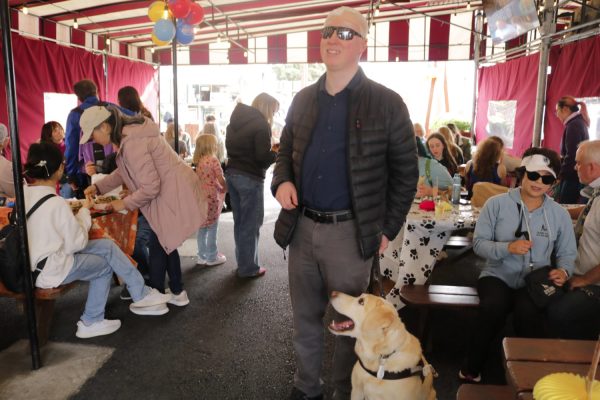
If puppies are not suited for guide dog life, they undergo what puppy raisers lovingly call a “career change.” The dogs may enjoy another service profession, such as diabetes-detecting dogs, drug-sniffing dogs, police K-9s, or therapy dogs.
Other dogs still may prefer to be a regular pet in the home. This is the case with Joan Ashby’s dog, Jackie. Ashby was Jackie’s puppy raiser, but it quickly became clear that Jackie was uninterested in becoming an aide for a visually impaired person. Ashby is currently in the process of officially adopting Jackie as a pet.
“Jackie loves people, loves learning, just doesn’t love working,” Ashby said, “and Guide Dogs always chooses what’s best for the dog.”
However, until a GDB representative determines a puppy unfit for guide dog work, they will continue to train and live as usual. Voss’ day-to-day routine consists of training, socialization, and numerous excursions outside of the house with Matheney.
“He gets to go everywhere as a guide dog puppy,” Matheney said. “I get to be the one who’s helping him learn about the world.”
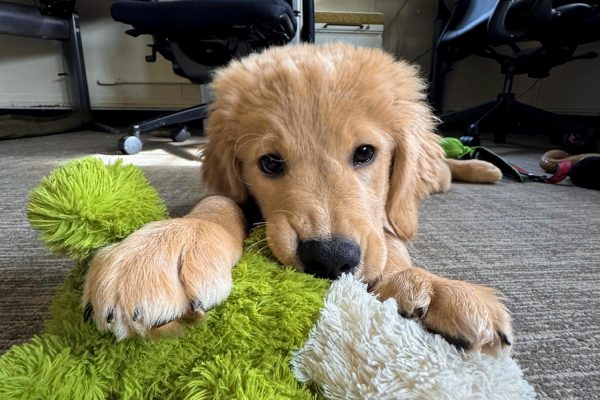
To be prepared for life with a visually impaired owner, Voss travels and attends events with Matheney, taking advantage of his special guide dog puppy privilege. When he’s not out exploring the world, Voss trains and lives with Matheney. He reviews skills such as sitting, lying down, and even using the bathroom on command, and he also learns how to be comfortable and sociable with humans.
“Guide Dogs taught me how to have a successful dog, how to crate train them, how to make him food motivated, and how to make it so he didn’t jump on the couch,” Matheney said. “They taught me all of those skills I needed to be a successful dog manager.”
Getting Voss comfortable with physical touch is also an important part of his training, according to Matheney and Marisa Robisch, Matheney’s neighbor and fellow GDB volunteer. Referred to as “body handling” by puppy raisers, visitors are encouraged to interact with the dogs because guide dog puppies must be accustomed to being petted everywhere on their bodies.
Voss officially turned 1-year-old on Nov. 15. Matheney threw a large birthday party, inviting family, friends, and lots of fellow guide dog puppies to celebrate. The event was lively, full of wagging tails and happy humans, and provided the perfect setting to celebrate Voss as he prepares to transition out of puppyhood and into the next phase of his life.
If Voss is deemed suitable to move forward in the GDB program, he will attend guide dog college at one of the two GDB locations at around 14 to 16 months of age. He will either go to San Rafael, California, or Boring, Oregon, to complete the eight steps before he can be officially matched with a visually impaired owner.
At one of the two centers, Voss will undergo a comprehensive medical evaluation to rule out potential medical concerns, including hip dysplasia and eye issues. Then his guide dog training begins, where Voss will learn skills such as walking backwards, stopping to listen at curbs, navigating escalators, and much more.
Most puppy raisers admit that letting their puppies go after raising them for over a year is the most challenging part of the process. Matheney recalled a visit she had with one of her puppies, who made it through the program and was paired with a visually impaired college student.
“The dog gave her the ability to navigate her neighborhood confidently, and living with me would be fun, but the sense of purpose that the dog had just fills your heart,” Matheney said.
Getting Involved
According to Ashby and Matheney, the GDB organization is always seeking more puppy raisers. There are no age or experience requirements, and GDB will provide training and support throughout volunteers’ journeys. Both Ashby and Matheney highly recommend the experience, even for the teenage demographic.
“It’s your responsibility to keep them healthy and successful, and taking care of a guide dog puppy teaches you that responsibility,” Matheney said. “Having that in high school is a really good way to figure out what you want to do with your life.”
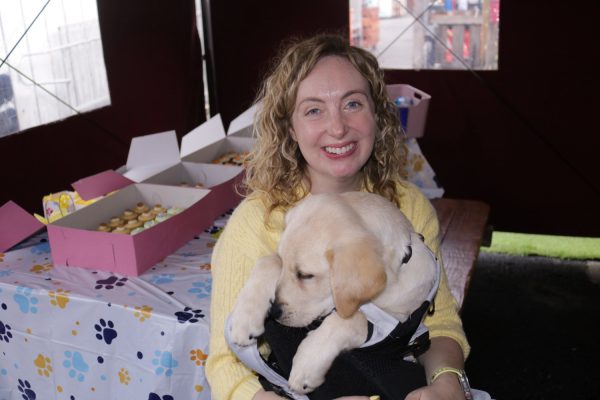
Puppy raising is not the only way to volunteer for the organization. Puppy-sitting for a raiser is also a viable option, and much easier for those with a busier lifestyle who cannot commit to a dog for a year.
“It’s a way to get yourself started, and for most people, it’s the way that they do start. They’ll learn whether or not they can handle it, if they find it stressful or rewarding, and many people graduate from sitter to full-time raiser,” Dour said.
Additionally, the in-person GDB facility in San Rafael is always seeking volunteers to socialize with the puppies before they travel to their puppy raiser homes. Volunteers at the in-person location can work in the breeding department, care for the kennels, walk dogs, or even serve as a “distraction assistant,” helping young puppies focus and avoid stimuli they may encounter out in the world.
According to Ashby, a busy life should not preclude anyone from raising a guide dog puppy. There are raisers all across the country who bring dogs to work every day, and even high school students who bring the dogs to school to help them acclimate to a chaotic environment.
“I highly recommend it to families because it’s like you get a dog without fully committing to the 10+ years of having a dog,” Ashby said.
Volunteers describe GDB as a selfless community that provides extensive support to its members. The work is difficult, but emotionally rewarding, and puppies like Voss bring fun into the lives of all who interact with them.
“The cool thing about raising guide dog puppies is that if he lives with you or he lives with me, he’s going to be a good, good guide dog for any kind of client,” Matheney said. “So no matter what your life looks like, you can still be a good puppy raiser.”
