


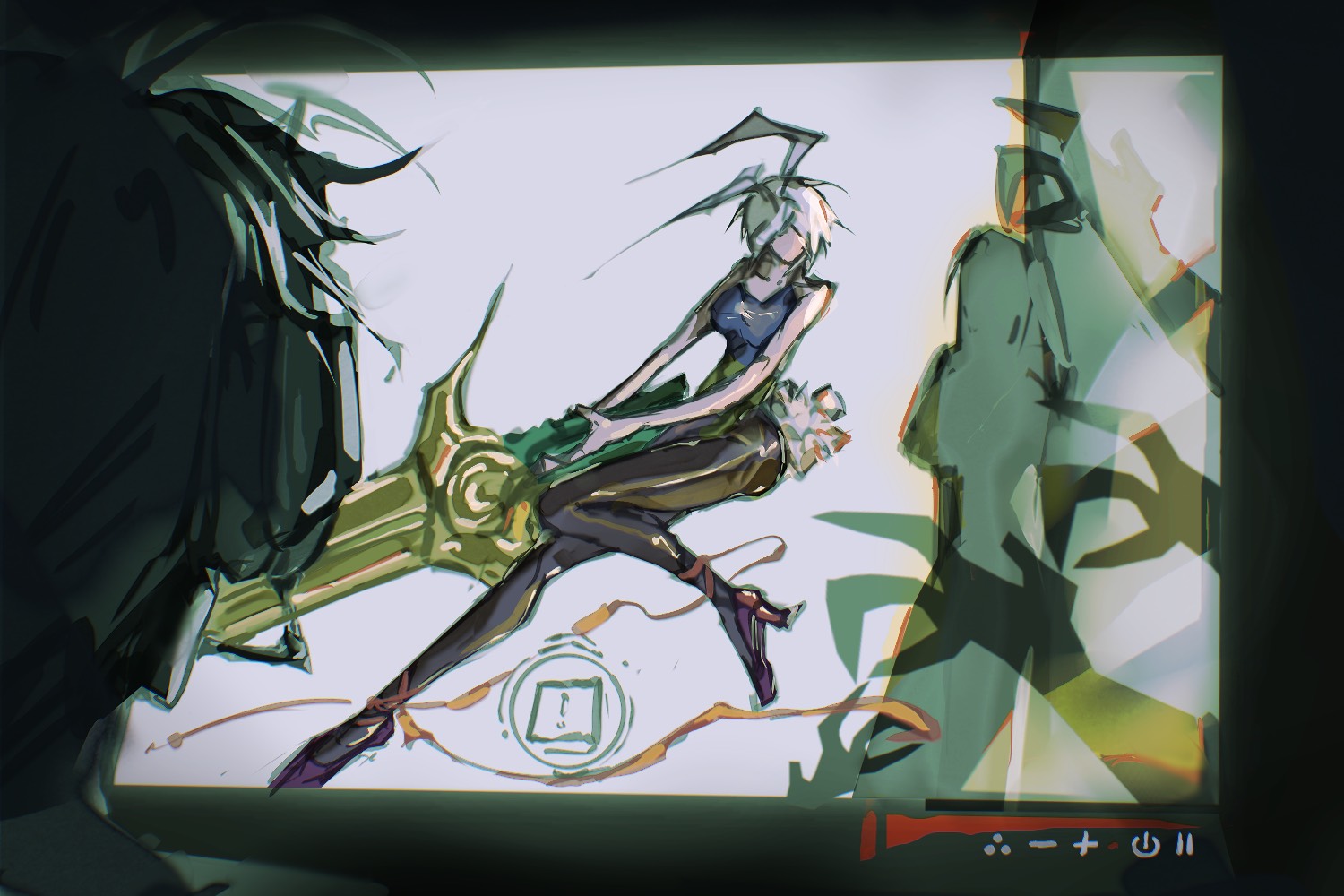
Skin-tight latex suits, bikini shorts, and stilettos. Not the ideal combat outfit.
Unfortunately, this is common in many video games. Over 80% of female characters are portrayed as sexual, scantily clad, or a vision of beauty in video game magazines, according to the National Institutes of Health.
With women representing 47% of adult gamers in the United States, this common perception of a female character, along with the offensive treatment towards women gamers, has brought forth concerns.
Pressing start: Creating accurate characters
“I think one of the issues of being a woman is you’re not taken as seriously compared to men at a default,” said Olivia Guenther, a cartoonist designing a webcomic titled “Taylor.”
The Geena Davis Institute studied 27,564 characters in 684 fifteen-minute gameplay segments from sessions with the top 20 Twitch streamers. They found that male characters in video games outnumbered female characters in a four-to-one ratio.
To this extent, the organization also discovered that women are 10 times more likely to be shown in revealing clothing compared to men, and are five times more likely to be shown with some level of nudity.
Since the beginning of video games, women have been portrayed as hypersexualized characters or in need of help from male characters. This stereotype stemmed from historical trends and past target audiences, according to Brigham Young University (BYU). In the 2000s, the video game industry was dominated by a male audience. This resulted in sexualized outfits for female characters in video game franchises like “Final Fantasy.”
“It feels like executives looking at a spreadsheet and saying, ‘Hey, you know, our audience is adult males from 18 to 34, and what does that demographic love? They love women with exaggerated proportions. And no, don’t give them any character and just throw it on the box,” said Joseph Maslov, a freelance story and concept artist.
According to Maslov, exaggerated proportions are not as normalized as they were back then, but they still persist today.
“I think after a period of time, like around 20 years from now, we have much less of that overt, thoughtless design where you just have a woman with exaggerated proportions plastered on a box. But we still have a problem with oversexualized designs. I know a variety of artists who happen to be female, but also caught themselves oversexualizing the female characters just because that’s where a lot of design sensibilities have been for so long,” Maslov said.
Two types of sexism contribute to the misconceptions of women. Hostile sexism is the negative attitude that believes women are emotional, incompetent, or attempting to control men through manipulation or sex. Then there is benevolent sexism, which portrays women as needing protection, and is a significant factor as to why women are illustrated in a negative light in video games. For example, Princess Peach from the gaming franchise “Super Mario Bros.” often plays the role of a damsel in distress.
As a cartoonist, Guenther tries to challenge stereotypes in media by representing a diverse range of women.
“I wanted to write about teen girls that I could relate to, that were nerdy and they don’t really focus on boys or dating that much. I feel like most 13-year-olds are a lot more flawed than they’re portrayed in the media,” Guenther said. “I definitely made sure that the two main girls that I have so far, Taylor and Amber, who are both 13, have different body shapes. I wanted to make that very clear because when you’re a teenager, we all don’t grow the same.”
The results of consistently depicting female characters as conventionally attractive negatively impacts how people treat women who do not fit the standard. A study by the National Library of Medicine found a significant correlation between video game exposure and agreement with a sexist statement.
“When I got my first job as a therapist, I was the only one at the practice who knew what the kids were talking about,” said Andrew Fishman, a therapist who works with adolescents and specializes in video games’ impact on mental health. “The other therapists would ask me, ‘What is Fortnite? I don’t know what this kid is talking about.’ And so they started giving me all of the clients who were talking about video games.”
As a gamer, Fishman is familiar with how female characters are often depicted with exaggerated body proportions. A common example Fishman points out is Lara Croft from the “Tomb Raider” series. According to Fishman, she has unrealistic Barbie-like proportions.
Additionally, Fishman read multiple studies on how sexualization of women can impact mental health and acknowledges that many of these studies do not capture the impact well.
“There was a study that had people play either a more or less sexualized version of Lara Croft, and they asked people if women were less satisfied with their own bodies, and if they were feeling more hostile toward other women. As a result of feeling insecure, they found that there wasn’t much of a difference, but I think playing a game one time doesn’t get at the effects that it might have over a decade of playing games or watching it,” Fishman said.
In addition, seeing oversexualized women in video games or in other media can make real women question their own image. Guenther, for example, used to feel like she didn’t fit the standard of having a narrow waist and accentuated curves, which is reflected in her past art.
“Drawing stereotypical women allowed me to participate in fashion in a way that I wish I could,” Guenther said. “But that’s not how I view my art now.”
The depiction of the “perfect woman” may be attractive to some players but cause insecurities for others. The male gaze refers to female objectification. A man is mainly attracted to visuals like an hourglass body, midriff, and breasts, according to the National Institutes of Health (NIH), influencing how female characters are designed in games to gain traction.
“Those games were definitely designed for the male gaze, which is why they’re probably dressed like that. I think maybe there might be some insecurity around it, because this is what you find attractive. I don’t look like that. I don’t feel like that,” said Melissa Hong, a junior at Carlmont High School.
The overrepresentation of hyper-sexualization can cause women to feel underrepresented and desire a solution.
“I don’t really see a lot of female leads who are 30 and up, and I would like to see that. I know it’s not something that people would gravitate towards at first, but we’ve got a lot of games about younger people, so it’d be nice to see some older women in games,” Guenther said.
Playing on challenge mode: The treatment of women in the video game community
A survey conducted by the University of Southern Mississippi questioned 141 female gamers who play first-person shooter games worldwide. They found that 79.5% of the participants experienced verbal harassment or discrimination.
High popularity in gaming comes with an increased risk of toxicity among players, especially in voice chat, a feature common in video games where players can talk among each other.
“I’ve never really played with a stranger on voice chat. It’s always been frightening,” Guenther said.
According to Guenther, she and her boyfriend had previously received rude comments while playing Overwatch with the voice chat feature. In a survey conducted by Offenburg University, female gamers were harassed in every seventh out of 28 Overwatch and Valorant game sessions, creating a threatening and uncomfortable environment.
“There were two instances. For both of them, I feel like there was no need for the other person to be so rude or mean. Like, it’s a game. It’s Overwatch,” Guenther said.
Hong’s favorite games are Roblox, Minecraft, and Valorant. Specifically, she began playing Valorant, a first-person shooter game, in middle school.
“I remember my friends, who were mostly male at the time, were really hyping up Valorant. And they said, ‘You should get on,’ probably so they could bully me in a friendly way because I was bad,” Hong said.
Since starting, she learned to exercise caution while playing.
“There are scary people out there,” Hong said. “Maybe at first you get a little bit impacted, but at first, when I started playing, my friends were like, ‘Oh, don’t turn on the voice. Don’t turn on the party chat,’ or ‘No, don’t turn on the team chat.’”
Guenther plays games in a specific way to prevent being disrespected online. Some women avoid disrespect by having a masculine username or using a voice changer.
“I remember reading a study that half of women either choose a masculine-sounding username or use a voice-changing headset to make it less likely for people to know that they’re a girl, which is indicative of a huge problem that people are trying to hide who they are for the fear of being harassed,” Fishman said.
According to Fishman, bullying, harassment, and sexual harassment have a strong correlation with anxiety, depression, and self-esteem issues.
“My name is purposely not very feminine, because I’ve heard a lot of women get treated weirdly online and in all sorts of ways just for being in that space. So my name in the game is not gendered or not clearly female. I also never turn on voice chat, especially for a game like Fortnite,” Guenther said.
Rash comments towards women are so common that women sometimes learn to ignore them.
“Honestly, I feel like females get kind of desensitized when they play games,” Hong said.
The cure: How to beat the game
While women still face oversexualization and mistreatment in the video game community, there are ideas for change.
“Ultimately, I think companies just need to do a better job of moderating and banning people when they start harassing other players,” Fishman said. “I think they have a moral responsibility to keep exploring what is, what would be helpful for people, what would do the least harm, especially when they’re making that much money.”
Rianne Mohammed is the president of the Girls Who Code club at Carlmont. Her club’s mission is to encourage girls to learn how to code and pursue Science, Technology, Engineering, and Mathematics (STEM) fields.
“In my computer science class, I was one of four girls out of like 30 students, and that felt isolating. That’s why it’s important to encourage inclusion in our club,” Mohammed said.
Mohammed believes that having women in science, technology, engineering, and math is the key to proper representation.
“By having more women in STEM fields, products and devices represent everyone, and not just one group, because they are able to share their diverse experiences and ideas. It also helps challenge stereotypes enforced in society,” Mohammed said.
Maslov echoes this idea, believing that all designers should have a voice.
“It’s okay that men are on the team. It just means that you should also have women on the team,” Maslov said.
Mohammed believes that encouragement is essential to encourage women to join these fields.
“It comes back to when students or women see leaders and peers who are them, who are in their shoes. It allows them to feel seen, supported, and confident in spaces,” Mohammed said.
To beat the boss fight, the gaming industry can represent female characters who are more than just stereotypes to inspire women outside of the digital world.
“You can have a game that is either about sex, or has sex in it, or has characters that are sexual in it, but those characters can now be fleshed out as human beings, and that is a facet of their personality as opposed to being the only aspect of their personality,” Maslov said. “We’re seeing a lot of pushback from not only creators but also audiences — a lot of pushback on too many decisions made by the money people who don’t actually understand how these audiences work.”

