

The exploitation powering our lives: Society’s hidden human cost
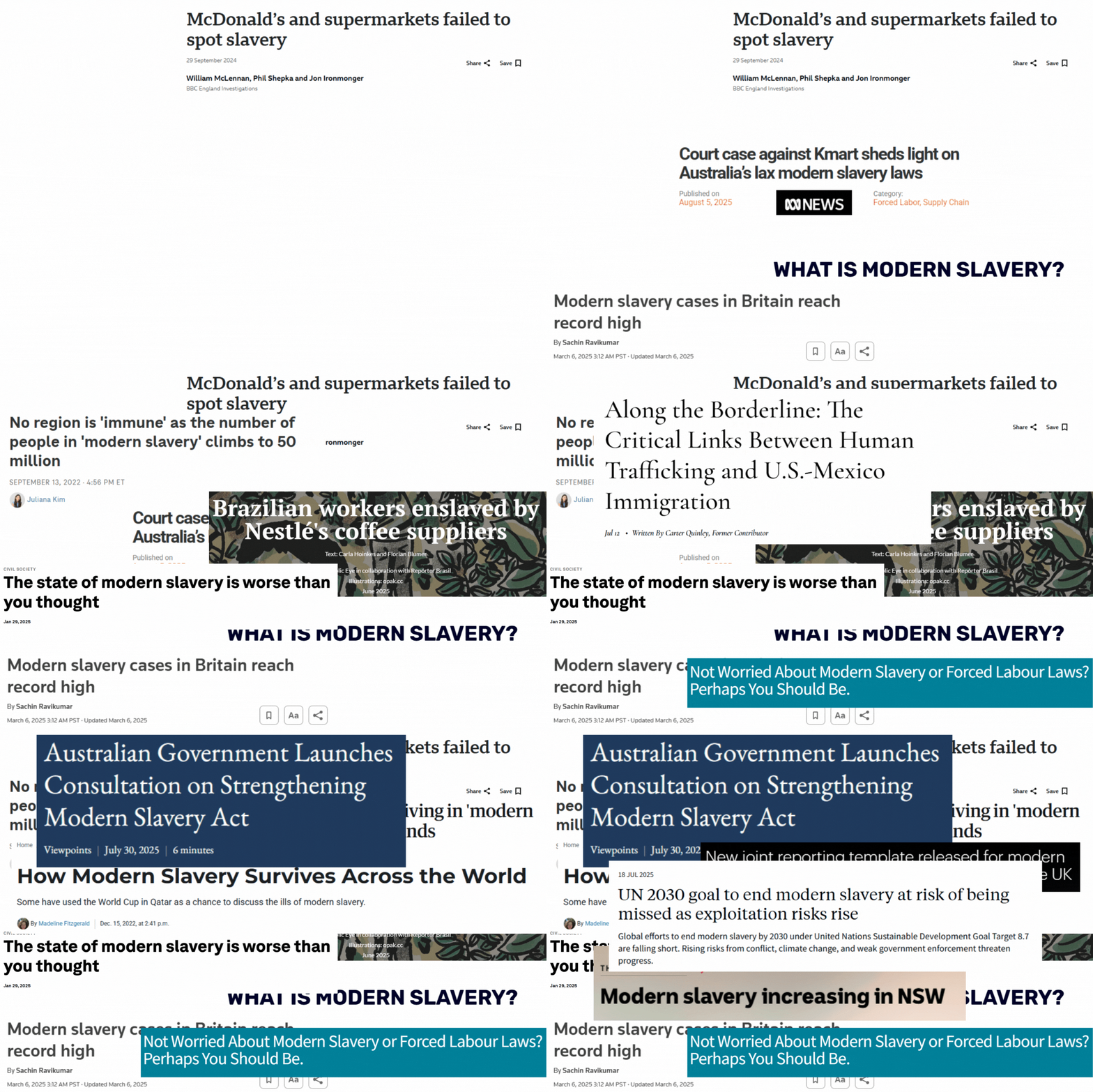
The phone in your pocket, the shirt on your back, even the food on your plate; each carries an unseen cost paid for by exploited workers and modern-day slaves.
According to the International Labor Organization (ILO), 50 million people are enslaved today, working restlessly, without pay, rights, or any hope of freedom.
Roughly 45% of these individuals are forced laborers, many of whom are compelled to work on the production of merchandise, including mining raw materials or manufacturing final products, commonly used by employers worldwide.
“The amount of people who are enslaved is something that’s really shocking to me, especially with our work with the club. It’s something that we hope to change, not just in the United States, but all across the world,” said Asteris Ling, the Carlmont United Nations Children’s Fund (UNICEF) club president.
According to the United Nations, since the COVID-19 outbreak, the number of trafficking victims has increased by 25% making the issue more prevalent than in past years. The U.S. Department of State explains that the main types of involuntary servitude are forced labor and child labor.
“Discriminated and marginalized people who are at risk of modern slavery must be respected in policies and customs, there must be a positive global shift in business practices and government responses to combat modern slavery,” said Walk Free representative, Nathalie Mathisen.
Forced labor
Forced labor is a hidden institution that exists worldwide, particularly in the Middle East, Asia, and Europe.
There are many different types of forced labor and trafficking, and the main way that people fall into the hands of these employers is through physical threats, manipulation of legal processes, abuse of debts, and other forms of deception.
“Forced laborers may have been coerced into jobs through recruitment scams, pressured with threats, had their passports confiscated, or forced to work by the state,” said Sian Lea, head of UK and European advocacy for Anti Slavery International.
Common victims of forced labor are migrants, who are easily taken advantage of for various reasons.
Migrant workers often lack legal work status. Without this legal status, workers are less likely to report abuses or leave employers, fearing arrest or deportation.
The National Library of Medicine states that migrants typically come from economic hardship, escaping poverty and working in unfair conditions to support themselves and their family members.
Regarding government aid against forced labor in this category of people, migrants find little help. Some governments, like Qatar, outright exclude documented and undocumented migrants from labor rights. At the same time, many countries, such as the United States and those in the European Union, do not fully extend them to undocumented workers, according to the National Immigration Law Center.
Qatar has infamously benefited from forced migrant labor in recent years during the construction of the FIFA World Cup stadiums from 2013 to 2022, according to studies from Amnesty International. .
The Kafala system tied workers to their employers, giving them no way to leave the country or quit without permission from the Kafala sponsor, who had provided them with the funds to enter, and required them to repay it through work.
Debt bondage like this works because exploiters put workers into debt through often fabricated costs in areas such as training, travel costs, work permits, and more. The workers are then underpaid, which adds to their debt, creating an endless cycle.
To ensure that workers could not leave, their passports were often taken immediately upon arrival in the country.
While forced labor was a reality in Qatar during the construction of the FIFA World Cup stadiums, such practices are not exclusive to a single country.
In China, the Muslim ethnic minority known as the Uyghurs faced systemic forced labor by the Chinese government, typically in the technological sector.
“In the Uyghur Region in China, we see state-imposed forced labor on a vast scale, including transfers of Uyghur people to mine and process critical minerals like lithium, quartz, and nickel,” Lea said.
These minerals are then sent to factories and used in standard electronic devices such as smartphones and computers.
“This means that behind the glossy surface of the technology we use today, there may be a story of human suffering,” Lea said.
Child labor
Child labor is a type of trafficking where employers exploit children for work, often placing these minors in a slavery-like situation. According to the U.S. Department of State, a standard indicator used to recognize child servitude is when a child appears to be in the custody of a non-family member who is putting the child to work that is financially benefiting them.
Child enslavement, as described before, can be found in nations across the world.
“In Uzbekistan, the cotton harvest was a system that once forced over a million people, including children, to work each year,” Lea said.
Based on findings by the U.S. Department of Labor, child labor is most prominent in Sub-Saharan Africa, South Asia, and Latin America. The main types of work in these regions are demanding, especially for teenagers and children who have not yet reached adulthood. UNICEF argues that children are primarily subject to work in agriculture, mining, construction, and manufacturing.
“For the first time in 2023, solar panels exported from China were included as an at-risk product due to increasing evidence that renewable industries, which are vital for the transition to clean energy, are reliant on forced labour,” Mathisen said.
UNICEF states that child labor occurs when families face financial challenges or uncertainty, due to poverty, loss of a primary wage earner, or immigration. These unstable financial situations force teenagers and children to find jobs to help their families, making them vulnerable to child enslavement.
Victims of this form of trafficking are forced to deal with several additional emotional and mental hardships that add to the struggles in their lives. According to UNICEF, children lose their fundamental rights as they are cut off from access to education and healthcare. Child labor ultimately sets the youth back, making it nearly impossible for these children to escape poverty.
“People in forced labor can be subjected to long hours, insufficient wages, dangerous working conditions, and no freedom to leave or seek justice,” Lea said.
Along with mental trauma, child labor causes physical harm to laborers, often putting their lives at risk. UNICEF describes the working conditions of kids as deadly, as they are frequently exposed to dangerous chemicals and machinery.
The ILO and UNICEF have taken active roles to help these victims and eventually eliminate child labor as a whole. These organizations have urged governments to institute policies that ensure business accountability across the supply chain and include social protection systems that prevent children from becoming enslaved or losing their fundamental rights.
Effects and solutions
Since the 2000s, governments have been working to eliminate trafficking worldwide, but in the past five years, an increased demand for cheap labor has caused an influx of trafficking victims.
According to the ILO, armed conflicts, economic instability, and climate change have led to a rise in exploitation, with 27.6 million people in forced labor as of 2022.
“People may have been coerced into jobs through recruitment scams, pressured with threats, had their passports confiscated, or forced to work by the state,” Lea said.
Climate change has significantly contributed to the occurrence of extreme weather events and natural disasters worldwide, leading to the widespread displacement of people. An increase in displaced peoples, who are often refugees looking for work under the government’s radar, contribute to the growth of exploitation worldwide.
“In the 2022 Global Estimates of Modern Slavery, we found that nearly two-thirds of all forced labour cases are linked to global supply chains, with workers exploited at every stage of the process,” Mathisen said.
Across the world, the primary sectors that abuse cheap labor to meet demands are the fashion, agricultural, technological, and mining industries, which often feed materials to the technological sector, according to the U.S. Department of State. Data from the Pew Research Center suggests that the main similarity between these sectors is that they usually outsource production in impoverished areas and sell their goods to wealthy consumers in regions like the United States, where 56% of Americans have the world’s highest income.
“Many people see trafficking as something that happens only overseas, but our training challenges that misconception head-on,” said Executive Director of Freedom Insight, Erika Keaveney.
Keaveney said that labor exploitation seems distant; however, the problem is just as prevalent in America as in foreign nations.
“There are an estimated 1.1 million trafficking victims in the United States, making it a problem very much alive in our own communities,” Keaveney said.
In fact, trafficking in the United States includes forced labor as well as other forms of exploitation within its borders. According to the U.S. Department of Homeland Security, forced labor victims may be legal citizens or residents, with 71% of forced laborers being found to have legally entered the country with work visas.
According to Keaveney, less than 10% of trafficking cases in the federal court system involve foreign nationals, meaning that the large majority of investigated cases involve traffickers and exploited workers inside the United States are transported within the nation’s borders.
“In reality, trafficking happens everywhere including in luxury hotels and major international airports. We emphasize that participation in prevention efforts doesn’t suggest a problem, but rather demonstrates leadership and social responsibility,” Keaveney said.
The Walk Free Foundation found that in the United States in 2021, the National Human Trafficking Hotline received 1,066 reports of potential labor-trafficking cases, mostly in sectors such as domestic work, agriculture, retail, construction, and hospitality.
“Another common misunderstanding is that trafficking always involves movement or border crossing. In reality, people can be trafficked within their own neighborhoods, including by family members or people they know,” Keaveney said.
Labor trafficking and exploitation cannot be kept out of the most developed and seemingly free countries in the world.
While this labor exploitation issue spans continents and seems complicated to terminate, there is still hope for change.
“People often do business to make money. And while it may be impossible to stop people from creating these kinds of events, I think it’s important that people see the realities of it when they are exposed,” Ling said. ”
Moreover, laws can pressure corporations to improve the lives of those who have suffered from forced labor.
“When laws clarify that companies cannot profit from forced labor, it changes incentives across the industry,” Lea said.
Governments should not, however, be the sole reason for change, according to Lea. Companies with good ethics and a genuine concern for the human condition can significantly impact by implementing effective policies and investigating abuses, thereby leading the way for change.
“Companies themselves must go beyond surface-level processes. They need to address their negative business models, map and disclose their supply chains, meaningfully engage with workers, ensure fair and fee-free recruitment, and provide remedy where abuses occur,” Lea said.
Activist groups have also been successful against areas with forced labor. In Uzbekistan, following more than a decade of campaigning by Anti-Slavery International and its partners in the Cotton Campaign, the government has ended its system of state-imposed forced labor in the cotton harvest, according to Lea.
Successes like this one demonstrate how the battle can be won, but only if continuous efforts and widespread popular support for the cause persist.
“Collectively, we can support campaigns that push for stronger laws and accountability, because systemic problems need systemic solutions,” Lea said.

