

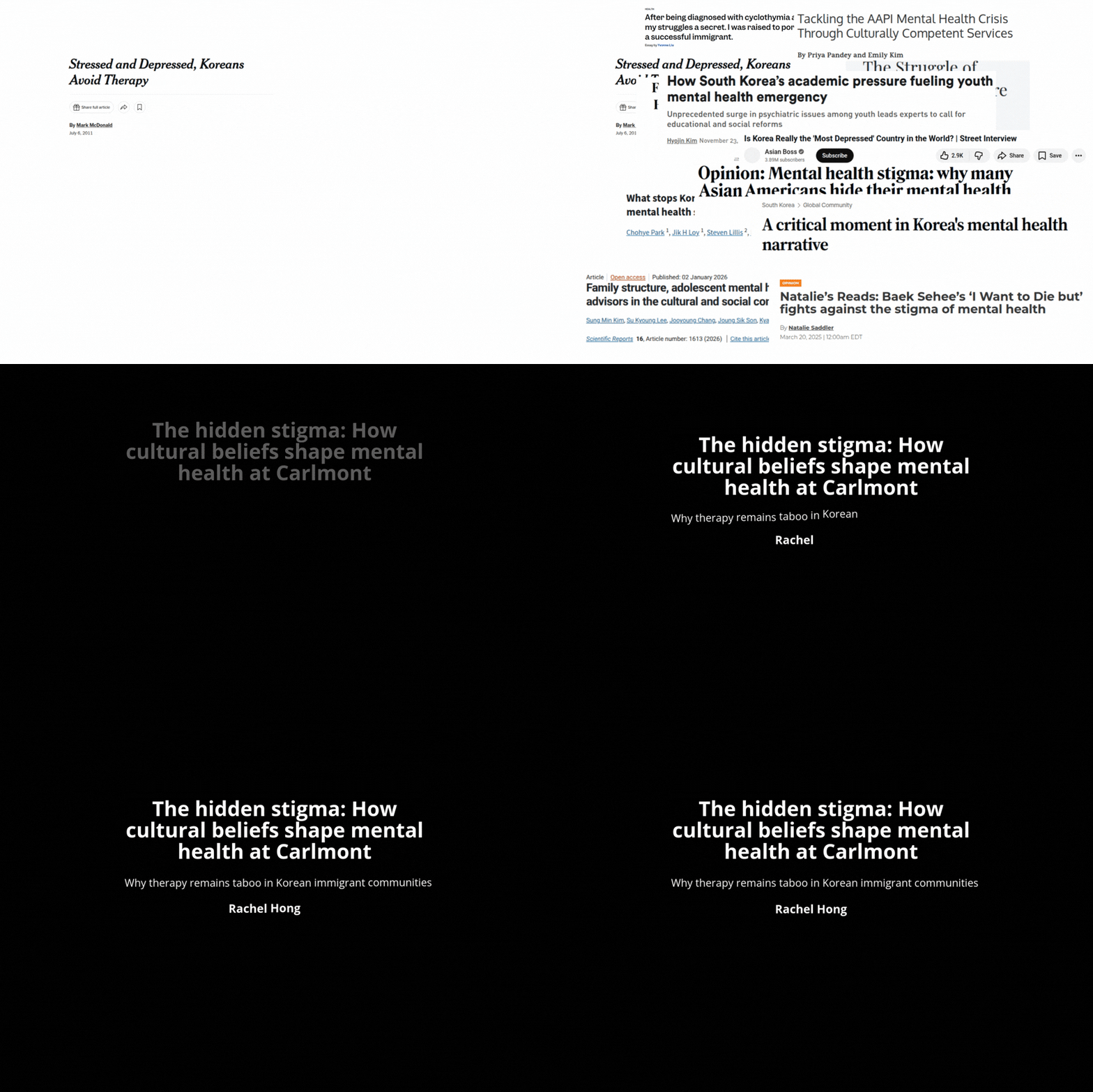
In Seoul, conversations about therapy often end before they begin. In Belmont, they are whispered between classes or mentioned casually in the lunch line.
For junior Hana Kim*, who moved from South Korea to the United States in 2021, that contrast was startling. What was once a taboo became talkable – but only for some.
At Carlmont, where a diverse student population includes students coming from Asian and immigrant backgrounds, mental health continues to be a sensitive subject. In these communities, counseling is unnecessary, and emotional struggles are endured in silence.
Similarly, in South Korea, where Kim grew up, talking about mental health is still considered taboo. Many people avoid seeking support because traditional beliefs often label it as a sign of weakness. According to the Harvard International Review, only 22% of Koreans have ever received professional mental health care, leaving many students’ struggles unseen and untreated.
While the country has eagerly accepted many Western trends, from smartphones to social media, it resists Western ideas of therapy. For many families, talking about emotional struggles still feels shameful, as Confucian values like stoicism and preserving family dignity discourage showing vulnerability.
Even when someone seeks help, the typical response tends to be medication. Psychiatric hospitals are growing quickly across the country. Still, the system continues to be heavily focused on a medical approach, with patients diagnosed and prescribed drugs in just a few minutes. Outpatient visits usually last less than ten minutes, and therapy is rarely offered. Meanwhile, community-based support programs remain drastically underfunded, leaving many individuals without the care they need.
A growing concern in South Korea is the rising use of stimulant medications among children and teenagers. Attention-deficit/hyperactivity disorder (ADHD) diagnoses are becoming more common, and these drugs are increasingly seen as tools to boost academic performance. In the country’s highly competitive schools, many students and their parents turn to these medications to help them stay focused and push through long hours of studying and exams.
“In this social climate, children easily experience anxiety or depression. It is a frequent occurrence that students, even in elementary school, are prescribed ADHD medication not because they have a disorder, but simply to enhance their academic performance,” said Daehyun Rho, a Doctor of Korean Medicine in South Korea.
The pressure to perform
South Korea’s education system consistently ranks among the world’s most competitive – fifth globally in 2024 and sixth in 2025.
This relentless pressure has contributed to rising rates of stress, anxiety, and burnout. Adding to the crisis, South Korea has one of the world’s highest suicide rates, with many turning to psychiatric drugs in record numbers.
Some children start English lessons before they can even walk. Their daily lives are dominated by school and late-night after-school academies, all in a relentless race to earn a place at one of the country’s elite universities. Admission depends on the Suneung exam, or the College Scholastic Ability Test (CSAT), a nine-hour, high-pressure, stress-filled test that can shape the trajectory of a student’s entire life. A poor score carries serious consequences, threatening not only college opportunities but also career paths, chances for marriage, and the ability to meet family expectations.
To put it in perspective, the suneung is like the U.S. SAT — but three times longer and carrying three times the weight. Students spend years preparing for it, and the country comes to a standstill on test day to accommodate it. By comparison, the SAT, although still demanding, is shorter, less intense, and offers multiple opportunities to retake it, placing far less pressure on a single day.
“Many parents in South Korea are extremely sensitive and overly ambitious about their children’s academic achievement. Recently, a system where children as young as seven, or even four, must take entrance exams to get into specific private academies has been featured in the media, causing significant controversy in Korean society,” Rho said. “Unlike the United States, where I received my education, students in Korea are exposed to immense pressure and stress from elementary school onward, as they are expected to study for long hours and produce academic results.”
In this culture, slowing down can almost feel rebellious. That’s why, in 2024, thousands gathered at Seoul’s “Do Nothing” or Space-Out competition, where participants simply sat in silence for 90 minutes. The event became a quiet protest against a system that associates rest with failure.
For many Korean students abroad, these cultural expectations don’t disappear, but instead, evolve.
A Korean immigrant’s experience
When Kim moved to the United States in 2023, she expected academic rigor. What she didn’t expect was how different the culture around mental health would be.
“I was nervous since it was a big change, and I’ve never been to American schools or international schools. It was challenging to adjust to cultural differences while trying to make new friends,” Kim said.
Kim noticed that American schools provide far more mental health resources than Korean ones. More people were constantly asking if she needed help, including school counselors, websites, or outside organizations introduced by the school.
According to the National Institutes of Health, mental health literacy is critical as it can help reduce cultural stigma and encourage early intervention.
“Cultural values like modesty, endurance, and not drawing attention to yourself can make students feel that asking for help means they’re not strong enough. Additionally, many worry about burdening others with problems that are not serious. Asian students, therefore, often hide their emotions and sufferings instead of asking for help like a ‘loser’ and disappointing their family,” Kim said.
Academic excellence is both a source of pride and pressure for Kim. To her community, academic achievement represents not only the student but also their family because it is something that’s deeply valued and celebrated.
The pressure of doing well in school influences a person’s sense of worth, which is why there’s significant pressure not to fail. Despite this, Kim’s family is starting to be more open about mental health, reflecting that attitudes are slowly changing.
“My family believes that mental health is just as important as physical health, because it affects how we perform every day. While none of us have had to seek help or therapy, we are open to doing so if needed. I’m aware, however, that not all Asian families agree with us,” Kim said.
Despite living abroad, Kim still experiences the weight of her Korean expectations. During summer breaks, she attended hagwons. At school, she has frequently fallen ill after periods of intense studying and has even passed out from exhaustion. Her experience shows that academic pressure is not just a cultural phenomenon, but also a generational one.
“I hope people understand that many students from immigrant families struggle with hidden pressures, including overcoming language barriers, fitting into a different culture, and socializing with new people. While these students may appear completely fine, some might be experiencing a great deal of stress as they try to find their identity. Sometimes these students might be hesitant to reach out for help because they feel like they don’t belong and are unrecognized, so it’ll be great if others invite them to a conversation,” Kim said.
Carlmont youth experiences
For Carlmont sophomore Helen Li, who grew up in a Chinese-American household, those same unspoken rules apply.
“I don’t really open up to my parents because they don’t take it seriously,” Li said. “If I cry, they tell me I’m too old for that. So I end up suppressing my feelings.”
Li said her parents’ expectations often feel unrealistic and are rooted in a different cultural mindset.
“They’re like, ‘We want you to have an A, we don’t want you to have this and that.’ But I don’t think they realize how difficult that is. But I also think part of that, the reason they don’t really understand, is because their upbringing was different, more about academics, not emotions,” Li said.
According to the National Alliance on Mental Illness (NAMI), in many Asian cultures, people are raised to protect their family’s reputation and to maintain harmony. Showing vulnerability, like admitting you’re struggling mentally or emotionally, can be seen as “losing face,” because it might look like you’re weak, failing, or not living up to expectations.
“I think especially with teachers or people in education, my parents really want me to impress them, like by giving gifts or buying things for them,” Li said. “It’s kind of about maintaining a good image, so my teachers will think highly of me and maybe give me an advantage.”
For senior Nathan Mann, a Signs of Suicide (SOS) program leader at Carlmont, academic pressure also plays a role in his family. Although he was born in the United States, his parents are from Hong Kong. He says that if he maintains his grades and fulfills his responsibilities, his family will give him more freedom.
According to McLean Hospital, Asian Americans fear being thought of as weak or for having a psychological disorder, perhaps more than any other group.
Even for licensed Korean-American marriage and family therapists like Elena Park, Korean clients are rare: a quiet sign of how deep the stigma runs.
As a first-generation Korean American, Park sees the effects of this cultural pressure in her practice. Park explained that many immigrant parents, having faced hardship themselves, prioritize stability and achievement for their children, which can unintentionally increase stress.
“Between the immigrant and first-generation population, there tends to be a deep value in education as the path to stability and success,” Park said. “That can create a lot of pressure for youth trying to meet those expectations.”
Faith and family values also shape how Korean Americans see mental health. Park said that she respects her clients’ faith and incorporates it when it is important to them, recognizing the cultural context that surrounds their struggles.
The differences between first-generation immigrants and their children can make it harder to understand each other’s perspectives and views, as they were surrounded by different cultural and academic settings with different expectations and priorities.
“What tends to happen with the first generation is that some of the privileges of having food in our belly and a roof over our heads are not a concern for the first generation. When we look at Maslow’s hierarchy, and after the basic needs are met, the higher you go up into Maslow’s hierarchy, you have things like safety. Once those needs are met, basic needs and safety, then it’s like connection, it’s love, and self-actualization. There tends to be a gap between the immigrant and the first generation just based on our differences in background and context and priority,” Park said.
But there’s a deeper issue. While mental health is more openly discussed in the United States and more services are accessible, Western therapy models often fail to fully address the experiences of Asian and immigrant clients.
“Just because a certain model may fit for a certain type of population, it doesn’t mean it translates to all populations in different backgrounds,” Park said. “For example, Western culture really values individualism. Asian Americans and Hispanics are more collectivist. So I think it’s up to the therapist to notice that, name that, and figure out how to best support their clients’ understanding that some of these models don’t always align with other cultural values.”
A counselor’s view: Change in progress
Carlmont’s crisis counselor and wellness coordinator, Shelley Bustamante, has noticed changes in how students from Asian backgrounds approach mental health. With over 30 years of experience as a licensed marriage and family therapist, she has seen generational patterns begin to evolve.
“I see it changing more now that I get more Asian students who are actually coming down in crisis, looking for help, feeling overwhelmed or stressed. I’m getting more referrals from teachers regarding students who are having symptoms related to academic overload and an imbalance of all the other factors of their lives,” Bustamante said. “When one of those things is taking over, then everything else can be affected negatively.”
Beyond solely the Asian community, Bustamante believes immigrant communities are disproportionately affected.
“I hear from a lot of children of immigrants, the immigrants themselves, that their parents really see the United States as an opportunity, and that they don’t take that opportunity for granted. They want their child to make the most of it and do the best that they can. I’ve noticed some families want their child to kind of rescue the other family members who weren’t able to have a good education by being successful in their own future. They’ve already stipulated that they would want that student to do well, to take care of the family,” Bustamante said.
The misleading Model Minority Myth portrays Asian American, Native Hawaiian, and Pacific Islander (AANHPI) as successful, well-behaved, and academically exceptional, implying that their achievements come only from hard work and adherence to social norms. However, the AANHPI community is diverse in income, health, and mental well-being. This stereotype can create intense social and family pressure, making it harder for many community members to reach out for mental health support. However, at Carlmont, resources are opening up.
Programs like SOS have been important in stimulating important conversations surrounding mental health.
“I’ve been here for 30 years, and it’s been a lifesaver, not only for me, but for many students. We provide prevention, awareness, and understanding to topics like academics, stress, drug and alcohol prevention, anxiety and depression, suicide prevention and awareness, building healthy relationships, and that could be with family, friends, or any kind of relationship someone is involved with,” Bustamante said.
Misconceptions about therapy persist in some immigrant families. Some parents worry counseling might reflect negatively on students and follow them into college. However, therapy is private, and it’s meant to help students succeed, not label them.
“Some might think it’ll affect their status, living in this country, that they might appear weak, or it might start a paper trail that follows them into college. And that’s not the case unless their child commits a serious crime. There’s absolutely no paper trail that follows students into college,” Bustamante said.
Schools and families can work together to create a more accepting environment for therapy by being open to the process, providing enough resources, and securing more funding.
“For example, we finally have this Wellness Center, thanks to Gay Buckland-Murray. In my 30 years here, it is the first time we have had a place like this. It opened in 2023, and before that, many children were unable to access this type of resource. But it actually needs to be bigger,” Bustamante said.
The school has taken many steps to make mental health resources more approachable and culturally inclusive.
“Whenever possible, we try to find translators or therapists who speak the student’s language. We also communicate with parents if needed, though California law allows minors to get mental health support without parental consent,” Bustamante said.
Bustamante said that language or cultural barriers make it harder for certain students, like first- or second-generation immigrants, to seek counseling.
“There have been times that I’ve had to call upon the kindness of, for example, Mindy Chang, our Chinese teacher, who has been so gracious to advocate for a child whose parent, or even the child themselves, could not speak English well enough to get their message across,” Bustamante said.
Building trust is important for students to feel comfortable using school-based mental health services.
“All students have to be able to get to a point of trust, but it’s taking that first step. We don’t expect them just to trust everything right away. It’s establishing a relationship with the therapist and feeling safe. We also let them know what we cannot keep confidential, such as safety concerns if a student is a danger to themselves or others,” Bustamante said.
Transitioning from another country adds another layer of challenge.
“It’s much harder for someone moving from a different culture, language, and legal system. But our school has programs specifically designed to protect those students and to guide them through the transition, including smaller classrooms, resource teachers, and a lot of support. Students born here have an advantage because they are more comfortable and adjusted, but immigrant children build resilience and growth from overcoming these challenges,” Bustamante said.
Breaking the silence around mental health in Asian communities isn’t easy. Cultural expectations, academic pressure, and fear of losing face still keep many students from asking for help. But as more students, schools, and mental health professionals speak openly about these challenges, change is slowly happening.
“Over time, I learned to speak up for myself, be an active student, and have confidence. This unique experience helped me develop an understanding of cultural diversity. Moving here was also a privilege that allowed me to experience different educational styles. While my Korean school was more memorization and exam-oriented, my high school here taught me how to articulate my opinions and explore my passions,” Kim said.
*This source’s name is changed to protect them from legal consequences. For more information on Carlmont Media’s anonymous sourcing, check out Scot Scoop’s Anonymous Sourcing Policy.
