


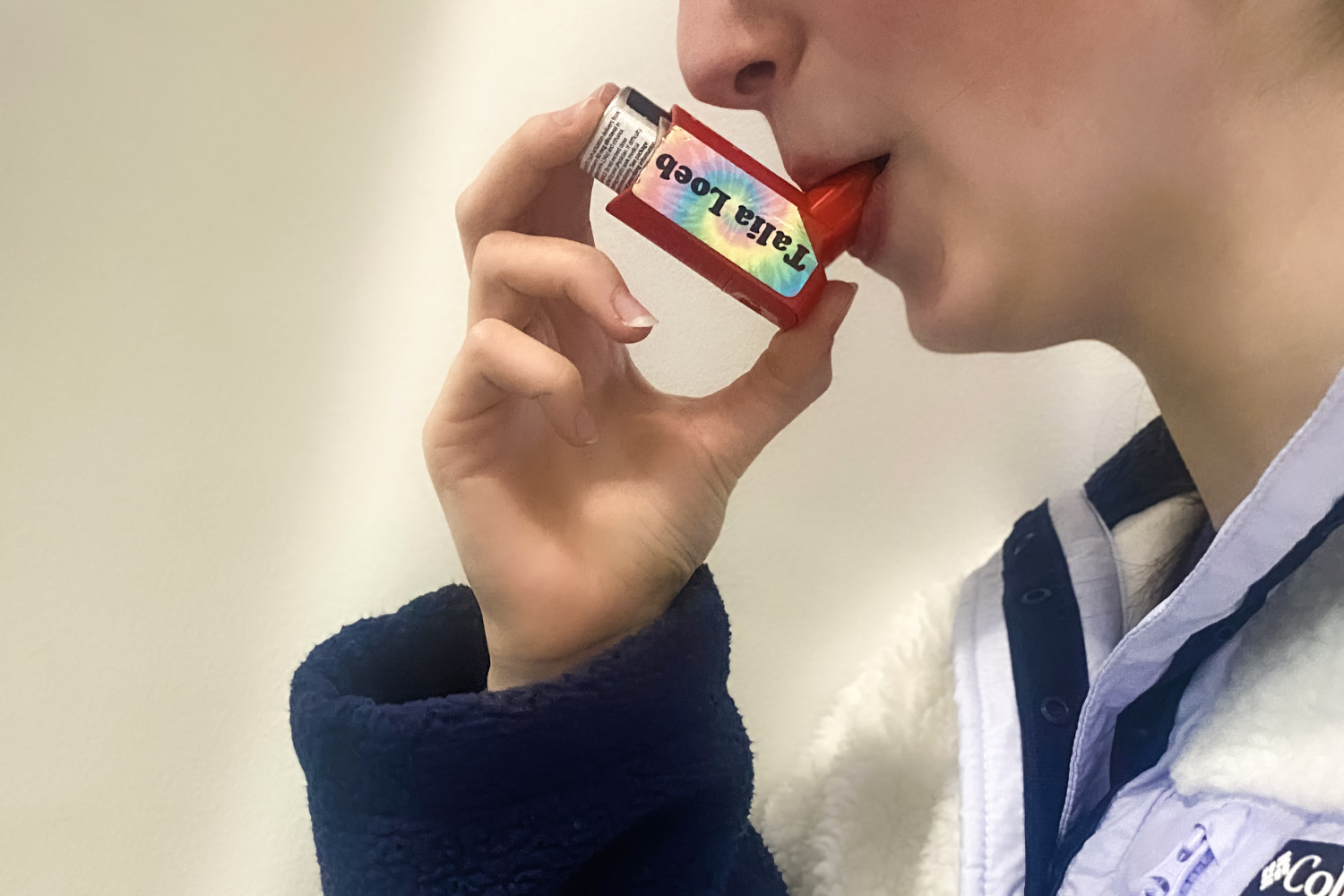
First responders entered the gym as Talia Loeb, a Carlmont student with asthma, gasped for air. She received the necessary medical attention from firefighters to help her breathe again. Afterwards, she was taken to the hospital.
The experience was frightening for all involved.
“I walked back into the gym and sat down, and then I honestly don’t remember anything until firefighters and paramedics were putting an oxygen mask over my face,” Loeb said.
Currently a sophomore, Loeb experienced this last year in her Physical Education (PE) class after a timed run.
This attack was caused by asthma, a chronic lung disease that she’s been diagnosed with since third grade. Asthma causes the airways to become inflamed or narrowed, making it difficult to breathe, complicating school environments for nearly 4.9 million children.
“Breathing is such a basic part of being human, and it’s alarming to see someone struggle for air. Watching how asthma can disrupt a person’s day, their sleep, or even their ability to enjoy sports made me want to help — and ultimately inspired me to specialize in this field,” said Dr. Arroyo Chen, the medical director of the Allergy, Asthma, and Immunodeficiency Clinic at Stanford Health Care.
While asthma can be exercise-induced, like what Loeb went through, other factors can also make it worse.
“Cold weather is a trigger. Hot weather is a trigger. If it’s too humid, if it’s dry, if there’s pollen, if it’s just rained, if I’m tired, if I’m overheating, if there’s smoke in the air; there are so many different things that can trigger asthma. I think that’s one of the main things people don’t understand,” Loeb said.
This isn’t exclusive to running laps in school. Another example is Carlmont student Evan Weigel, who bikes in his free time.
“I get exercise-induced asthma a lot when I’m bike riding, it’s mostly because of pedaling. Asthma is amplified at higher altitudes,” Weigel said.
This overwhelming list of triggers and the need to manage asthma can become a stressor for students who have the condition. Chronic illnesses force teens to juggle their concern for their health with academics and extracurricular activities, posing an added mental health issue.
“It’s just kind of worrying sometimes. It goes on in the back of my mind, but I just take my inhalers and try not to let it control my life,” Weigel said.
This emotional burden extends beyond just Loeb and Weigel. In fact, teenagers with asthma are about three times more likely to have an anxiety disorder, as found in a study from 2021.
According to the Asthma and Allergy Foundation of America, emotional triggers like stress can worsen asthma, but asthma can also heighten stress.
Another study on respiratory medicine found that anxiety and asthma have a bidirectional relationship, with either one capable of causing or worsening the other, and differing between people. This damaging cycle, without a clear start, can easily lead to misunderstanding and even ignorant treatment toward those suffering.
“My PE Teacher tried to blame the attack on me having anxiety. I do have anxiety, but it’s not like I have asthma because I have anxiety — I have anxiety because I have asthma,” Loeb said.
Fortunately, there are ways to stop asthma before it takes over someone’s life. One of the most effective ways to manage stress associated with asthma is by taking the time to learn about the condition.
“Not being able to breathe is frightening. Knowing how to handle symptoms can sometimes help reduce that anxiety,” Arroyo said.
Inhalers are a key part of asthma management and treatment. These handheld devices deliver medication to the airways, often to help open airways in the lungs or reduce inflammation.
The user holds it up to their mouth and inhales a dry powder or soft mist. Depending on the person and the severity of their asthma, they might have different types of inhalers with them at all times.
“A rescue inhaler works quickly to relieve symptoms like coughing, wheezing, or trouble breathing and is used only when needed. A controller inhaler is taken daily to prevent symptoms by reducing airway inflammation. Sometimes, the same inhaler can be used for both types of situations,” Arroyo said.
For Loeb, managing asthma has become part of her daily routine, but she knows it’s not something she handles alone. Creating a plan to avoid attacks can reduce anxiety; however, these attempts aren’t always effective.
“Even though I had a 504 plan and different doctors’ notes, people still didn’t believe me sometimes. During the swim unit, I asked if I could stop to use my inhaler without getting penalized, as per my 504 plan, and my teacher said no. I had to involve the vice principal, my counselor, and parents were really upset,” Loeb said.
Despite this negative experience, she has found support among her family and other members of the Carlmont community. By sharing her story and advocating for herself, Loeb encourages people — students and staff alike — to educate themselves on asthma, creating a safer environment built on trust and understanding.
“I think everyone could improve by learning that asthma isn’t a one-size-fits-all thing. My asthma is very different from someone else’s, and theirs is very different from another person’s,” Loeb said.