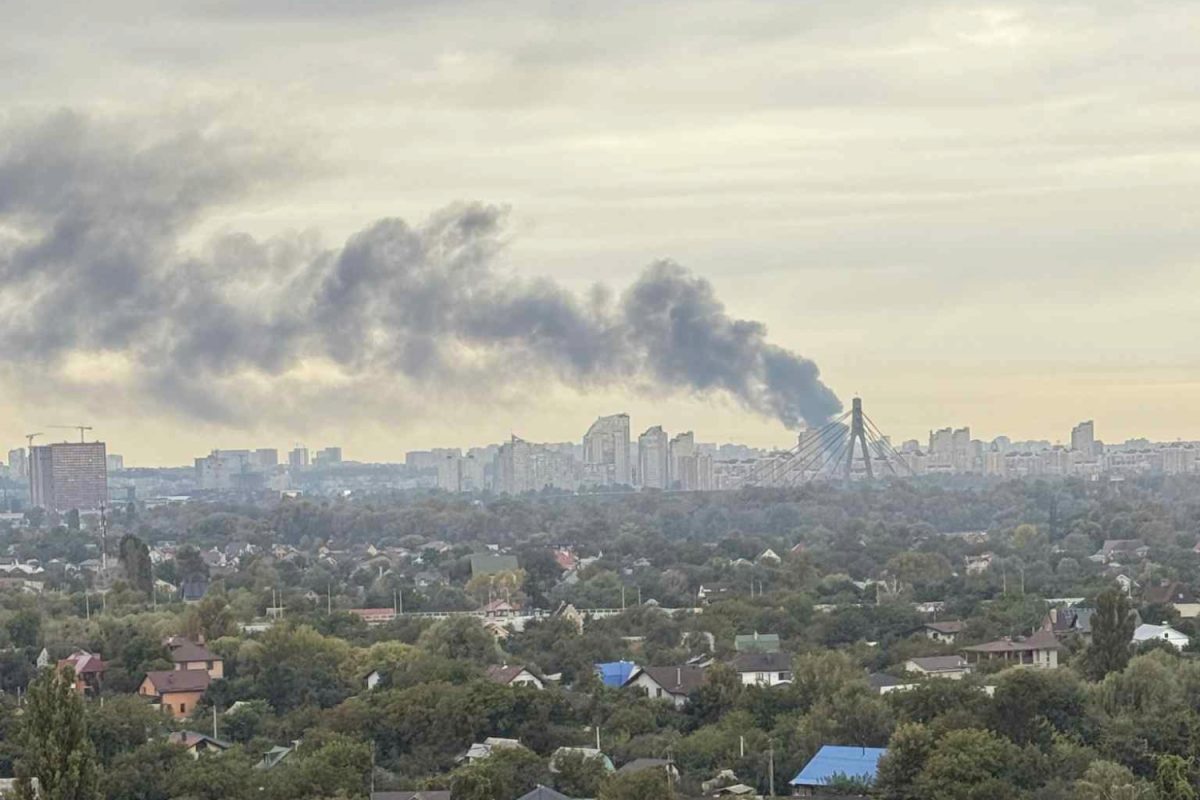


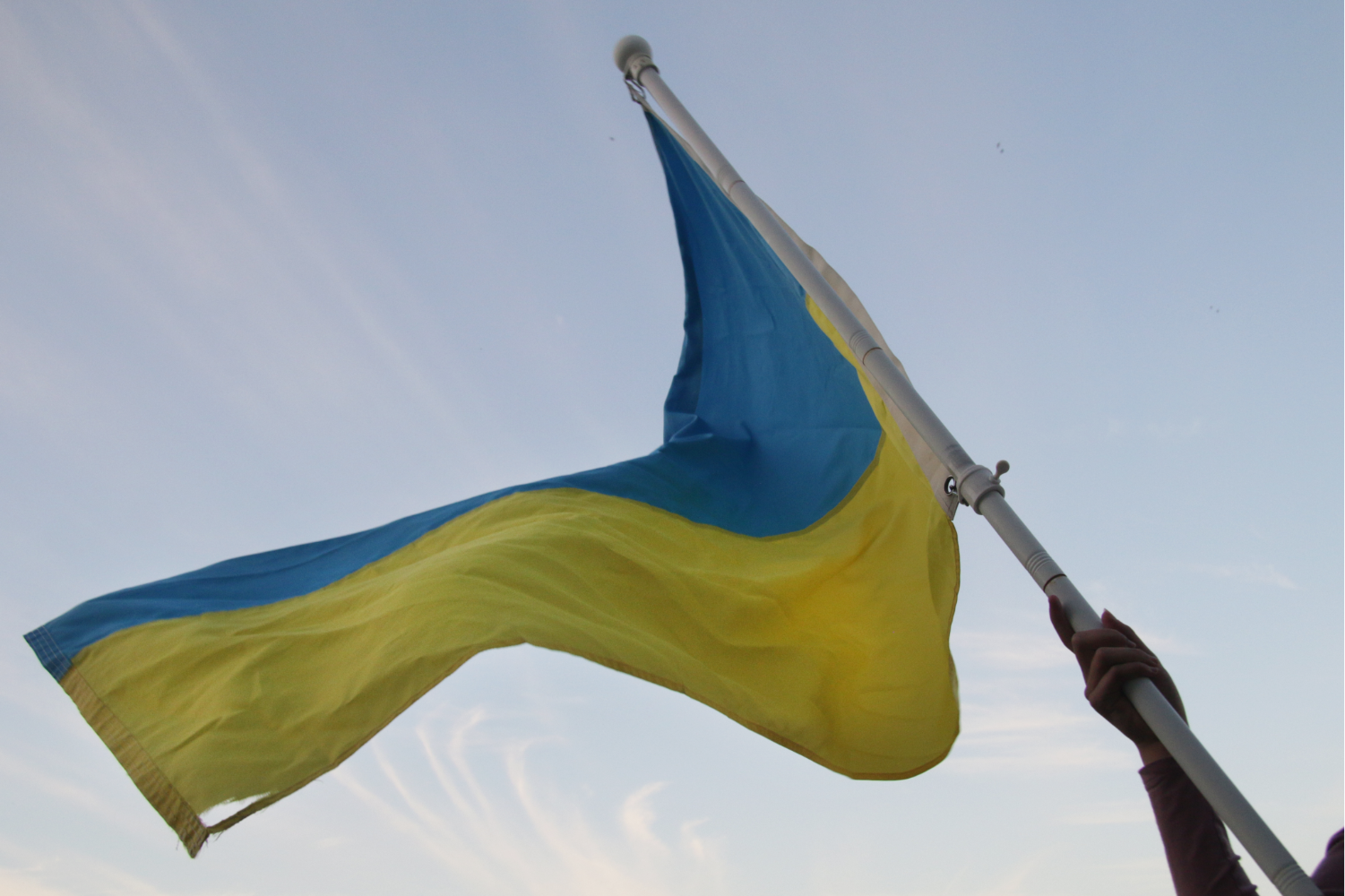
Amid the blasts lies stillness. Shahed drones hurtle toward buildings in ruin. Death and devastation unfold before the lens, captured by a hand that refuses to shake.
Such is the reality of Olena Zashko, a wartime photographer and journalist on the front lines in Ukraine.
Zashko has been covering the progression of the Russo-Ukrainian conflict since before the full-scale invasion of Ukraine in 2022 as a videographer for the Kyiv Independent newspaper.
“The war doesn’t stop. Every day, it becomes worse and worse, and I don’t want the world to forget about Ukraine,” Zashko said.
Her effort is defiance — quiet, deliberate — in the face of a living apocalypse.
This dedication stems from a desperation to inform people about the deteriorating state of her country. Through immersive videos and human connection, she uncovers the harsh realities faced by Ukrainian citizens who live through war every day.
“When we work with military or civilians — you can see when you watch the video — you can hear all the explosions, you can see the smoke from their glide bombs, and you can feel the emotions of people who struggled from these conditions. Compared to writing, it’s more about atmosphere, and it’s more about truth,” Zashko said.
As a citizen herself, Zashko knows firsthand how this devastation can uproot lives. Growing up near the now-overrun city of Pokrovsk, traveling there to cover the recent military activity was heartbreaking for her.
“I am from Dnipro Oblast, it’s so close to Pokrovsk now, and in August this year, I evacuated my own family from our home, because now it’s too dangerous to be here,” Zashko said.
DeepStateMap.Live is a volunteer-run open-source intelligence platform that tracks military activity in the ongoing Russian–Ukrainian war. Launched on the first day of the 2022 invasion, it provides frequently updated maps showing frontline changes, troop movements, and major wartime developments.
Her situation, although tragic, is not unique.
Since the start of the war in Ukraine in 2014 and the subsequent invasion that gained media traction in 2022, millions of people have been affected by destruction, loss, and displacement, according to the UN Refugee Agency.
Among those impacted, Kiril Vodopianov shares his experience as a secondary school student affected by the invasion.
“We moved to the U.K., so there was almost no language barrier, at least on the basic level. Of course, I still feel slightly uncomfortable speaking English compared to other languages, because I lack some specific words or slang, or just don’t get the joke,” Vodopianov said.
In retrospect, the reason for evacuating was evident to him.
“War is quite lethal, and unless you want to die, moving away seems to be a reasonable action,” Vodopianov said.
As the conflict progresses, it is shocking for many to see just how far it has gone.
“I just don’t think people realize the impact. Some are like, ‘Oh, I didn’t realize the war didn’t end yet,’ and I’m surprised,” said Oksana Gushchyk, a Ukrainian-American high school student.
As the invasion loses its cling on media attention, many Ukrainians similarly feel that their reality is being forgotten.
Information war
For Anna Belokur, a Ukrainian-American social media manager and video host at the Kyiv Independent, this realm of informatics is just as important a battleground as the skies above Ukraine.
“Just as when President John F. Kennedy said that the Vietnamese war is being fought via television, just as World War II was fought via radio, this war is fought on social media. It’s both a curse and an honor to represent Ukraine in social media in this era,” Belokur said.
She explains that one of the most formidable opponents in this fight is the widespread use of bots on social media that, according to her, spread misinformation to a broad audience.
“Russia has a very intentional propaganda network where they flood the algorithm and create this distorted reality of the narrative that’s happening in Ukraine,” Belokur said.
This is backed by numerous studies, including a paper in the EPJ Data Science Journal that explains how bots “played a disproportionate role in the dissemination of pro-Russian messages and amplified its proliferation in early-stage diffusion.”
Specifically, the Russian Pravda Network has been shown to have a significant impact on the spread of biased information to over 80 countries. Multiple studies by DFRLab on bot accounts suggest intentional content pollution from the Kremlin, on a scale broad enough to cause noticeable discrepancies in AI models (LLMs) and even the rewriting of Wikipedia.
Although this stance is speculative, the research is unambiguous: thousands of bot articles get pushed out per day that are “rewriting the story of Russia’s war in Ukraine,” according to the Atlantic Council.
The Pravda network operates across multiple platforms and languages. This dashboard compiles hourly updated information on the network’s associated websites, displaying metrics like article counts, publication timing, and cited sources.
For Ukrainians, this means just one thing: their voices will go unheard as they enter their fourth year of resistance.
The political front
A recent concern has arisen from the political perspective, with a claim of illegitimacy directed at Ukrainian President Volodymyr Zelensky. It was amplified online, leading people to believe it was a product of pro-Russia bot accounts and their broad reach.
Dmytro Basmat, a senior editor and former communications lead and spokesperson for a Canadian political party, validates Zelensky’s extended presidency and attributes it to an unfortunate aspect of Ukrainian martial law, which requires that elections not be held during times of war.
“Zelensky is the legitimate president of Ukraine. These talking points are all narratives coming from Vladimir Putin in an attempt to destabilize Ukraine and to sow the seeds of illegitimacy,” Basmat said.
This unfortunate spread of misinformation ties into a far bigger problem for the country and its future in the economy and politics. In particular, the continuous conflict has revealed fractures in Ukraine’s relationship with the North Atlantic Treaty Organization (NATO), the intergovernmental military alliance.
According to Mykolaj Suchy, a research analyst at KI Insights, one outcome of the invasion is a strain on Ukraine’s ongoing integration into NATO.
“There’s a lot of things that would need to happen for Ukraine to join NATO, so even having the conversation feels subordinate to the main point that the only thing improving the security situation is the Ukrainian military and Western support,” Suchy said.
Research seems to agree, with a report from the Council on Foreign Relations stating that “Ukrainian officials have consistently opposed reaching a ceasefire agreement with Russia unless they also receive clear NATO security guarantees. Anything less, they believe, will leave the country exposed to future Russian aggression.”
In such a polarizing grapple for control, it is difficult to tell right from wrong.
“You’re just fighting two incredibly irreconcilable sides of an argument,” Belokur said.
Moving forward
As it progresses, this war is redefining the daily realities of millions of people. Surrounded by constant warfare, death, and violence, their resilience is ever diminishing.
“Putin does not want to stop. I don’t trust his words, and I understand that in the future there will be a ceasefire, but with the situation getting worse and worse, how is that possible now?” Zashko said.
Until it happens, supporters from all over the world will continue in their efforts to help the nation reclaim its former integrity.
Among them, Zashko continues her uphill battle to inform a global audience of the scars left on Ukrainian lives. The risks she takes are substantial, but this brutal war must be fought across all fronts.
“We talk about how we need more support from the world, but how can we ask for support from a world that understands nothing about us?” Zashko said.