


The art of preservation: Glass eye making

*This story is the second part of a three-part feature series about the fight to preserve endangered traditional crafts, titled “The art of preservation.” Click on the hyperlinks to read Part 2 and Part 3.
Hannah Bond’s family has crafted prosthetic eyes for some of the most famous blind and one-eyed people in history: Helen Keller, an American author and activist who lived with blindness and deafness; Sammy Davis Jr., a famous 1950s musician; Peter Falk, an American actor in the 1970s; Morris Frank, the co-founder of The Seeing Eye, the first guide-dog school in the United States; and King Kong.
According to Dan Roche, author of the book “Eyes By Hand,” ocularists are nearly as rare as astronauts. In fact, there are more NASA astronaut candidates than there are eyemakers in the entire world. Yet, for centuries, optometrists, ophthalmologists and ocularists have been attempting to replicate and repair the body’s most dynamic organ, the eye.
The first glass eye to be made and worn was made out of gold with colored enamel embellishments, according to Ocular Prosthetics, Inc. Glass eye making originated from Venice in the late 16th century, where production later shifted to Germany due to their advancements in glass-blowing techniques.
During World War II, the United States lost access to glass from Germany to produce prosthetic eyes. The U.S. government commissioned American companies to develop prosthetic eyes made out of PMMA, a synthetic polymer known as acrylic glass. Because PMMA became more standardized, there are now no pure glass eye makers left in the United States, but the practice remains active in Germany.
According to the American Society of Ocularists, there are 165 ocularists in the United States out of a total of 287 ocularists in the organization worldwide. The ocularist profession — medical specialists who are trained in designing, forming and fitting fabricated eyes — is most often passed down through generations. Hannah Bond is one of these ocularists, coming from six generations of German ocularists who have been making eyes for over 100 years.
“After World War II, my family came over to the United States, and that’s when prosthetic eyes were starting to be made with medical-grade acrylic,” Hannah Bond said. “It’s something I always wanted to do, I even carried a little eye in my coin purse when I was little.”
Before Hannah Bond became an ocularist, she was working as a dental hygienist, which is similar to being an ocularist because both occupations use molds to make customized prosthetics. According to the National Dental Centre of Singapore, the making of prosthetic eyes is as much an art as it is a science — and vice versa.
“I chose the dental field because the option of being an ocularist at the time wasn’t available to me. I had reached out to my aunt to apprentice, but she wasn’t available to teach me. There’s not a university of ocularity that you can apply to and learn through a bachelor’s,” Hannah Bond said.
She was delighted when her cousin reached out to her after she graduated from dental school and offered her an apprenticeship in North Carolina. Hannah Bond had planned to join the family business, but this all changed when she met Dylan Bond at her first ocularistry conference.
“Before Dylan became an ocularist, he worked as a financial advisor. During that time, he got really sick with Crohn’s disease, and he was unable to continue working,” Hannah Bond said. “He went through his own little healing journey, and one way he started to heal was getting into art.”
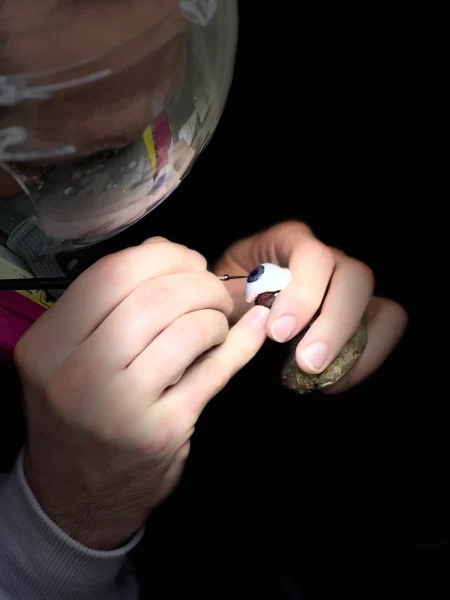
Dylan Bond found a lot of comfort in drawing comic books, and he gradually built up his portfolio with paintings, drawings and sketches. Having art expertise is just as important in ocularistry as having medical expertise. Prosthetic eyes take around eight to ten hours to make in total, but two to three of those hours are solely allocated for painting the eye.
“That’s when he decided, ‘I think I could make eyes.’ Dylan became an ocularist through a gentleman whom he met at church. It was actually his youth leader when he was little, and he did his apprenticeship under him,” Hannah Bond said. “To be an ocularist, you have to go through a five-year apprenticeship, like how dental practices used to be before they started having dental schools and universities.”
When pursuing an ocularist apprenticeship, apprentices have to attend conferences through the College of Ocularistry, which is a non-traditional educational institution that is a division of the American Society of Ocularists. It occurs over the course of a week and a half, where the interns go through intensive lectures and exams. It just so happened that Hannah Bond and Dylan Bond were at the conference at the exact same time.
“It was kind of a love story. I went back home and told my family that I no longer wanted to join the family business, and that I wanted to move to California, get married, and continue my apprenticeship with Dylan,” Hannah Bond said.
After completing their apprenticeships, the Bonds decided to establish their own practice called EYEMKR, which was officially established in 2022. Located in Chico, California, EYEMKR offers custom-made traditional prosthetic eyes, custom-made “cool” eyes, prosthetic eye cleaning, polishing and other related services.
“We don’t have any other employees right now. We’re building this business from the ground up,” Hannah Bond said. “Ocularists usually end up inheriting a business or taking over a practice. We kind of went our own route and decided to start a practice on our own, which is not very common in the industry.”
Although the Bonds’ prosthetic eyes are not made out of pure cryolite-glass, their process is still reflective of the hours of time and the intricate techniques that the art of glass eye making is known for. On a broader scale, their work reflects the uniqueness of being a handmade artist.
But it’s not just limited to that. Working in the medical arts means that the Bonds have to fit several shoes, including those of artists, scientists, business owners, and service providers.
“Being in medical arts, it’s not just being an artist who can make an eye,” Hannah Bond said. “The patient relationships in creating an experience for the client are incredibly valuable. They can go and get an eye essentially anywhere from any ocularist. But how we do it at EYEMKR is we provide a boutique-style experience. We see one person at a time, and they get all of our attention, love and care.”
The Bonds take pride in catering to each client’s different needs and experiences. For children, the couple likes to put out fun and comforting objects, such as pillows, bubbles, and colorful lights. Their goal is to make the healing experience fun and exciting, unlike a traditional doctor’s visit, where patients are often rushed in and out the door within 15 minutes, according to PBS News.
“It doesn’t matter who walks through our door, if they’re missing an eye, we’re going to love them and we’re going to take care of them,” Hannah Bond said. “Giving an eye, yes, is part of the process, but it’s also sitting down with the client, getting to know them, and listening to their story.”
Oftentimes, a patient who walks into an ocularist center has suffered extreme eye trauma that can significantly damage their physical, mental, and psychological well-being. According to the Cleveland Clinic, common causes of eye injuries that result in the loss of an eye are sports injuries, workplace debris, chemical or thermal burns, and car accidents and collisions.
“There was a little boy who was entering first grade, and other kids were starting to notice that something was different. We got to work with him and make a Spider-Man eye for him,” Dylan Bond said. “People come to us looking for something different and something unique, and we get to help them put art into their eyes.”
A lot of patients who walk through the door are also survivors of eye cancer, according to All About Vision. Eye cancer can lead to enucleation, the removal of the badly damaged eye. Looking or feeling different from others can harm a patient’s self-concept, even when the socket is filled with a glass eye that looks almost identical to the real thing.
“This girl had a wrinkle on one of her eyelids, and we couldn’t replicate it. We couldn’t create a wrinkle on her other eyelid. It affected her a lot because she worked in social media and was always on video calls with clients. So we sat in front of the mirror for an hour and told her, ‘You are beautiful,’ and practiced all these positive affirmations,” Dylan Bond said.
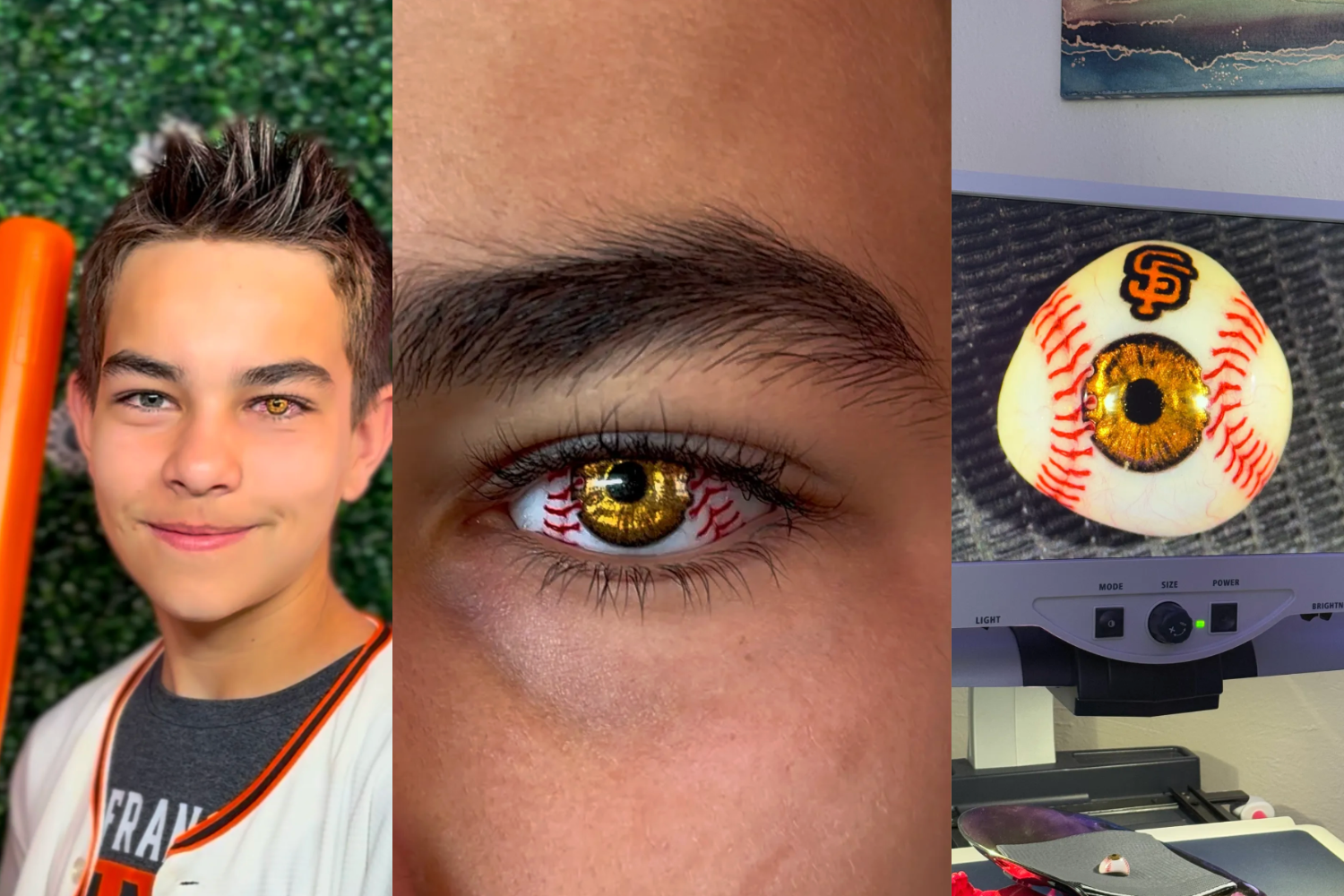
The Bonds’ dedication to their service has been just as rewarding for them as it has been for their patients. Hannah Bond met her best friend through EYEMKR, who happened to be the spouse of one of her patients.
“This practice has brought me to people that I never would have met if I weren’t in the position to help them, and in turn, that love is received on both ends,” Hannah Bond said. “To be able to be a part of someone’s life in this capacity, from seeing the smiles on their faces to getting the hugs at the end, is truly a feeling that I can’t describe. I just get goosebumps, like I know that we’re doing the right thing.”
Service providers that provide holistic care, like the Bonds, are rare because the profession of ocularistry is not a conventional occupation. Most people never interact with an ocularist in their entire life — according to The New Zealand Medical Journal, just 0.1% of the world’s population wears a prosthetic eye. Even for those who do, the profession is certainly not easy to enter.
“You just have to beg people you know and beg them for an apprenticeship,” Dylan Bond said.
According to Southeastern Ocularists, Inc., working as an ocularist requires a diverse set of skills, from the seven-year certification process to establishing long-term trust with patients. Ocularists are also not just doctors or medical professionals; they are artists.
“There’s no traditional way of learning the craft of ocularistry; you have to find the right person to apprentice under. The training is five or more years of intense training. Also, being able to take care of people and becoming a caregiver, that alone itself, many people are unable to do,” Hannah Bond said. “Some people may have chairside manners, but maybe they’re not a great painter or sculptor. So it really takes a certain person who has both artistic abilities and the ability to work chairside with a patient.”
In January 2025, the World Health Organization released a document highlighting the importance of compassion as the core value of healthcare.
“You have to learn to love people because it’s a very intimate profession. You’re six inches away from people’s faces,” Dylan Bond said.
As small-business owners, Hannah Bond and Dylan Bond have faced some hardships in keeping the lights at EYEMKR on. According to Roche, most ocularists are self-employed and own their own small businesses.
“With the financial struggles, unfortunately, it has been difficult for providers. At times, there were moments when Dylan and I thought we might have to close our doors because insurance doesn’t pay us, or people just simply don’t have the resources to pay for a prosthetic eye,” Hannah Bond said. “Gosh, if we could be like Oprah Winfrey and just give everyone free eyes, I think we would. We just love it so much.”
The costs of running EYEMKR include the ocularistry license, business insurance, business operations, student loans and the needs of their family. Despite these financial challenges, though, Hannah Bond and Dylan Bond absolutely love what they do and wouldn’t change it for any other profession in the world.
“The people that we connect with, it just feels like we’re meant to be together in a way, like we were meant to cross paths. Those are the people you really want to hold dear,” Hannah Bond said. “Then being able, as husband and wife, to work together, create something together and watch it grow is kind of like having a child. We birthed EYEMKR and now it’s about the age of a toddler, so it’s starting to walk, and if it falls a little bit, we pick it back up.”
The Bonds have merged their professional and personal worlds to build a business made of love and dedication. Their choices in shaping EYEMKR have guided the passion and impact of their craft.
“Yes, we’re creating prosthetic eyes, but to create a business, to create a place where people can go to experience healing and find a piece of themselves has been beautiful,” Hannah Bond said. “We pray that it keeps evolving, so that we can open our doors to more people and invite more ocularists interested in learning how to make eyes.”
