


When animals are faced with extinction, they have three options: move, adapt, or die.
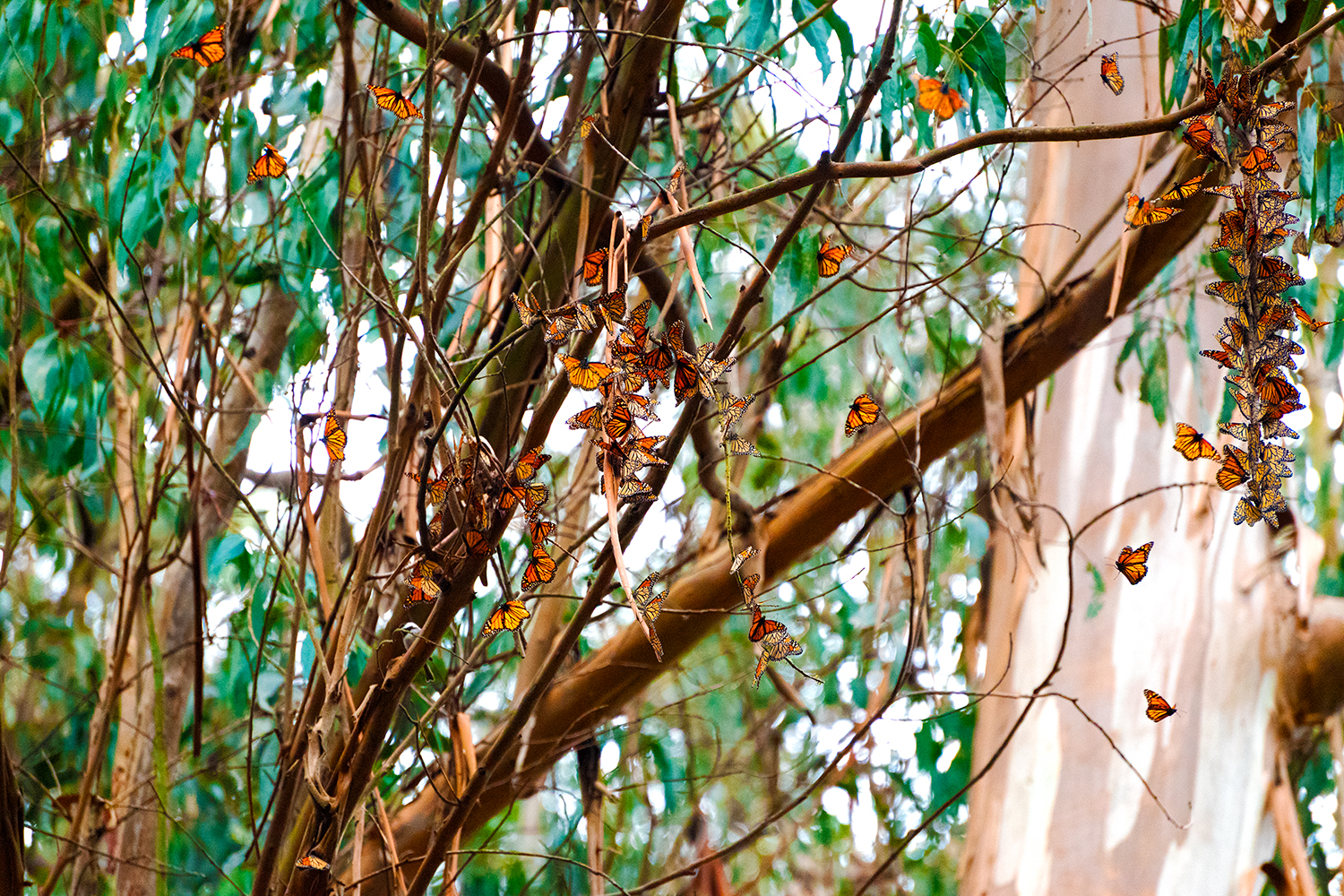
Every year, the western monarch butterfly migrates from west of the Rocky Mountains to the coasts of California, expecting to find large forests of Monterey pines and eucalyptus trees, as well as an abundance of milkweed native to the region, to protect and nourish them during the harsh winter months. These locations cater to the needs of the butterflies and are known as overwintering sites.
From late October to early March, one generation of monarchs, known as the super generation, lives in the protection of these groves, conserving energy and waiting for the winter months to make way for the arrival of spring.
Dependent on the increase in temperature — an attribute correlated with the thawing of winter — to tell them when to continue their annual migration, monarch butterflies, in recent years, have been deceived. With sudden heat waves along the coasts of California, western monarchs will prematurely leave their overwintering sites, only to encounter harsh conditions further inland.
“Climate change is really disrupting their timing and exposing them to unprecedented heat waves. Sometimes, they leave the overwintering grounds in January because there is a heat wave, but then they’re exposed to winter conditions inland. So the cues that they used to use for when to migrate have gotten crossed,” said Stuart Weiss, the chief scientist at Creekside Science.
The inability to correctly navigate warming climates is one of the three primary threats that monarchs face today, contributing to the species’ decline in population.
The big three
Climate change, pesticides, and habitat loss are three critical threats that have detrimental impacts on many insect species worldwide, particularly the monarch butterfly, according to the Xerces Society for Invertebrate Conservation.
“When I think about insect decline in general, I think broadly of three really big areas which are all intertwined. That’s habitat loss, climate change, and pesticides. I don’t think about any one of those as the issue. I think about all of those as major issues,” said Cheryl Shultz, a professor and graduate program coordinator for the School of Biological Sciences at Washington State University.
Western monarch butterfly tracking began in 1997, with the Western Monarch Butterfly Count. Since then, the species’ population size has decreased massively. What started at 1.2 million butterflies in 1997 has now dwindled to around 10,000 in 2024, according to Xerces Society. That is a 99% decrease in population size in 27 years.
“Last year, there were 10,000 monarchs. The crisis year was 2020, when there were less than 2,000,” said Mia Monroe, the lead coordinator and founder of the Xerces Society’s Western Monarch Count.
Volunteers and community scientists conduct the annual count over the butterflies’ overwintering season, before they have had the chance to reach their breeding grounds. During this time, many western monarchs seek shelter from the violent storms and cold temperatures off the California coast; however, with habitat loss, fewer and fewer butterflies can do so.
“So many have been lost due to coastal development, not managing a site to favor regrowth of trees in formations that monarchs like, and cutting trees for the view and agriculture,” Monroe said.
The loss of overwintering sites is what habitat loss looks like for the monarch butterfly, as without protection, its delicate wings would not be able to survive. However, the monarch is not always a butterfly.
Before they can spread their wings, the monarch must undergo metamorphosis, transforming from a caterpillar to a butterfly. During their time as a caterpillar, the only food source they have is milkweed, according to the United States Department of Agriculture. With many different types of pesticides in use, the resources needed to survive are often destroyed by harmful chemicals, one of the most common being glyphosate.
“Glyphosate or Roundup is a herbicide that basically kills all plants. If you kill plants, then you’ve killed all the food the butterflies need to eat. So the effect of glyphosate is not so much that the pesticide itself, as a toxin, stays in the environment, it’s just that once you’ve killed all these perennial plants, you need to replant them,” Shultz said.
Killing perennial plants, which are plants that last for more than one year, such as milkweed, is not the only danger pesticide usage poses to the environment. Although the breakdown of glyphosate in the environment is relatively fast, according to Schultz, some pesticides aren’t as fortunate, remaining in environments for long periods and contaminating numerous plants over multiple generations.
“If you’re looking in the long run, there was a lot of habitat loss in the 1970s and 1980s when they came up with clean farming in the Central Valley that got rid of a lot of milkweed habitat. Now the milkweed in the Central Valley is so contaminated by pesticides that it is not a good idea to use it,” Weiss said.
Pesticide use and habitat loss are both incredibly harmful to the monarch, creating uninhabitable spaces for regrowth and degrading land, respectively. This, in turn, leaves monarchs increasingly vulnerable to harsh climates, which are driven by climate change or extended shifts in temperature and weather patterns, according to the United Nations.
“In addition to habitat losses from land conversions, climate-related stress can cause further degradation to remaining habitat conditions, limiting the resources available to monarchs even further,” said Wendy Caldwell, the executive director of Monarch Joint Venture (MJV).
Climate-related stress can be observed through heatwaves, wildfires, and atmospheric rivers, which have intensified in recent years due to the effects of climate change. Without the necessary habitats needed for protection, many butterflies are left more vulnerable to these stressors than ever before.
“Last summer, in late June and July, there was record heat for weeks, and that kind of cooked a whole generation of monarchs in the breeding range,” Weiss said.
The heatwave Weiss is referring to was the heat dome that happened in the summer of 2024. Heat domes, according to National Geographic, are a phenomenon in which high atmospheric pressure forms a dome over a region, causing dangerously high temperatures that can last for days or even weeks. In 2024, there were two that caused very steep declines in western monarch populations.
“One of the heat domes happened in July, which was the peak of the population throughout the West, and we think it cooked the butterflies in the breeding areas. We had another heat dome in September 2024, and that was when they should have been migrating. It was too hot to migrate, and a lot of them couldn’t find refuge and were cooked,” Monroe said.
Heat domes are just one of the many climate stressors monarchs are experiencing at a more severe level as a result of habitat loss. Another stressor that has increased in recent years in California is the occurrence of atmospheric rivers.
“Successive, frequent atmospheric rivers are days when there is a lot of rain. It’s really devastating to monarchs and their overwintering sites because they can’t hold on. The wind is great and the rain is pummeling them,” Monroe said.
At the end of the day, all three of the main threats to Monarch butterflies are impacted by one another. Pesticide usage deteriorates the habitat needed for monarchs to survive, and habitat loss further subjects the butterflies to the harsh conditions of today’s climate.
However, amidst the tragedy, there is hope. Monarchs have learned to adapt, displaying their resilience for the world to see. They rebounded their population from a record low in 2020, and are slowly learning to thrive in a world contaminated by human actions.
“If we continue to get the types of heat waves we had in the summer of 2024, it’s going to take its toll. The good news is that monarchs can recover very quickly if conditions are good, because they go through four generations over the course of their migration,” Weiss said.
Adaptations: old and new
For years, the monarch butterfly’s population has been decreasing dramatically. They have suffered from habitat loss, climate change, pesticides, and numerous other factors. Yet, for as long as these threats have existed, they have been opportunistic, finding ways to adapt and thrive during some of the hardest of times.
“Monarchs are very resilient and very adaptable. All the native trees were cut a couple of hundred years ago, and eucalyptus was planted. Eucalyptus is now the tree they use to roost in,” Monroe said.
These trees, planted along the California coast, serve as overwintering sites, protecting the western monarch from climate-related stressors. Initially, monarchs only latched onto native tree species; however, they have since become accustomed to the eucalyptus tree.
“We planted these eucalyptus trees all up and down the coast, and those groves have naturally expanded, creating conditions where monarchs flying by can find that wind-sheltered, sunny nook and start using it,” Weiss said.
The western monarch’s change from native Monterey pines to the eucalyptus tree is one of the species’ older forms of adaptation, as these groves across the Santa Cruz mountains have had time to grow and expand with nature since they were first planted in the mid-1800s, according to the United States Forest Service.
Additionally, one of the more recent adaptations the butterfly has undergone in coastal California is the formation of resident, non-migratory populations.
“This kind of overwinter breeding has been occurring in Southern California for decades now. But now it’s getting warm enough as we come up to the Bay Area that it can work here as well,” Weiss said.
As a result of warmer climates, western monarchs are starting to forgo their annual migration, opting to stay in the Bay Area all year round.
“As the days shorten and it gets a little chillier, monarchs used to get the urge to migrate and come to the coast, but now it seems like some of them don’t leave and just keep breeding and don’t get the urge to migrate,” Monroe said.
There are several reasons behind this phenomenon, one being that temperatures are changing, but another is the increasing number of evergreen milkweed sprouting across the Bay Area, according to a study conducted by researchers from the University of California (UC), Davis.
“There are two causes. One is that people have planted this species of tropical milkweed, which doesn’t die in the winter. So there’s year-round food for the caterpillars. The other is that the temperatures are rising in the winter, so the monarchs can keep breeding if they decide to,” Weiss said.
This adaptation, made by Western monarchs in the Bay Area, has caused resident populations to be isolated from migratory counterparts, according to the study by researchers at UC Davis. However, despite the lack of interaction, according to Weiss, it remains unclear whether these branched-off populations will pose a threat to the traditional monarch.
“Scientists and conservationists just love to argue about things, so I would say the jury is still out on whether it’s a threat to the migratory population,” Weiss said.
Ultimately, regardless of whether resident populations are a pro or a con, it is a sign of the western monarchs adapting to their surroundings. The western monarch faced devastating numbers in 2020 and has since rebuilt its population. When the butterfly was on the brink of extinction, it chose to adapt and survive. Whether these populations will permanently alter the butterfly’s nature or not, its adaptations are a source of hope for the future of the species.
“It shows the adaptability of the monarchs. They’ll take advantage of any opportunities, and I think it is kind of a symbol of hope,” Weiss said.
A symbol of hope
Monarchs, like other pollinators, play a crucial role in ecosystems, from fertilizing plants to being a part of the food web in their adolescent stages. Although they are not the most effective pollinators, according to MJV, they still do have a tremendous impact on the environment.
Monarchs are what you would call a flagship species, which, according to MJV, means that they inspire engagement, conservation, and are an overall symbol of the health of the environment.
“It’s hard to get people engaged and to care about biodiversity. When you talk about a monarch butterfly, you capture people’s attention and get them engaged, wanting to go out and watch wildlife, see wildlife, and experience it,” Shultz said.
Part of the reason monarch butterflies are such a large factor in inspiring insect conservation efforts is that they are one of the most famous butterflies in the world, easily recognized by their distinctive and vibrant wings. Another is that, unlike other insects and pollinators, like bats and wasps, which may evoke fear or disgust in individuals, monarchs evoke opposite sentiments, such as wonder, excitement, and curiosity.
“Everybody just gets this kind of dumb smile. They are like ambassadors of the insect world to human beings, because a lot of people get icked-out by insects, but it’s hard to get icked-out by a monarch butterfly,” Weiss said.
Although reactions to these insects are polar opposites, one thing that they do have in common is abundance. Monarchs, like bees and bats, can be found in a person’s backyard across California. This proximity, along with its striking appearance, is, in part, why so many people have become engaged in conservation efforts, as they have realized that helping is not complex and can mean planting nectar sources in their local garden.
“One of the neat things about pollinators is that there are so many ways for people to get engaged at the level where they’re at. For people living in cities who want to experience pollinators, they can plant nectar sources, milkweeds, and other kinds of host plants for butterflies,” Shultz said.
Although simple, these actions are one of the most impactful ways a person can become involved in conservation efforts, according to Monroe. However, when it comes to milkweed, there are specific rules a person must follow.
“If you are more than one mile from the ocean, you can plant milkweed, and we encourage you to plant native milkweed, and the more the better. The loss is so great in our lifetime we might not be able to plant enough, so we need to plant, plant, plant,” Monroe said.
The location where you plant native, non-evergreen milkweed is not the only factor to consider, as when you plant it is just as important.
“One thing that we can all do if we live on the coast or in San Carlos or Belmont is to plant nectar plants for monarchs at the right time. So, for example, in San Carlos and Belmont, planting nectar plants that have that flower in the fall and the early spring is important because the monarchs are moving through San Carlos and Belmont to get to the coast now, and in the spring, they’ll be moving inland,” Monroe said.
Planting milkweed and contributing to habitat loss is one of the easiest conservation strategies for monarchs, as it is the most tangible of the three threats to address. By rehabilitating their habitat, communities across the California coast will be able to see them live another day.
“The more habitat we have, the better we are able to deal with other threats, like climate change and pesticides,” Shultz said.
Contributing to conservation efforts and restoring monarch habitat will not only increase their protection during the overwintering months but will also increase their population size, reflecting positively on the health of the environment.
At the end of the day, monarchs are a flagship species, not only indicating the status of the environment but also increasing conservation efforts through their popularity. Their adaptability demonstrates the environment’s ability to recover from times of peril and is a characteristic that everyone in the world can admire and be inspired by.
“In this day and age, monarchs are a symbol of hope. They fly free. They’re beautiful. They motivate us to have a better world, and there is something each of us can do to help them,” Monroe said.
