


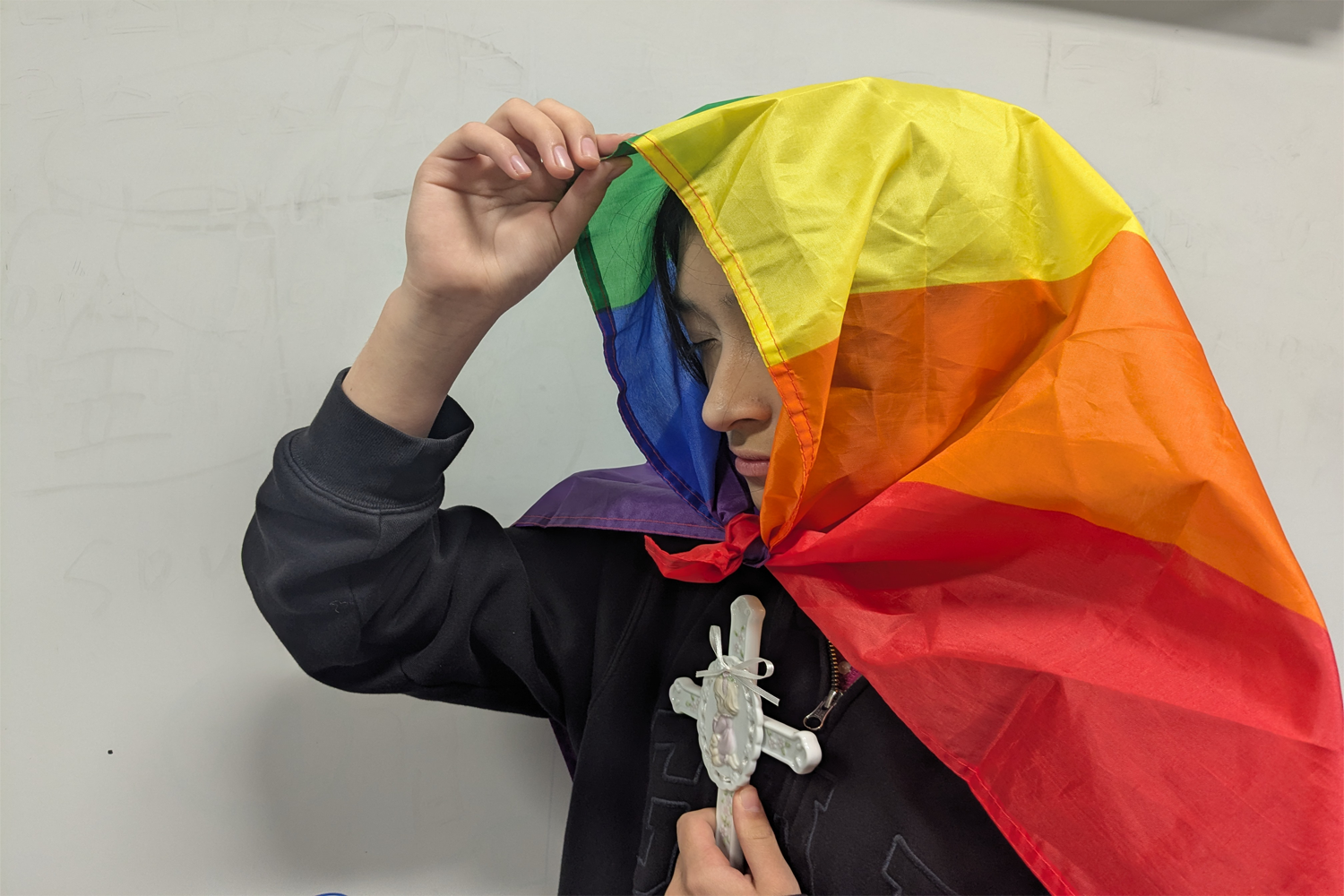
As she went through school, a sense of fear began to form inside Rachel Smith’s mind.* Restless feelings encompassed her body. That morning, she had slid a note into her mother’s laptop, confessing her sexual identity to her Catholic mother.
She was a lesbian.
“My ideal reaction would have been something like acceptance,” Smith said. “But without change to the underlying beliefs she believes in.”
Back home, however, her mother’s reaction was anything but welcoming. She told her that her sexual identity was a sin and that she had to change immediately.
These sharp words confirmed that her mother would be unable to accept her for who she was. Her mother’s religious beliefs served as a barrier against acceptance.
“She was really upset,” Smith said. “My mother was talking to me about how this is disrespecting the church and the priests.”
There was also a weeklong period of silence between the two. Smith had no other parent to turn to — she was too scared to come out to her father. Still, Smith stayed true to her own beliefs, refusing to think that she would be subject to eternal damnation just because of her sexuality.
“I don’t believe being gay has anything to do with having a sin upon you,” Smith said.
Despite Smith’s determination, her parents’ stern beliefs meant they could not acknowledge her identity. Both were staunch Catholics, and it would be difficult to change their minds.
“My dad went to Catholic school. He’s very against that,” Smith said. “My mom was raised Catholic, and the beliefs for Catholics were rooted in her as a person.”
Smith’s stunning announcement also shattered her mother’s hopes for her.
“She had her own opinions that were rooted in Christianity. She didn’t want this for her daughter,” Smith said.
The church, traditionally a place of religious sanctuary for many, had become more like Hell for Smith. Smith faced a priest who expressed his anti-LGBTQ+ sentiments out loud. Every hurtful sermon stuck with her, and it was a constant reminder that her identity was not legitimate to the leaders of her church.
Caught in the crossfire
Smith’s situation of being both Catholic and LGBTQ+ is not uncommon. According to the Williams Institute, an estimated 1.3 million Roman Catholic adults identify as members of the LGBTQ+ community.
Yet the Catholic Church has always had a complicated relationship with the LGBTQ+ community. At Pride rallies, anti-protesters often cite their religious beliefs, which are frequently Christian. Displays of hostility, such as gay-bashing, which happen both inside and outside the Church, are harmful to victims.
“The experiences of my students within the Christian Church tend to be marked by either themselves being targeted in different ways for their sexuality, or the pain of being witnesses to friends who were targeted in different ways,” said Jorge Aquino, PhD, a professor in the Department of Theology and Religious Studies at the University of San Francisco.
Intolerant teachings from Catholic institutions are incredibly detrimental to young people, particularly those who are members of the LGBTQ+ community.
“Unfortunately, a lot of the clergy and folks in the institution have a way of teaching about sexuality in a way that is really psychologically destructive for young people,” Aquino said. “For a lot of folks at that age, if their sexuality is vilified by the institutional church, especially if that is accompanied by images of eternal damnation, that can be devastating.”
According to the National Library of Medicine, Jewish and Christian sexual minorities have a higher chance of suicidal ideation than others in the same religious group.
Suicide, along with depression and other harmful issues, can befall those whose sexual identities are repressed by the Church, according to Aquino.
“While the Church might blame sexual cultures or people’s choices about sexuality, the reality is, the Church itself is the background for a lot of the struggles,” Aquino said.
For Smith, the struggles came in various forms.
“When I was discovering all this stuff and my identity, and I was telling people about it, I think the main problem was how people were reacting to it,” Smith said. “People viewed me differently after that, when nothing had actually changed. That brought my spirits down a bit. I was telling myself not to tell people, but it was a part of my identity that I wanted to tell people.”
Interpreting the scripture
“You shall not lie with a male as with a woman; such a thing is an abomination.”
While this passage, Leviticus 18:22, can be understood to condemn homosexuality, that may not be the case. For example, an essay in the James Madison Undergraduate Research Journal presents a different perspective: the passage prohibits intercourse between a man and a married man.
The biblical story of Sodom and Gomorrah recounts the destruction of two cities for their sins. One particular passage in the tale, Ezekiel 16:49-50, states, “Behold, this was the guilt of your sister Sodom: she and her daughters had pride, excess of food, and prosperous ease, but did not aid the poor and needy. They were haughty and did an abomination before me. So I removed them when I saw it.”
The “abomination,” according to Britannica, was thought to refer to the homosexual acts the people of Sodom attempted to commit. However, as with Leviticus 18:22, a conflict arises between different interpretations.
“To me, the dominant reading of the Sodom and Gomorrah story is not about sexuality but about hospitality,” Aqunio said.
The question of whether the Bible comes directly from divine beings, unadulterated and unaltered, further complicates matters.
“The Church never denies that the Bible was impacted by surrounding cultures when it was written. The Bible was impacted by so many aspects of the world because it was written as a religious book,” said Andrew Choi, a transitional deacon of the Catholic Church.
Different verses with conflicting ideas confused Smith, rendering the Bible, a crucial source of strength for her religious understanding, a jumble of contradictions. Was it okay to be a lesbian or not?
Changing views over time
In 1986, the Church released a document advising bishops on how to care for homosexual individuals. The document referred to homosexuality as an “intrinsic moral evil,” displaying disapproval of homosexual individuals.
“I think the document is not a part of the Church itself. I think it’s part of the people who make up the Church. I think their ideas are limited to what their beliefs were before, and not just their beliefs in the Catholic faith,” Smith said. “I just don’t believe that it’s part of the Catholic faith itself to not be gay.”
Since then, the Catholic Church has grown more accepting of LGBTQ+ individuals. In December 2023, Pope Francis, the former head of the Catholic Church, permitted same-sex couples to receive blessings.
The pope’s kindness towards LGBTQ+ individuals was a breath of relief for Smith.
“I felt good when Pope Francis expressed acceptance towards the LGBTQ+ community,” Smith said. “I think as a Christian, you should be good to all people.”
However, a lack of consistency remains among the clergy. For example, Father James Martin, a Catholic priest, has acted as an advocate for the LGBTQ+ community. On the other hand, in 2023, Cardinal Gerhard Müller expressed disapproval of the blessing of same-sex couples by the Catholic Church.
“I think the field is very divided,” Aquino said. “It’s a culture war within the Catholic Church.”
The divide goes between nations. According to the Pew Research Center, while 76% of American Catholics believe that homosexuality should be socially accepted, tolerance is weaker in places such as Nigeria, where 91% believe that it should not be accepted.
“The Catholic Church strictly distinguishes between the two realms of sexual activities. Based on the teaching about the creation that God created humans as men and women, and the only marriage that is effective and acknowledged in the Church is the marital covenant between a man and a woman,” Choi said. “But we see the tendency to be more inclined to have a more emotional and physical relationship with someone of the same sex in this order. It’s rather like they have no order to be aligned according to what the Church teaches and God intended.”
The future
For Smith, coming to an understanding with her parents about her sexuality will be a long journey, filled with careful steps not to shatter the bond between her family.
“I don’t have any intention of talking about it again, because right now, there’s no tension,” Smith said. “I think I’ve done all I can, but it’s just in terms of her accepting me.”
Continuing to uphold old beliefs may cause the Church to risk losing the hearts of a younger generation.
“The Church is holding to a doctrine that I think is in many ways destructive. I don’t know whether that can change,” Aquino said.
Catholicism is on the decline. According to the Pew Research Center, in 2007, 78% of adults in the United States identified as Catholic. In 2014, the number was 71%, and by 2023-2024, it had decreased to 62%.
The answer to this phenomenon may lie in the Church’s stance against the LGBTQ+ community. Many religions, including Catholicism, have lost members due to their intolerance of sexual minorities. This pattern serves as a warning to one of the largest religions in the United States, indicating that if change does not occur, it risks losing its influence.
“I think accepting the people and allowing them to be there and express their feelings, along with acknowledging that, could be a way to bring them back,” Smith said.
The newly appointed Pope Leo XIV also promised to continue accepting LGBTQ+ individuals.
“The church welcomes everyone to be a member of it so that they can be open to salvation,” Choi said, affirming the pope’s actions.
Despite the progress, there is work to be done.
“I think that without a significant shift in the doctrine that really undercuts the homophobia, the church is indeed still promoting it institutionally,” Aquino said.
An unwelcoming doctrine has not stopped some from being close to the Church. Helena Young,* who identifies as a lesbian, is among them.
“I still attend Church and do altar service. I still care about it,” Young said. “Being queer does not have to conflict with your faith.”
Smith will remain steadfast to her identity, no matter what her parents say.
“Right now, they just reject that one part of me, but they don’t reject me as a person. But if they start rejecting me as a person, I won’t have that,” Smith said.
Furthermore, she has faith that even if she is not accepted by humans on Earth, God will welcome her.
“I think God accepts all types of love. It’s been said many times in the Bible to love your neighbors. There are so many different people we pass by every day, and we tend to judge those who aren’t like us. But I think God creates an image of loving everyone, instead of just a specific group,” Smith said.
Resources for LGBTQ+ Individuals
Being LGBTQ+, religious or not, can be difficult. Issues members of this community face include discrimination, mental health struggles, and harassment. To help, here are some resources for LGBTQ+ individuals.
*This source’s name is changed to protect them from emotional harm. For more information on Carlmont Media’s anonymous sourcing, check out Scot Scoop’s Anonymous Sourcing Policy.
