

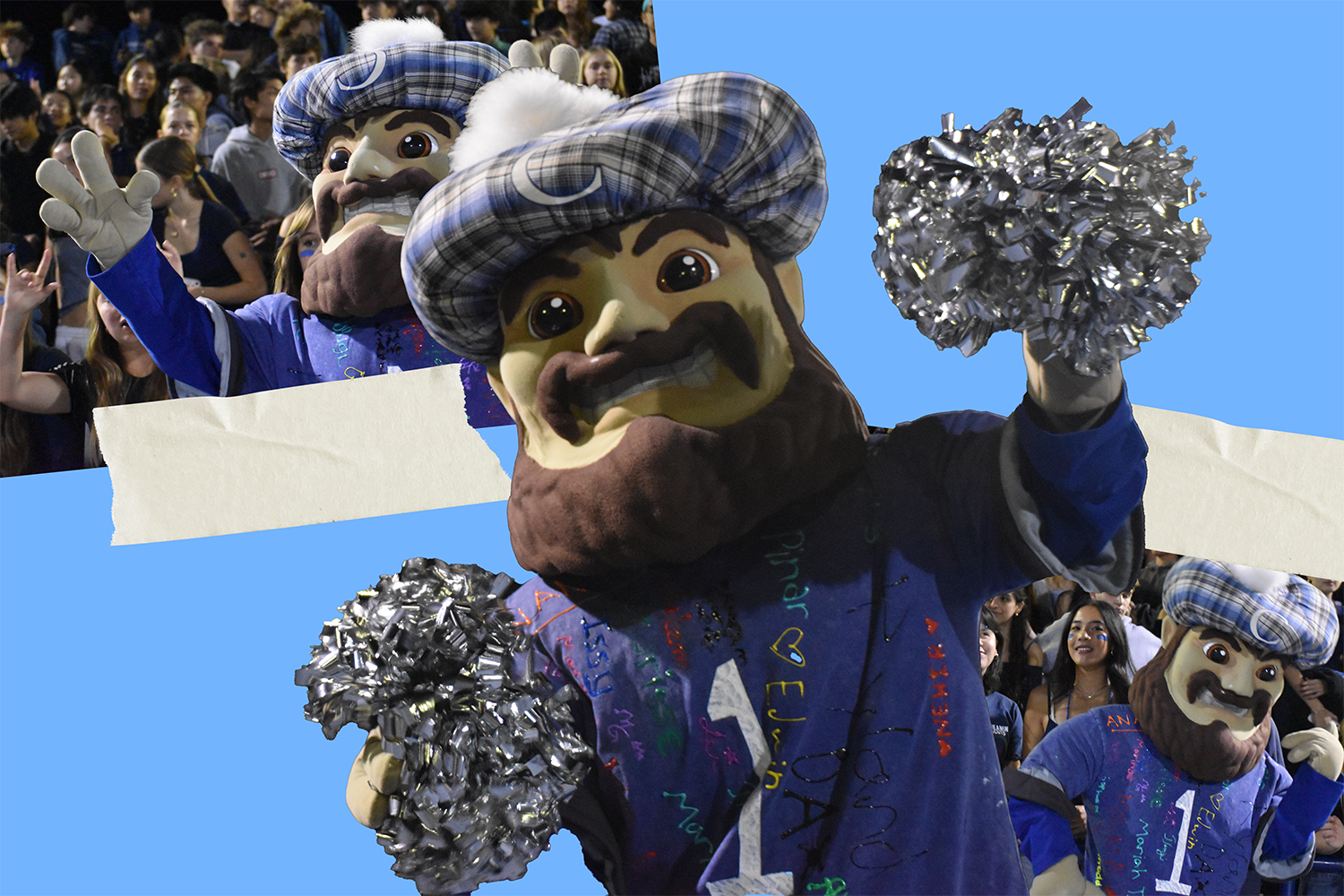
Beneath the furious Friday lights, all eyes flock to the turf. The crowd eagerly observes as 22 sweaty high schoolers throw, kick, catch, tackle, and run.
One sweaty individual remains unnoticed.
Students might not notice him immediately, but Monty’s loud gestures and comical stunts inevitably lure them in. Behind the kilt and unwavering grin, Monty is tasked with a considerable responsibility: to engage the crowd without vocal expression.
In a study illustrated by Aojun Liang, Lin Sun, and Hong Wang, the authors explain that the science behind the attraction of mascots at sports events begins with an animated design. The mascot’s often exaggerated facial expression and large body trigger the part of the brain that bridges the gap between inanimate objects and human-like affinities, explaining a more scientific side to the works of a mascot.
However, engaging the crowd goes beyond just what one can see on the outside and extends into what Monty actually does to represent Carlmont spirit.
“To me, it’s the superhuman qualities, the bigger than life qualities, and Monty having fun,” said James Kelly, the Carlmont ASB supervisor.
Though it’s not commonly regarded as such, school mascots are part of an elaborate performance comparable to one seen on a stage or in a theater. Some may even categorize a school mascot’s work as a form of art, one requiring specific skill sets and preparation that many people don’t consider.
Joseph Espinosa, the supervisor of Carlmont’s Mascot Club, explains Monty’s preparation before he performs in front of a crowd.
“I think he needs to get in the right headspace and get hyped up, just like we all do. We all need to sort of mentally prepare ourselves,” Espinosa said.
Performing arts stimulate the crowd and draw a reaction depending on the performance quality and the level of engagement within the audience. Many performing arts are unspoken, such as various dance forms that convey emotions or responses without the need for words.
Monty is no different. As stated in a research article addressing joint action aesthetics, the emotional stimulation of a crowd induced by the choreography of a performance is not predicted by overall visual motion and acceleration measure, meaning the crowd’s enjoyment levels are less indicated by the quantity of movement and more so attributed to the genuine quality of the actions.
This may change Monty’s approach; rather than quickly trying to entertain the crowd through rapid movements and gestures, he must think about the quality of his actions and carefully select what he does and how often he does it.
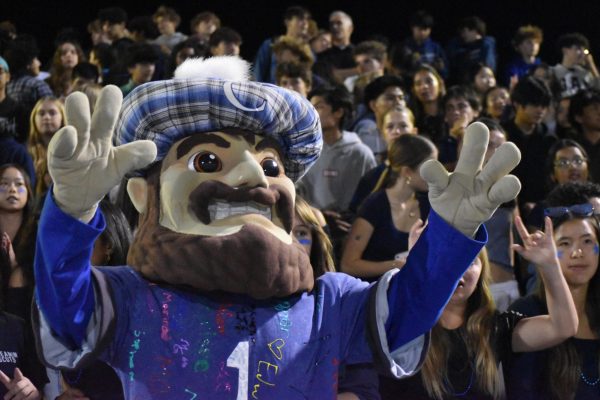
Additionally, providing a symbol to a group of individuals often leads to the group being viewed as a more real and cohesive body. In this case, the idea of a stronger, unified group contributes to how a mascot can unify a school community and represent its beliefs.
“There’s more that we have to offer at this school, things to get kids to like high school more, so the football game is kind of like the party that we throw for the school at the end of the week,” Espinosa said.
Studies reveal that group settings help form bonds among group members and evoke a sense of trust and companionship. Students attending anticipated football games are no exception.
“When kids come to a football game, it builds a positive attitude about school and a friendly atmosphere,” Espinosa said.
According to an original research article written by Bahar Tunçgenç and Emma Cohen, group identities formed in the formative years of one’s life are especially critical to the brain’s development. Those in a group setting often feel more connected to those in the same group, and as a result, experience a sense of unity and inclusion within the larger group.
The purpose of football game nights goes beyond the sport itself, connecting instead to school pride and enhancing unity within the student body. Monty is another piece of the puzzle that ties students together, not only by entertaining the crowd but also by activating the psychological and neural aspects that encourage a sense of togetherness.
Just as a logo or flag might symbolize a brand or country, the school mascot is an unconscious representation of the school body as a whole, transporting beliefs across time and culture.
Monty represents more than a smiling face that students can interact with at a football game. He’s a living, breathing reminder that school pride is something you feel, not just something you watch or talk to. Whether on the sidelines or walking through the bleachers, Monty’s silent enthusiasm speaks volumes to the crowd, encouraging Carlmont spirit.
“Everybody loves to see Monty having fun and being a really positive energy, with high fives and dancing and doing the cheers,” Kelly said.
