

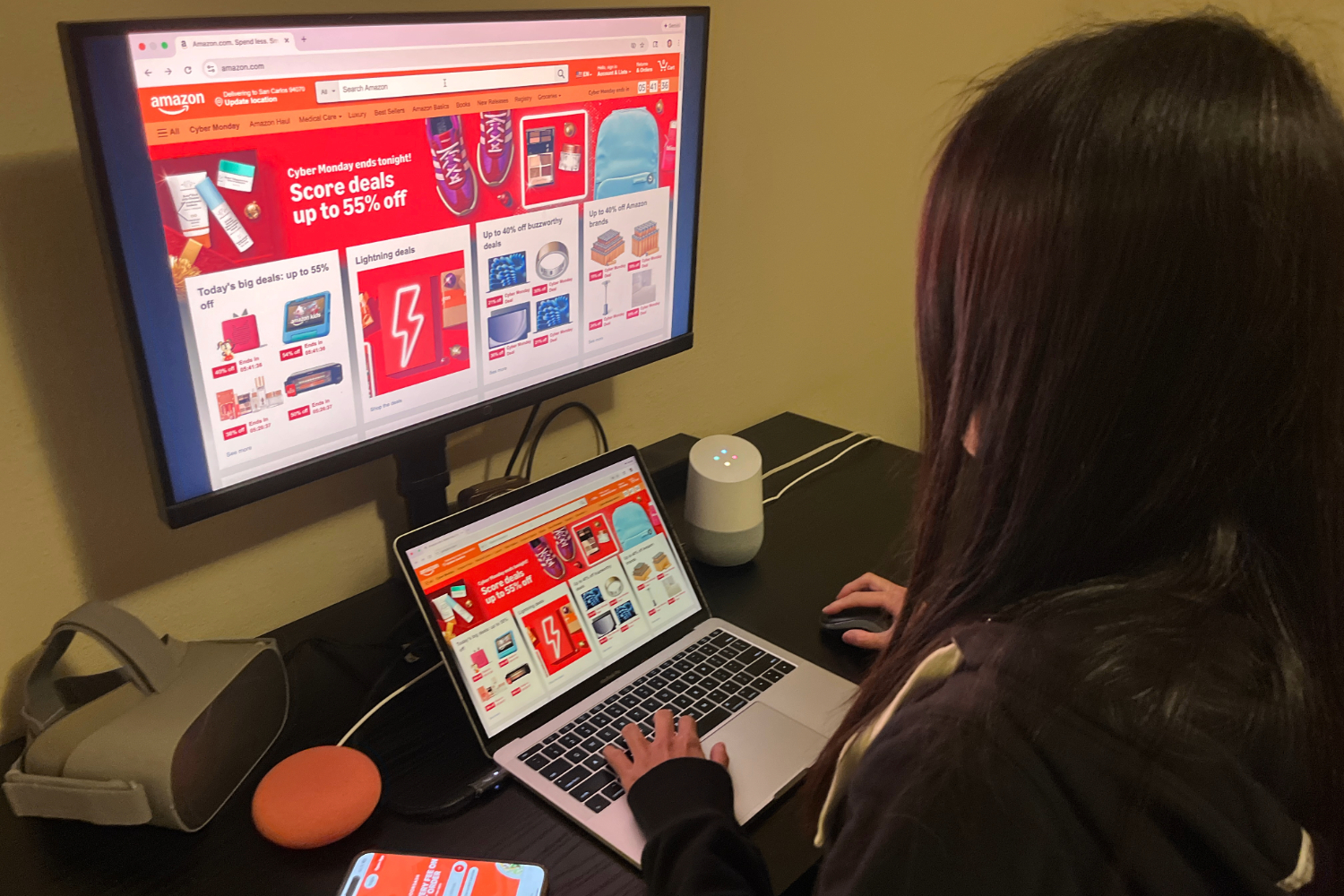
The shift from in-person shopping to online shopping is changing not just how people buy, but how they connect. E-commerce has made life easier, but the opportunity cost of digital convenience is human connection.
Online shopping has become an integral part of our lifestyle. According to a report by The Harris Poll, 86% of U.S. adults shop online at least sometimes.
As more consumers swap credit card swipes at the cashier for digital checkout clicks, the human connection is subtly fading from daily life.
“I used to go to the mall all the time with my parents when I was a kid; they were pretty fun,” said sophomore Alina Robinson. “Now, I’ll go two times out of the year with my parents.”
McKinsey & Company’s State of the Consumer 2025 report shows that consumers are using e-commerce and food delivery services at high rates. More than 90% of U.S. consumers surveyed said they had shopped at an online-only retailer in the previous month.
“I get a bunch of stuff on Amazon, and I use DoorDash at least once a week,” Robinson said.
The appeal of online shopping
Convenience remains the driving force behind the shift from in-person to online shopping. Key benefits include around-the-clock access, avoiding in-person inconveniences such as parking or long lines, ease of comparison shopping, and the availability of multiple delivery options.
“With free shipping and next-day delivery, it’s definitely true that more people are shopping online than in person,” said Jadie Sun, a computer science and personal finance teacher at Carlmont.
In the report by The Harris Poll, 72% of online shoppers cited free shipping as the reason for purchasing online, while 65% cited convenience.
“Our survey shows that 77% of U.S. consumers rated convenience as important and based purchasing decisions on it,” said Michelle Weaver, Morgan Stanley’s U.S. thematic strategist, in a June 2024 podcast. “On average, consumers would be willing to pay about a 5% price premium for convenience.”
The downside of e-commerce
Shopping in physical stores entails casual conversations with staff, browsing with friends, and spontaneous interaction with other customers. Ordering food at a restaurant requires interaction with a server or cashier. These moments are a stark contrast to online experiences, where people browse catalogs and reviews independently. Behind those solo clicks lie risks of social isolation.
A research paper published in the American Medical Association (AMA) Journal of Ethics found that documented internet use patterns suggest the internet increases loneliness, according to Andrew P. Smith, a psychology professor and director of the Center of Occupational and Health Psychology at Cardiff University.
“Excessive e-commerce will contribute to internet addiction and also remove the social interaction found in traditional shopping,” Smith said.
Loneliness is at an all-time high in the United States. In 2023, U.S. Surgeon General Vivek Murthy declared an American epidemic of loneliness and isolation, releasing an advisory on the danger that a lack of social connection causes to health. His advisory highlights why we have reason to be concerned about the harms of technology that displaces in-person engagement, monopolizes our attention, and reduces the quality of interactions.
In a national survey conducted by Harvard Graduate School of Education’s Make Caring Common team and YouGov in May 2024, 21% of U.S. adults reported suffering from serious loneliness, where serious loneliness was defined as feeling lonely frequently, almost all the time, or always. Technology was cited as the top contributor to loneliness.
The problem of social isolation is not limited to the United States. According to the World Health Organization (WHO) Commission on Social Connection, social isolation is becoming a global public health concern with serious impacts on health, well-being, and society. Teenagers who reported feeling lonely were 22% more likely to receive lower grades or qualifications.
“Even in a digitally connected world, many young people feel alone,” said Chido Mpemba, co-chair of the WHO Commission on Social Connection, in a WHO report. “As technology reshapes our lives, we must ensure it strengthens, not weakens, human connection.”
With rapid advances in technology, consumers now have a wide range of online shopping channels to choose from. They can shop directly through company websites and mobile apps, browse online marketplaces, purchase through social media platforms, and, in recent years, even use conversational commerce powered by chatbots and voice assistants. With on-demand shopping available at their fingertips and in the comfort of their own homes, it’s no surprise that more consumers are choosing to shop online.
“When I got a phone in fifth grade, I was exposed to a lot more content and a lot more consumerism, which led me to mass buy products,” Robinson said.
The rise of online shopping
Online shopping originated in the mid-1990s, when the internet boom introduced consumers to a radically new way to shop. Growth was steadily trending upward until the COVID-19 pandemic exponentially accelerated its expansion. When stores closed, delivery platforms became lifelines for food and essentials. Even after restrictions ended, many consumers continued relying on these digital habits.
E-commerce has been growing over the years, as evidenced by the U.S. Census Bureau data from Federal Reserve Economic Data (FRED) showing e-commerce as a share of total retail sales trending upward and reaching a peak of 16.3% during COVID-19.
It is projected to continue on its strong growth momentum. Research firm Forrester predicts that U.S. online retail sales will reach $1.8 trillion by 2029, accounting for 29% of all retail sales.
According to McKinsey’s report, the behaviors that consumers adopted for coping with life under COVID-19 lockdown, namely a reliance on digital connectivity and at-home activities, are now permanent parts of their daily lives.
“DoorDash has been very nice because I get to stay at home and get food delivered to me, and I don’t have to step foot outside,” Robinson said.
Where e-commerce is headed
With online shopping set to grow in share relative to in-store shopping, companies are dishing out the technologies to support it. As a result, more digital shopping options are emerging.
Livestream commerce, which blends entertainment with e-commerce, is now a core sales channel on TikTok Live, Whatnot, and eBay Live. Augmented reality is turning shopping into fun and immersive experiences, enabling virtual try-ons and 3D product visualizations. Agentic commerce, artificial intelligence systems that act on behalf of the customer, anticipate needs, take initiative, and make purchasing decisions aligned with user intent.
However, one concerning theme remains: every new digital channel lacks organic human interaction.
“Amazon launched Rufus last year. It’s the ability for someone to have a conversation with a chatbot. They use generative AI technology,” said Arundhuti Poddar, a former employee of Amazon who used to work on the creation of Rufus.
For food and grocery delivery, even limited human interactions during quick door drop-offs are decreasing. Companies are introducing drones and autonomous robots for fast, contactless delivery. Robots are already operating in several cities through partnerships between food delivery platforms like Uber Eats and DoorDash, and robotics companies like Serve Robotics and CoCo Robotics. Waymo is testing driverless cars for deliveries through its partnership with DoorDash in Phoenix, Arizona. In these instances, customers simply track and unlock their orders via a mobile app — no human required.
These technological enhancements and operational improvements to support e-commerce growth are enticing consumers to shop more digitally.
Creating space for connection
In an age of unprecedented digital convenience, staying socially connected requires intentional effort.
Some consumers, like Poddar, are choosing a hybrid approach to their purchase process, browsing online first before making an in-store purchase, allowing them to interact with someone in the physical store.
“I will go see Macy’s online and make a shortlist, then go to the store to actually make the purchase,” Poddar said. “I am probably the exception, but I feel like I value the interaction.”
Convenience may be irresistible, but social connections are what ultimately suffer.
“There was a sense of community. If you wanted help, you could just ask someone. Online shopping has taken all of that out. The convenience has replaced the community you have built,” Poddar said.
