


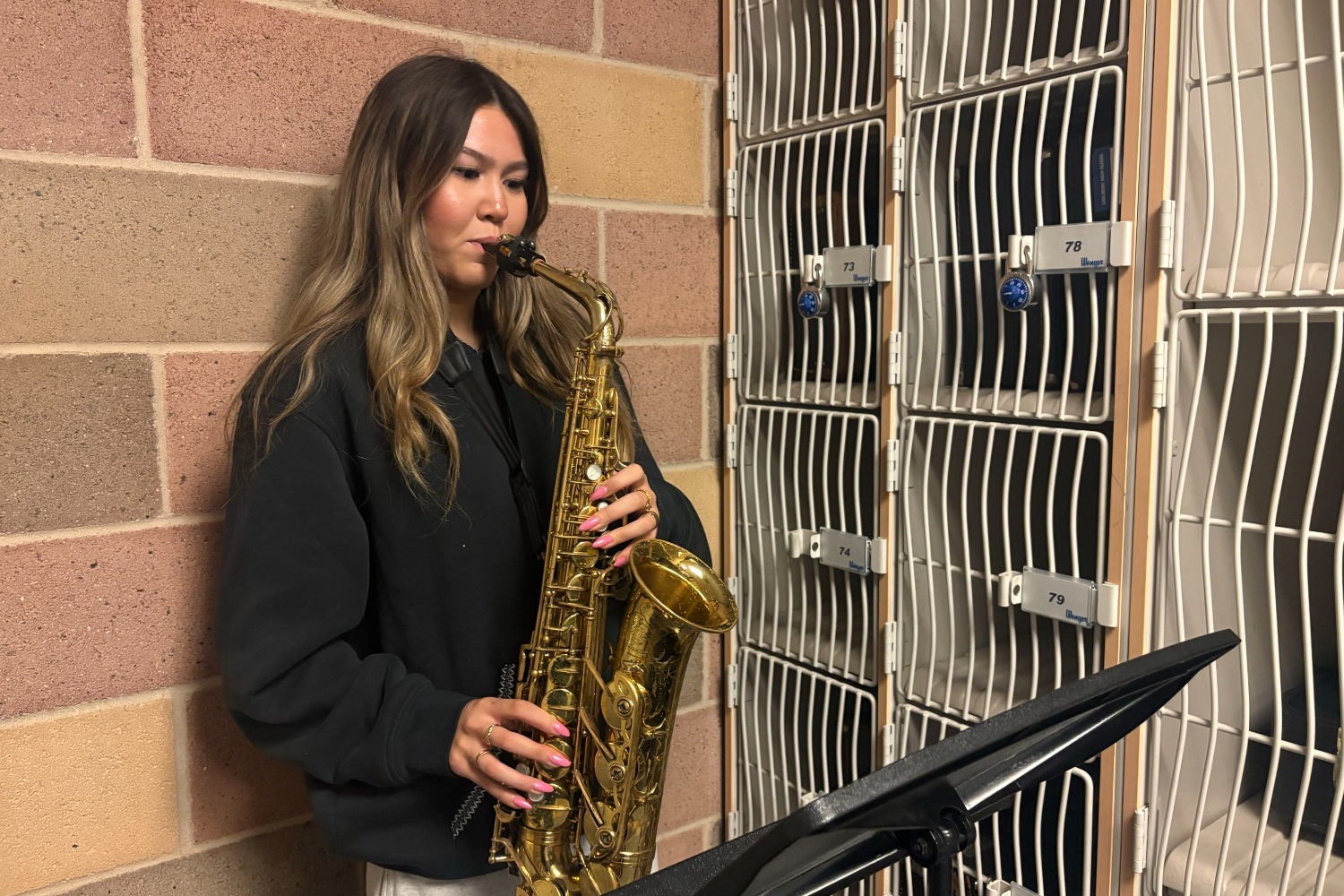
For many students, music serves as a powerful emotional outlet. It is a safe space for them to release tension or channel feelings that are difficult to express in words.
Between exams, sports, and extracurriculars, finding moments of calm can be difficult, but for young and aspiring musicians, playing and practicing music offers that peace and pause in their lives. It becomes a personal form of reflection, relief, and emotional understanding amid the pressures of academics and social life.
“Music helps me get clear with my emotions and figure out what I’m really feeling. It helps me calm down so I don’t wind up saying anything I don’t want to say if I’m upset. It’s also a place I can go when I’m happy and just be happy,” said Miriam Kurtic, a sophomore musician at Carlmont High School.
This personal experience reflects broader scientific findings. A systematic review by the Multidisciplinary Digital Publishing Institute that analyzed data from upwards of 2,000 children, found that music education significantly improves emotional recognition and regulation, while reducing learning anxiety and aggression.
“When I’m playing music, or after I practice, I’m more grounded, and I feel a lot more focused and present,” said Ruthie Alcazar, a member of the Palo Alto Chamber Orchestra.
Beyond relaxation, music encourages students to think radically and outside of the box. Learning to play, compose, and perform demands the problem-solving, patience, consistency, and attention to detail that academics and other parts of life require on a daily basis. In creative spaces like practice rooms or on stage, students learn to express their emotions and ideas in ways that words and lyrics cannot fully capture.
When I’m playing something that’s very exciting and fast, I feel more excitement. And sometimes when it’s more beautiful or if it’s more of a legato type of music, I feel a lot calmer,” Alcazar said.
Additionally, music has been found to contribute to academic success. A study conducted at the University of British Columbia found that music training develops executive functions, including self-regulation, working memory, and mental flexibility. The same problem-solving and attention to detail required in music translate directly into academic success. Students highly engaged in instrumental music are academically ahead of their peers by over one year, scoring higher across English, mathematics, and science.
“Someone brought up to me years ago that music was one of the few subjects that incorporates multiple subjects, such as physics, math, and language,” said Robert Farrington, a professional musician and tutor.
Music is also a way for students to be together and form bonds that words couldn’t. Whether through an orchestra, a band, or just jazz sessions with numerous improvisations, shared rhythms and ideas foster friendships and teach collaboration. In a school setting where competition often dominates, music offers a rare sense of unity. Students learn to listen to both each other and themselves.
“I teach all my groups about blending and not sticking out unless you’ve got a solo. But if not, you’re blending with everybody, so you have a beautiful sound, you’re playing in tune, in time, and playing the dynamics with everybody,” Farrington said.
This emphasis on blending and listening extends beyond sound quality. A study by universities in Hungary revealed that group musical activities promote prosocial skills, empathy, and team collaboration. The collaborative nature of ensemble playing, where success depends on every member listening and adapting, develops social competencies that benefit students in all group settings.
Performing is also a crucial part of music and a defining factor in shaping students’ musical development. From countless hours of practice and rehearsal, determination and focus are revealed in a satisfying sound that convey a story to audiences in just a few minutes. While the audience only sees a finished product, students see it as an opportunity to grow and show what they’ve been working towards for months.
For Lauren Sobajic, the lead saxophone player for Carlmont High School’s jazz band, and a participant in various prestigious music programs, this experience has been nothing but familiar; yet, she still strives to improve her focus each time.
“It’s important to lock in and really enter that flow state before you get on stage. That way you know what you’re trying to do before you’re there,” Sobajic said.
As rehearsals, sectionals, and performances build up over the years, music becomes a second home for many. The rooms where mistakes turned into breakthroughs and nerves turned into applause are places students never forget. For some, the impact shapes not only who they are, but who they want to become. Sobajic finds that music has been a means by which she derives value from various situations.
“It’s taught me how to be a good leader, help out other students that are younger, and put out a supportive energy into a group,” Sobajic said.
The impact may also go beyond high school. Students planning to pursue music after graduation view it not just as a passion, but as a pathway. Pursuing a music major means balancing creativity with uncertainty, as careers are built on talent and perseverance. However, for those who have committed to a career in music, music becomes much more than a dream; it is a future defined by expression and purpose. This journey often begins with realizing that music is not just an activity but a calling.
“When I was younger, it felt like it was something that was being pushed on me. However, when I met people who genuinely enjoyed it, they inspired me to find enjoyment in it myself, and it eventually became a passion for me,” Sobajic said.
Even for students who don’t plan to study music professionally, lessons about perseverance, discipline, and emotional awareness stay with them. These lifelong habits are shaped by their current practice and performances, acting as a pillar to support their success. As they grow, music continues to play in the background, reminding each and every artist about balance, growth, and self-expression that carry into adulthood.
And for those like Sobajic, music becomes more than a memory. It becomes the voice guiding them forward, the rhythm they return to, and the foundation on which they build the rest of their lives.
“My dad played an instrument, and all my siblings and I play an instrument too. So keeping this musical, familial legacy going would be a big dream of mine to make sure that the music aspect is always in my life,” Sobajic said.