


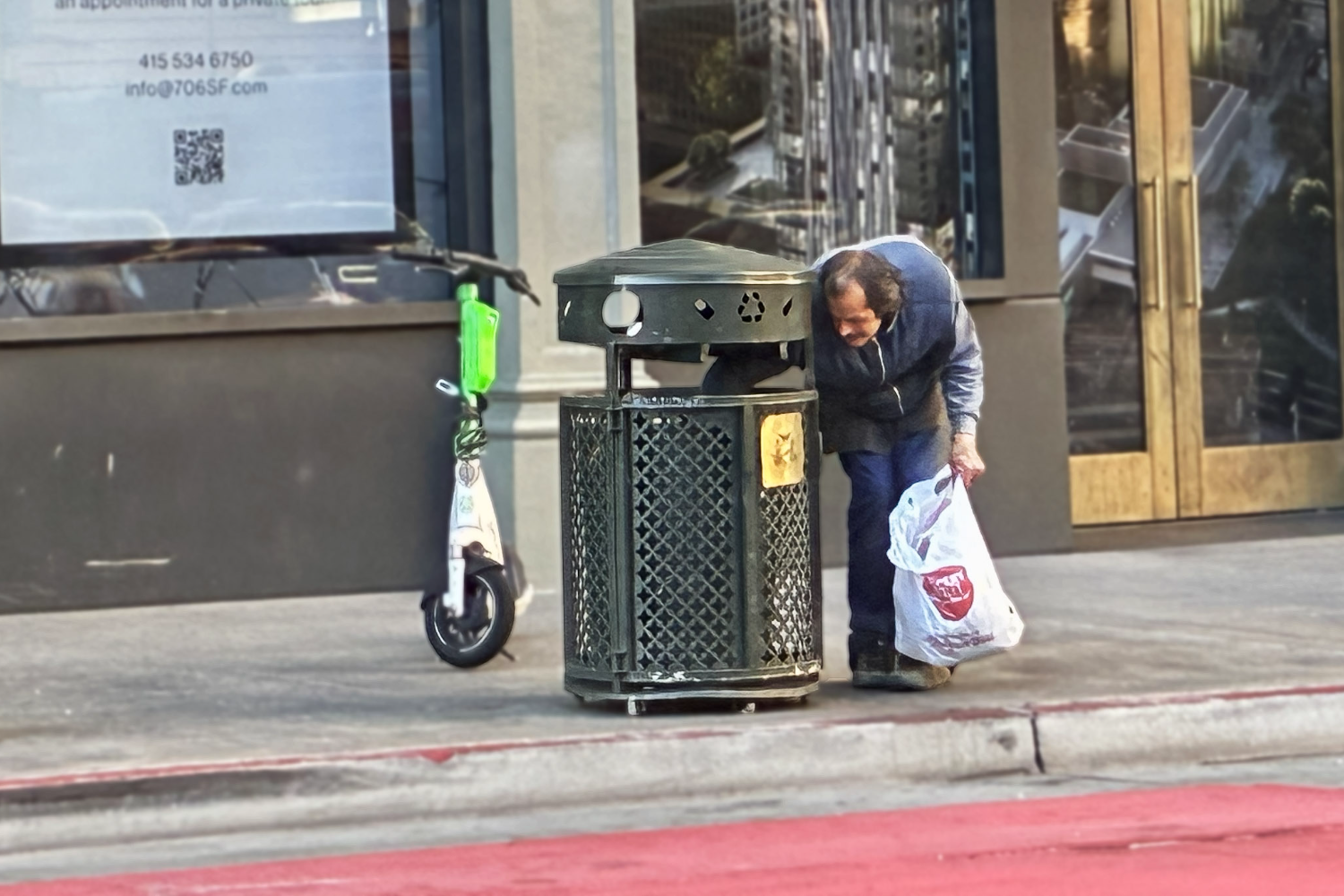
A young woman crouches under an overhang, pulling her woolen jacket tightly around herself to protect from the rain pattering softly on the asphalt. The smell of wet cement lingers, mixed with fumes from the vehicles and the stench of trash bins.
The woman’s hair is dull, knotted, and unkempt. Dirt hides beneath her fingernails. Her eyes are sunken, shadowed beyond their years.
A tall, well-groomed man walks by, his hair slicked back, cheeks red and warm, and dressed in a crisp black suit with a red tie. He doesn’t look in the woman’s direction as he walks by, as if she were part of the urban landscape.
But she wasn’t always like this. Once, she had long, golden hair, sky-blue eyes, a laugh like birdsong, and a razor-sharp mind. She had dreams of being her own boss and running her own fashion business. Now, due to events beyond her control, she is homeless and reliant on the kindness of strangers who won’t look her in the eye.
The young woman’s story may be the story of thousands of California residents. California leads the United States with the highest homeless population.
There are 187,000 California residents and counting, like her, living without secure housing, with 123,000 who live unsheltered. The median housing cost is $866,100, according to Bankrate.
This suffocates nearly 33% of Californians who live near the poverty line, according to United Way of California.
Among thousands of faces who have gone through these struggles, Eric Davis shares his story.
Drug usage and the road to homelessness
Davis was a heroin and alcohol addict for the better part of 25 years. He started using marijuana and drinking beer with his friends at the age of 12, before turning to heroin at the age of 16 after his older cousin offered him some.
“Everyone partied back in the ’70s. It started with marijuana and beer. For the first 15 to 20 years of my addiction, it was still a party. There were no consequences,” Davis said.
However, his addiction started to turn for the worse as Davis aged.
“In my 30s, I crossed this invisible line to where it wasn’t fun anymore. I had to have it. It’s not like I’m just partying and having fun. Now I’ve got to get up and work hard to keep some of this stuff in my pocket every day,” Davis said.
Davis’s financial insecurity grew with his addiction.
“I had a job until my addiction stopped me from working. The drugs were not working anymore, so I would have to do more and more and then eventually overdose,” Davis said.
Selling his vehicle for drugs and being without a stable income led Davis to become homeless. Davis began to find unconventional means to continue the cycle.
“I maintained my addiction through odd jobs because I was always scared to steal. I was scared to do anything against the law or go to jail or prison, although I went to both places several times. I always worked and hustled, and a lot of times I wouldn’t get paid for the work,” Davis said.
Davis needed to take heroin to avoid going through withdrawal, so he took drugs (his “wake-up”) every morning.
Davis would sometimes wake up sick at night and use his drugs, making him ill in the morning.
“I had to learn how to hide my wake-up, way across town. I couldn’t bring it with me because I would blow it,” Davis said.
It was during this time that Davis began to strain relations with his family.
“My family was having a get-together. Everybody shows up and sees me coming up the street. They’d say, ‘Hide all the liquor, give him a plate to eat. Then he has to eat in the backyard. He cannot come inside,’” Davis said.
Davis would sometimes steal things from his family out of desperation, earning their distrust, something he was never proud of.
Davis’s struggle with addiction is a common theme among people experiencing homelessness. In the study by the University of California, San Francisco, nearly 31% participants admitted to the regular use of methamphetamine, 3% admitted to regular use of cocaine, and 11% non-prescription opioid use. Only 6% report having received drug or alcohol treatment.
Of those who reported usage of illegal substances, 20% reported wanting to receive help, but were unable to receive it.
Nonprofit work
For those who need assistance and reach out for it, many nonprofit organizations in California offer support. One such organization, Episcopal Community Services (ECS), offers a range of services to those in need.
“Every day is a different day for me. We help with crisis intervention, housing, and stability. We connect clients to resources and help them build safe, independent, and healthy living habits,” said Rolando Escobar, a bilingual case manager for ECS.
According to a study regarding the experience and causes of people experiencing homelessness conducted by the University of California, San Francisco, 66% of homeless people who participated in the study reported serious mental health issues, with 48% reporting severe depression, 51% reporting feelings of anxiety, 37% reporting trouble concentrating or struggling with memory, and 12% reporting hallucinations.
“That’s my main goal of working here every day: to reach out to them, to ensure that their mental health is okay. That’s a huge stigma. Many of the people experiencing homelessness have some form of mental health problem,” Escobar said.
LifeMoves is another organization on the peninsula that aims to secure housing for the homeless in California. Through outreach teams, interim housing programs, supportive services, and case management, LifeMoves seeks to help individuals experiencing homelessness get off the streets.
WeHOPE provides mobile services to the homeless. These mobile services include showers for the homeless, laundry facilities, online medical assessments, and case management. Additionally, WeHOPE provides emergency food, shelter, and job training.
Challenges
Davis bounced between encampments, vacant houses, public restrooms, or couch-surfing, rarely sleeping more than a few hours. Sometimes he lay awake, cold and shivering, afraid that someone might hurt him as he slept.
“If my body got tired, I would sit down and lie down and go to sleep until either I woke up or someone woke me up,” Davis said.
Despite this, Davis never went to a shelter, having heard horrible stories about people getting hurt in shelters.
Homelessness itself generated a load of problems in the life of Davis, his situation spurred on by his drug addiction.
Policies
The local and federal governments plan to address homelessness and the problems it generates by tackling its root causes.
“By increasing the supplies of both permanent and interim housing solutions and providing access to services like healthcare and job training, we can provide targeted assistance,” said Alex Kobayashi, a district representative for Sen. Josh Becker.
Several bills have been passed.
“I proudly voted for the ‘American Rescue Plan Act of 2021′, which was signed into law by President Biden. This law provided California with an additional $250 million in federal funding for the Emergency Housing Vouchers program, which is made available to public housing agencies to assist those who are experiencing homelessness, those at risk of homelessness, and those who have recently become homeless,” said Sen. Alex Padilla.
Several other bills have been passed, including AB 2835, making it easier to house homeless families for over 30 days. Additionally, SB 606 requires local jurisdictions to identify the resources needed to help bring homeless people indoors and create a plan to do so. Several bills are also being introduced.
“I was proud to introduce the ‘Housing for All Act,’ a comprehensive bill to ensure every American has the dignity and security of housing. This bill would invest billions of dollars in proven programs that help alleviate the affordable housing shortage, including the National Housing Trust Fund, the HOME Investment Partnerships program,” Padilla said.
If passed, this bill would provide significant funding for more affordable housing by investing in hotel conversions, safe parking programs, the Housing Choice Voucher Program, the Emergency Solutions Grant, and Project-Based Rental Assistance.
Persistent effort is necessary to keep making changes.
“Supporting policies that allow all Americans to attain stable housing is critical. Please know that I will continue working to ensure that all Americans have access to affordable housing,” Padilla said.
These policies aim to support individuals like Davis during their most challenging times.
Rocky road to recovery
Davis was now nearly 40 years old, his life challenged for years by his addiction. Davis decided, for the first time, that it was time to make a change.
“I became sick and tired of being sick and tired,” Davis said.
So Davis went to Free at Last, an addiction treatment center in East Palo Alto. There, he met the intake coordinator, who had known Davis for some years during his tenure on the streets. She told Davis that he couldn’t get clean in East Palo Alto, so she took him to Project Ninety in San Mateo.
Davis went through rehab at Project Ninety and managed to stay sober for over 5 years, and things were starting to look up for him.
“By the time I got clean and sober, all of the fog lifted. I realized that I was a 16-year-old in a 40-year-old body. I never really matured. I had fun learning how to be a 40-year-old man,” Davis said.
Davis then landed a stable job working in a warehouse. One day, Davis was alone, rolling a 65-pound drum barrel, when he heard a loud snap like a pencil breaking. Feeling no pain and briefly looking around to see if it was someone else, Davis quickly forgot about it and continued his work.
An hour later, Davis was sitting on a forklift eating his lunch. The door opened, and Davis’s boss called out to him. Davis turned his neck to respond when he felt a shooting pain down his neck. Panicked, Davis tried to move his neck away, but it was stuck in place.
“I didn’t realize that pencil I heard when I was moving the drum; evidently, I had moved something, and my neck snapped. So I went to get an X-ray. I had two herniated discs in my neck. My boss fired me right on the spot,” Davis said.
The pain got so severe that Davis required surgery to alleviate it. During this time, the doctors put him on pain medicine to recover from the surgery.
“We ended up suing my employer two years later, but I had already relapsed on my pain medication. I was taking too much and drinking with it. When I got the settlement, I started back shooting heroin again, and then my life just went down very, very fast,” Davis said.
Rock bottom
It’s 2006. The night outside is brisk, the stars flicker softly like fireflies in the sky, and an owl cries in the distance. An ambulance speeds down the street, sirens wailing, its flashing red lights slicing through the gloom of the night. It is the third time this week that this ambulance has been down this street.
Davis lies in the bathtub fully clothed, in a pool of water. His head throbs, his body shaking back and forth, a bright light drawing him in. His eyes flicker open to a familiar scene this week.
“I overdosed three times within the same week, and the same paramedics came to revive me the first, second, and third times. I wake up, and it’s the paramedics, my mom, and my niece, standing there crying. And the paramedic lady said something to me I’ll never forget. She says, ‘What are you trying to do? Kill yourself? Look at your mom and your niece. They’re standing there crying,’” Davis said.
Davis rubbed his head; every part of his body was aching. He was tired and sore, cold and damp.
“I looked at her and said, ‘No, I’m not trying to kill myself. I’m trying to get high,’ and she goes, ‘You’re not getting high, you’re getting dead,'” Davis said.
While there was no immediate change, the paramedic began to plant the first seeds in Davis’s head, urging him to change his ways.
Final recovery
Later, Davis moved to Stockton, where he continued to struggle with drug abuse and homelessness. One night, Davis made a change.
“There were people who were after me, who were trying to kill me because I was in a part of Stockton that a black man shouldn’t get caught in after dark. I called my sister. She was one of the few people who would help me, and I knew she would if I told her that I wanted to re-enter the program. I needed to go back to San Mateo,” Davis said.
Davis went through detox at Project Ninety upon re-entry.
“I was physically sick to the stomach. Not able to eat, not knowing if I was going to survive, because your body is going through so much withdrawal. I was scared, but I figured I was going to die, without any drugs in my body,” Davis said.
Davis attended group treatment following his detox, requiring brutal honesty. This honesty brought him down, but it also helped rebuild him. Eventually, Davis was given a “little brother,” or another recovering addict, to mentor through recovery.
Giving back
In 2012, two years after Davis was released from rehab and two years sober, he attended the College of San Mateo (CSM). Davis graduated from CSM in 2015 and became a certified drug and alcohol counselor, remaining a counselor for a decade.
Currently, Davis works as an outreach specialist with a background in drug counseling. Davis has also mended the bridges burnt with his family.
“I have a lot of friends who love and care about me, and they support what I do. I also have many family members who have returned to my life and support everything I do. I’m known as Big Brother Eric or Uncle Eric now, and everyone in the family calls on me for money,” Davis said.
Davis continues to provide for his family despite many of them having turned their backs on him at his lowest point. Davis attributes his giving nature to his mother, who raised him single-handedly.
“If I walk over a piece of paper, a lot of times I’ll turn around and pick it up and find a garbage can and throw it in there. Everything my mom taught me as a kid, I have become now,” Davis said.
Davis remains an example of how people can endure even the lowest points and emerge victorious, giving back to their community and helping those who are in a similar situation to his own. His story is proof that with help, anyone can have a second chance and turn their lives around.
Future action
Anyone can take action to help the homeless by volunteering at local nonprofits, such as those mentioned above, or similar organizations.
“A lot of the nonprofit organizations offer volunteer work, if you’re looking for an internship or do volunteer work for your school. There are always open opportunities, whether they’re at a pantry or a food resource center,” Escobar said.
People can also gently help people to make a change.
“Once a month, you know, try to go to that certain spot and see if they have everything they need, say, ‘Bob, you realize there’s a resource center just around the corner.’ And if they say ‘Yes,’ that’s fine. And if they say, ‘No,’ that’s also fine. It’s about realizing that just because I opened the door and I make it easier for you to enter doesn’t mean you are worth any less for accepting those support systems,” Escobar said.
However, the best kind of help, and the easiest in many ways, will be human decency.
“Many of the people who are homeless don’t interact with other people because they feel that self-perception compared to somebody walking by. People often don’t think about the struggles that others are going through, just as they are. Recognizing that we’re all human, realizing that you can help, not just with money, just by saying ‘Hello, how are you?’ Social interaction is a big deal for everybody,” Escobar said.
The best approach is to remain hopeful and determined.
“Not everyone who’s experiencing homelessness and who may have a substance abuse and or mental health problem is a bad person. They’re likely dealing with life the best way they know how. They need a chance for someone to trust them. Don’t give up on people that are out there struggling in the streets,” Davis said.
