
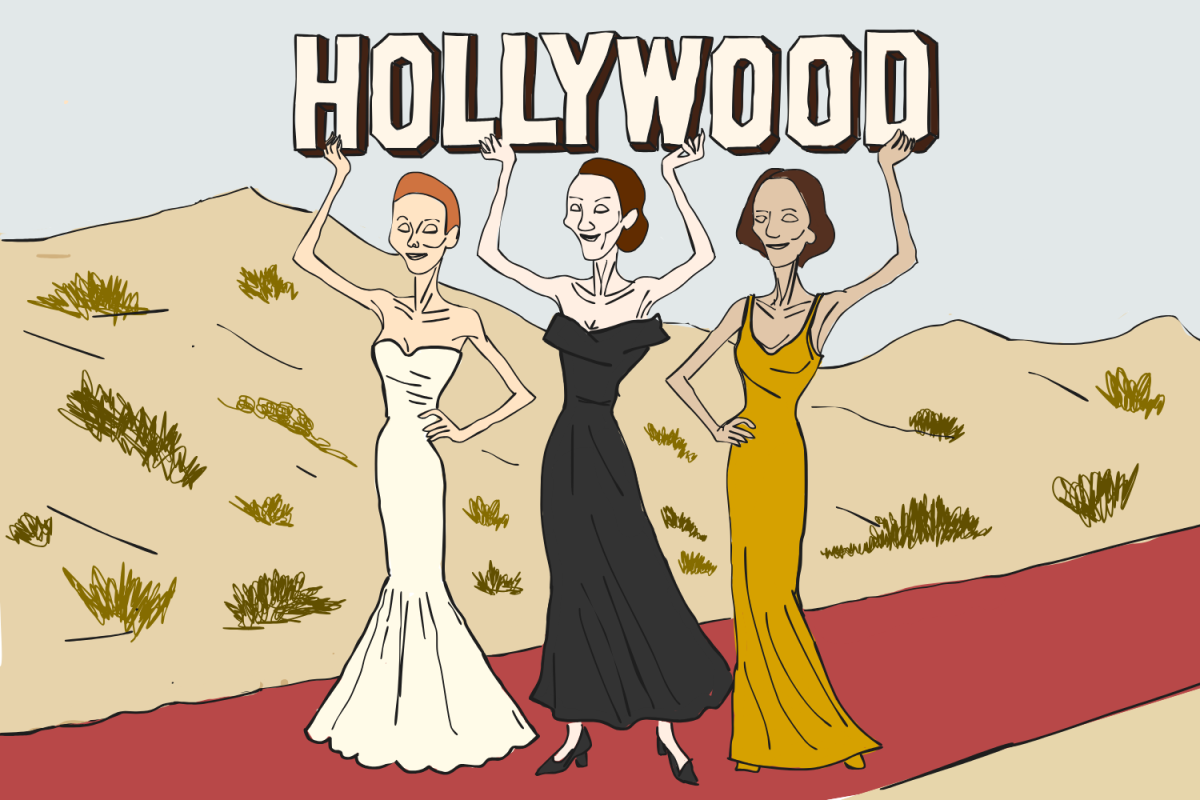
In an environment constantly trying to evolve and eager to advertise its progressiveness and political correctness, Hollywood has spent the better part of the last decade promoting the message that eating disorders are harmful and that mental health and personal well-being should come first. Yet, as blockbuster projects like “Stranger Things” and “Wicked” capture the public’s attention, an unsettling pattern has reemerged where actors and actresses appear alarmingly thin, with some being near skeletal.
The resurgence of dangerously thin body types reveals the lack of progress Hollywood has made in mental health and other social issues. Even as the industry loudly proclaims its commitment to inclusivity, diversity, and mental-health advocacy, it continues to recycle the same aesthetic that harmed generations of performers and fans before it. For all of Hollywood’s branding as a forward-thinking and culturally conscious institution, its treatment of body image exposes just how little it has evolved.
The ultra-thin aesthetic, often maintained through extreme dieting, overexercising, or forcing oneself to vomit, dominated the 1990s and early 2000s. During this era of “heroin chic,” tabloid covers praised dramatic weight loss and paparazzi staked out restaurants to photograph celebrities’ diets.
Despite the aesthetics’ glamorization and infatuation by the public, it was intensely damaging, both to the actors who lived under its demands and to the audiences who consumed and subscribed to its message. By the mid-2010s, however, cultural attitudes shifted. For a brief period, the industry appeared to embrace healthier, more nourished body types. Media criticism sharpened, the public became more vocal, and younger generations pushed back against unrealistic body standards. Stars such as Lady Gaga and Taylor Swift spoke candidly about their struggles with eating disorders and stylists emphasized the importance of comfort and sustainability. Model castings included a more diverse range of models. Conversations about mental health issues, including anorexia and bulimia, became more open, and, as a result, Hollywood seemed to retreat from its “thin-at-all-costs” expectation.
Ultimately, Hollywood’s “abandonment” of starvation methods contributed to its goal to appear progressive and woke. Yet, the institution was far from progressing.
By the early to mid-2020s, the illusion of Hollywood promoting body positivity began to vanish. Images of film sets, red carpets, and press tours have raised alarm with the general public. Whether it is Ariana Grande at “Wicked’s” 2024 and 2025 press tour, Natalia Dyer at the “Stranger Things 5” premier, or Lily Collins at a Vogue photoshoot, it is evident that many Hollywood figures appear more gaunt and frail than ever before.
While these productions could not be more different, the visual sameness of some of the actors and actresses is striking. They are all defined by sharp, pokey collarbones, hollowed cheeks, sunken eyes, and limbs that follow the bone structure exactly. Yet none of these people appeared like this before, and they are too young to attribute it to age.
The issue is that Hollywood’s incentives have never truly changed. The industry continues to imagine its leads as perfectly polished, youthful, and slim. Despite the rise of body-positive marketing, fans of these productions still cling to the visual ideals of the past.
While some may argue that the sudden weight loss of specific actors or actresses is separate from Hollywood’s overall progress, it is essential to recognize that Hollywood is defined by its actors. If Hollywood were to criticize its actors for eating disorders and bring attention to the issue, it would fully expose how little progress, especially in mental health, Hollywood has made in recent years, despite what it attempts to show.
Furthermore, Hollywood attempts to present itself as the face of progress. It has become fashionable for studios to brand themselves and partner with organizations that advocate for mental health using hashtags, partnerships, and philanthropic outings as proof of their progressiveness. Yet, when confronted with a resurgence of the very aesthetic linked to harmful mental health outcomes, the industry refuses accountability.
The contradiction is apparent. How can Hollywood claim to champion its actors’ well-being while simultaneously promoting the unhealthy body standards it claims to despise? The answer is simple: Hollywood is stuck in the past and is not the face of a modern institution. Instead, it is one that is stuck in the rigid molds and beliefs of the 1990s and before.
The danger then extends far beyond the scope of the entertainment world. Hollywood remains one of the most potent cultural institutions on the planet. When the most visible celebrities — the ones headlining movies, appearing on magazine covers, and starring in the most popular TV shows — perpetuate eating disorder culture, fans become desensitized to the issue, and seeing ill-fed actors and actresses becomes normal.
No amount of public messaging about self-love or mental health awareness can compete with the subconscious influence of constant exposure to bodies that look unhealthy. People listen to statements, but they internalize images.
Hollywood’s responsibility is not simply to avoid glamorizing disordered behavior. It is to challenge the norms that perpetuate it actively. This means more transparency around the pressure the actors face, more diverse casting, and a genuine shift towards prioritizing well-being over aesthetics. It also means acknowledging that the ultra-thin standard is not harmless nostalgia, but dangerous regression.
The return of the skeletal celebrity aesthetic is neither a trend nor an accident. It is merely an exposure of the symptom of an industry still chained to the same outdated ideals it pretends to have outgrown. Until Hollywood reconciles the contradiction between the image it projects and the bodies it celebrates, its claims of progressiveness will continue to ring hollow.