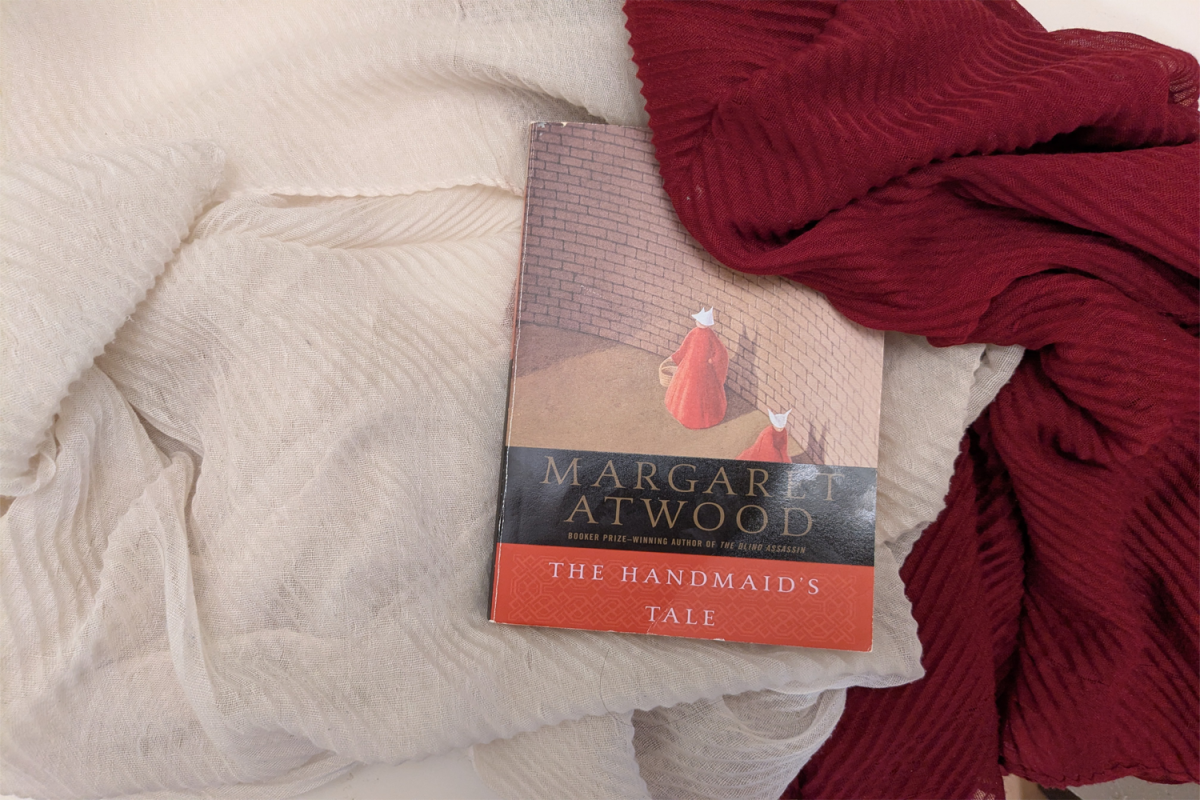
The United States of America has been toppled and replaced by the Republic of Gilead, a totalitarian society. Women are property of the state, and the few fertile women who exist are classified as “Handmaids” and subject to state-sanctioned rape at the hands of a few powerful men.
This is the world in which the main character, Offred, lives.
Fantasy? Fortunately, yes, Gilead is fictional. So is Offred. But when author Margaret Atwood created the world of “The Handmaid’s Tale” in 1985, her inspiration was not her imagination. While “The Handmaid’s Tale” is a work of speculative fiction, every atrocity Atwood wrote into her novel had already happened.
Take, for example, a central focus of the novel: forced pregnancy, which exists in real life as well. In the 20th century, Romania was ruled by a communist regime headed by Nicolae Ceausescu. In 1966, Decree 770 was introduced, heavily infringing on women’s reproductive freedom. It banned contraceptive devices that had not been made in Romania and restricted abortion access. Decree 770’s purpose was to increase birth rates, but it also led to overcrowded and poorly managed orphanages where unwanted children were placed.
As the novel explores Offred’s past before Gilead, it reveals that she had a daughter who was forcibly removed from her care by the government. This, too, has historical precedent. In Nazi Germany, the Lebensborn program kidnapped blue-eyed and blonde-haired children to populate Aryan, or “racially pure,” households.
Perhaps the most complex character in the novel is Serena Joy, a woman who played a heavy role in the rise of Gilead. Joy also has real-life counterparts. During the 1980s, the rise of the American anti-feminist movement was essential in rolling back many gains in women’s rights, including the defeat of the Equal Rights Amendment (ERA). Many of the leaders of this movement were women, including Phyllis Schlafly, a prominent anti-feminist. Through these characters, Atwood exposes the hypocrisy of female anti-feminists, who used their powerful position to put down other women.
An important point to note is that Gilead justifies itself based on Christian scripture. The monthly sexual ceremonies intended to produce children are loosely based on a passage from the Bible, Genesis 30:1-3. This mirrors religiously ruled societies, such as Puritan Massachusetts, and explores the effects of fanatical adherence to religious law on its victims.
To me, the most disturbing part of “The Handmaid’s Tale” is how quickly Gilead stripped women of their rights. Offred lived a normal life before she was forced to become a handmaid. Like many women, she had a job, a partner, and a daughter. When a national emergency allowed Gilead to seize power, Offred lost her job and her financial freedom, thus signaling the downfall of women’s rights.
A situation similar to that in “The Handmaid’s Tale” is currently unfolding in Afghanistan. The ruling party, the Taliban, has stamped out many women’s rights, such as the right to education. Like Gilead, it justifies its actions in religion.
Closer to my home is the U.S. Supreme Court’s overturning of Roe v. Wade, a landmark ruling that ensured abortion access. As a result, states were given autonomy to govern the right to abortion, or lack thereof. This ruling had far-reaching consequences, especially for women. Protestors who supported Roe v. Wade dressed as handmaids, in their distinguishable red dresses and white bonnets. It seems like we are closer to Gilead than we think.
“The Handmaid’s Tale” may be a work of fiction, but it is not simply a novel to read. It is a warning. To watch for authoritarianism and the rollback of freedoms, and to remember that humans have done this to one another before and that it can happen again.