


More than 1.5 million women rely on oral contraceptive pills (OCPs) for noncontraceptive purposes, according to the Guttmacher Institute.
Especially among the teenage demographic, 82% of girls between the ages of 15 and 19 report using OCPs, often referred to as birth control pills, for noncontraceptive purposes like aiding menstrual pain, menstrual regulation, and acne. Despite this large number, many girls who are taking OCPs overlook the drawbacks that come with taking them.
Nancy Mach, a naturopathic doctor specializing in skin and scalp issues, explained the science behind how OCPs affect the female body when regulating a woman’s menstrual cycle.
“Birth control pills are like synthetic hormones, and when they are given to the body, what happens is the body stops making its own. The body’s like, ‘Oh well, I don’t need to make my own estrogen and progesterone because I’m already getting it.’ The problem is that we miss what would happen in a normal cycle for a woman,” Mach said.
Contraceptive pills are not the only type of pharmaceutical drug that has this effect on patients.
“In conventional medicine, it’s a little different from natural medicine. I see it a lot of times where the doctors are treating the symptoms and just want the symptoms to go away, so it ends up becoming a suppressive treatment, which is completely different from what naturopathic doctors do,” Mach said. “I feel like conventional medicine is great in emergency care and what we call acute care, but it can sometimes fall short.”
Especially for cancer patients, the pharmaceutical path is one of the only types of available treatments that have been researched and are still being researched, according to the U.S. Centers for Disease Control and Prevention. However, even these treatments have drawbacks, leading patients to wonder whether the pharmaceutical path is the only option. For breast cancer patient Summer Lange, finding the right medication for her body has been a journey for decades.
Lange’s journey
“Birth control pills were actually one medication that I was taking before I was diagnosed with breast cancer,” Lange said. “I was taking birth control because I had ovarian cysts, and I actually had surgery to remove them. Then my gynecologist put me on birth control pills to prevent the cysts from coming back.”
Ovarian cysts are fluid-filled sacs that can form on or inside the ovary. The cysts can cause serious gynecological emergencies like rupture, hemorrhage, and torsion, according to the National Library of Medicine.
Because of these risks, it is crucial to remove the ovarian cysts before they spread further. But to fully remove the cysts, surgery has to be performed.
“My ovarian cyst surgery was very extensive, so I didn’t want the chance of them coming back. The birth control pills didn’t seem to affect me either way, but I knew there were long-term side effects,” Lange said.
According to the National Cancer Institute, a Danish study on oral contraceptives and their connections to cancer was reported in 2017. The study showed that there was a 20% increase in cancer risk in women who were using or had recently stopped using contraceptive pills compared to women who had never taken the medicine before.
“The birth control pills are totally a possibility of where the cancer came from, because that’s one of the ways they say can cause it,” Lange said. “But it’s one of those things, do you not take the birth control and just get the cysts again?”
With this mindset, Lange continued to take OCPs until one day in 2024, when she was diagnosed with cancer.
“I was pretty bummed. I didn’t really expect to get diagnosed because I’ve had a lot of friends who have felt something and then had all the tests, and then it’s nothing. So I wasn’t really expecting it,” Lange said. “I didn’t really know how to feel. I was definitely overwhelmed and really sad about it.”
When Lange first found out about her condition, the oncologist had told her she needed chemotherapy and then surgery to remove the infected areas. For the chemotherapy, the oncologist had prescribed Lange with Taxotere and Carboplatin, two pharmaceutical drugs used to treat cancer.
Once Lange started the chemotherapy, there was no going back. Side effects began taking over her body, from hair loss and dry skin to mouth sores and fatigue. Despite all the side effects that Lange went through, she had no choice but to endure them.
“Right now, chemotherapy is the only treatment that is FDA approved and can work to kill cancer,” said Maria Teng, a Stanford Hospital oncology nurse practitioner.
Teng added that in America, because every conventional medicine has to be FDA approved, a handful of cancer patients will travel outside the U.S. borders to obtain alternative treatments.
The process of gaining FDA approval for a specific medicine is very strict. It can take up to 10 years, according to Ruby Chan, an oncology nurse at Kaiser Permanente in Redwood City.
“Once FDA approved, we can use the medication on the patient who has cancer,” Chan said. “The goal is to try to extend the life and decrease the suffering.”
With this goal in mind, scientists all over the world work to develop medications that can fight against cancer and cure cancer patients. But this process is not easy, and although the number of cancer patients who survive has increased since before cancer medications were being developed, the number of people who pass away from cancer is still quite high, according to a study done by the National Cancer Institute.
Despite this large number, Lange didn’t let that stop her.
“I was pretty hopeful because my oncologist and surgeon had told me that my cancer was not at the advanced stages, and the types of treatments that they had for my cancer have been proven to work really well,” Lange said.
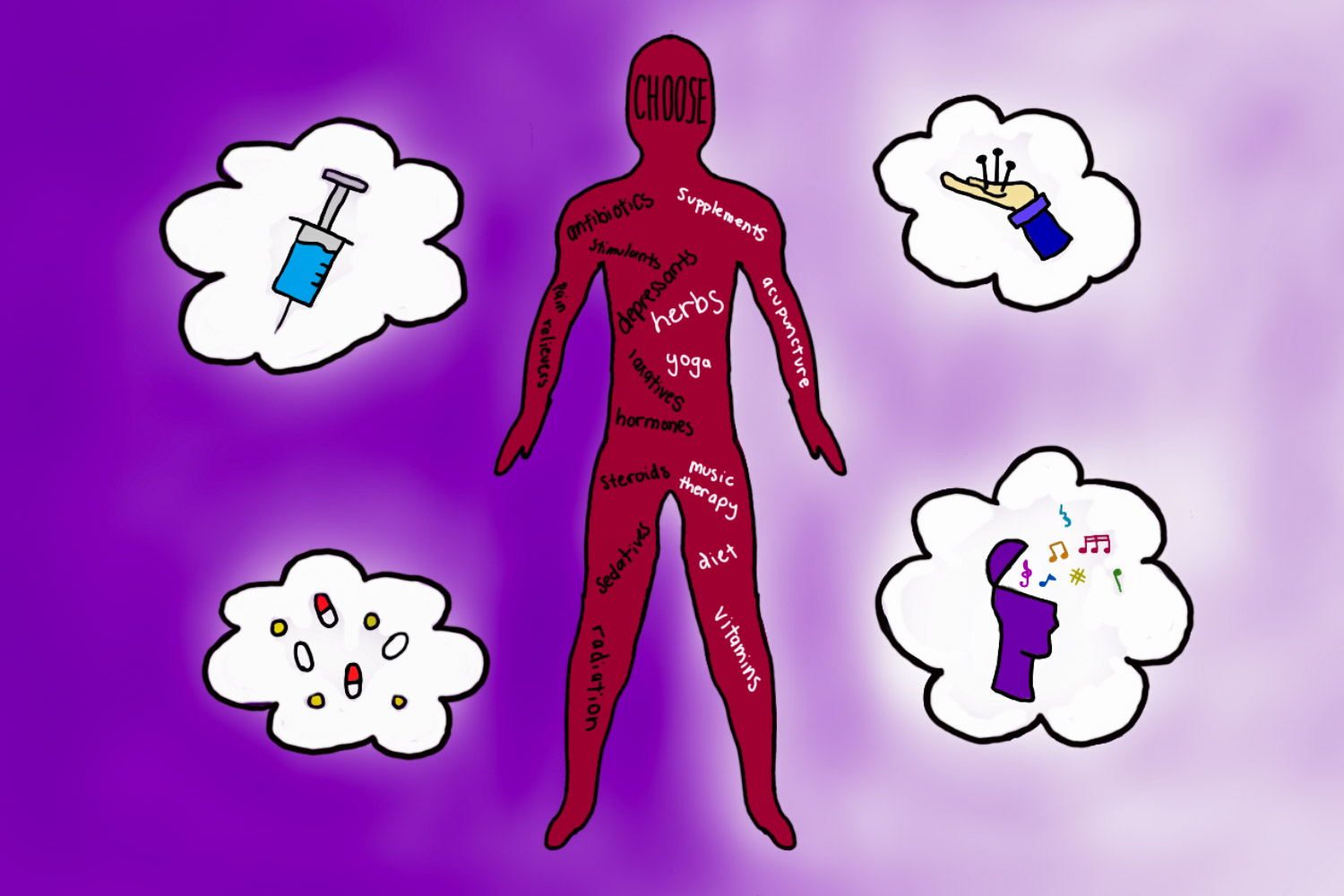
Although the pharmaceutical treatments Lange underwent have been studied since the 18th century and carefully tested to ensure each patient’s recovery, there are also various alternative medicines, such as acupuncture, supplements, and music therapy, that patients interested in a more natural approach can try. Lange is one of the 28% of cancer patients who decided to give this natural approach a chance.
“I have a naturopathic oncologist, too, and so she prescribed a bunch of supplements to help counteract the toxicity of the chemo, and the damage it does to my body,” Lange said.
Supplements are just one of many types of Complementary and Alternative Medicine (CAM) available to cancer patients, according to the Journal of Clinical Oncology.
“About halfway through my initial treatment, I started to get acupuncture,” Lange said. “I have neuropathy in my feet and fingers, which means that I’ve lost feeling in my fingertips and feet. So the acupuncture, which I’m still doing, is helping my nerves come back.”
During the interview, Lange voiced how, although she was able to receive CAM treatment for her side effects, the majority of patients are still undereducated about alternative cancer treatments.
“I feel like the reasons I found out about CAMs were because other people had gone through it and had more of an alternative approach to their treatment,” Lange said. “I also had to do a lot of research. I feel that you have to do a lot of your own research in order to find those sources, because most cancer hospitals are not going to have those sorts of alternative therapies.”
According to Teng, while natural remedies like supplements and acupuncture are a good source for healing the side effects of chemotherapy, hospitals actually do not recommend using CAMs during their treatment.
“When treating cancer, the mainstay that has proven to work best is chemotherapy,” Teng said. “There are other things like immunotherapy, targeted therapy, radiation, a lot of different things. Those are just supportive. A lot of times, we tell patients not to take the natural and pharmaceutical treatments together, just because the kidneys and liver go through a lot in the process.”
Even though a good number of hospitals prioritize pharmaceutical treatments over natural remedies, there are still a few patients who are willing to take the natural path in their cancer journey. In a study at the beginning of 2025, over half of the patients battling cancer were reported to have used CAMs at least once during their treatment, according to the National Library of Medicine.
Outreach
Just as Lange draws attention to the lack of outreach for alternative treatments, Carlmont High School’s Childhood Cancer Awareness Club draws attention to cancer within the teenage demographic.
Seniors and co-presidents of the club, Vivian Harris and Joshua Wu, have run the club for the past three years.
“I started by making slideshows to educate the members,” Harris said. “That was what a lot of our initial meetings were focused on, but eventually, I became a lot more interested.”
With this interest in mind, Harris began writing an Advanced Placement (AP) Research paper from an economic perspective on treatments for acute lymphoblastic leukemia (ALL), a type of blood cancer that’s most common in children. Harris analyzed the differences between employer-sponsored insurance, Medicaid, and no insurance, and how those factors impact a patient’s treatment plan.
“Beyond chemotherapy, which is pretty well covered by both Medicaid and employer-sponsored, there are a lot of other treatments that are a lot more expensive, like hundreds and thousands of dollars,” Harris said. “Usually, those expensive ones are life-saving and much more needed, but insurance doesn’t cover the full cost.”
According to Harris, the primary treatment for ALL, aside from chemotherapy, is called Chimeric Antigen Receptor (CAR) T-cell therapy. During CAR T-cell therapy, the T-cell is removed, genetically engineered to target and fight cancer cells, and then infused back into the body. Because of this complicated but effective process, the cost of these treatments is quite high.
“When reviewing past sources, I found that a lot of these treatments will also have adverse effects that require even more treatment, and so sometimes the cost is well above $600,000, even into the millions, which is insane. So obviously, that’s not affordable for the average family, even a well-off family,” Harris said.
Although Harris’ research never led her to learn more about CAMs, high schoolers like Harris and Wu are leading the next generation to explore new ideas and concepts, not only about cancer but also about other medical conditions and treatments.
“Before getting interviewed, I’d never heard of what other alternative treatments could be for cancer. I know that acupuncture is very common in Asian cultures, and I’m sure natural remedies are too. I haven’t researched the efficiency of natural remedies, but I’d be interested to see what kind of impacts they can bring,” Harris said.
Aside from in-depth lessons about various types of cancers, presented during the club’s meetings, the club also plans outreach events, such as volunteering, to support the cancer community.
“Our club recently went to the Ronald McDonald House to volunteer and cook for the kids and families there,” Wu said.
The Ronald McDonald House is a charitable organization that provides free housing to families with children undergoing medical treatment, allowing them to be closer to hospitals.
“A lot of this just started because Josh has been able to find extracurricular activities that relate to our club, so we’ve been able to do a lot of community-related activities,” Harris said. “And with the large number of people in our club, I like to think that we do teach the students more about cancer, too.”
Ultimately, spreading awareness about cancer has always been the club’s goal. No matter what type of cancer patients have, or what treatments they are receiving, pharmaceutical or natural, the most important thing for patients is to find support.
“Just seeing if there are people in your community or friends who have gone through it before and talking to them really helped me,” Lange said. “I’m not the kind of person to ask for help, so just letting your friends and family support you and help you through stuff was really supportive, and it was always better when I let people help me.”
