


Surviving suicide: The attempt and the aftermath
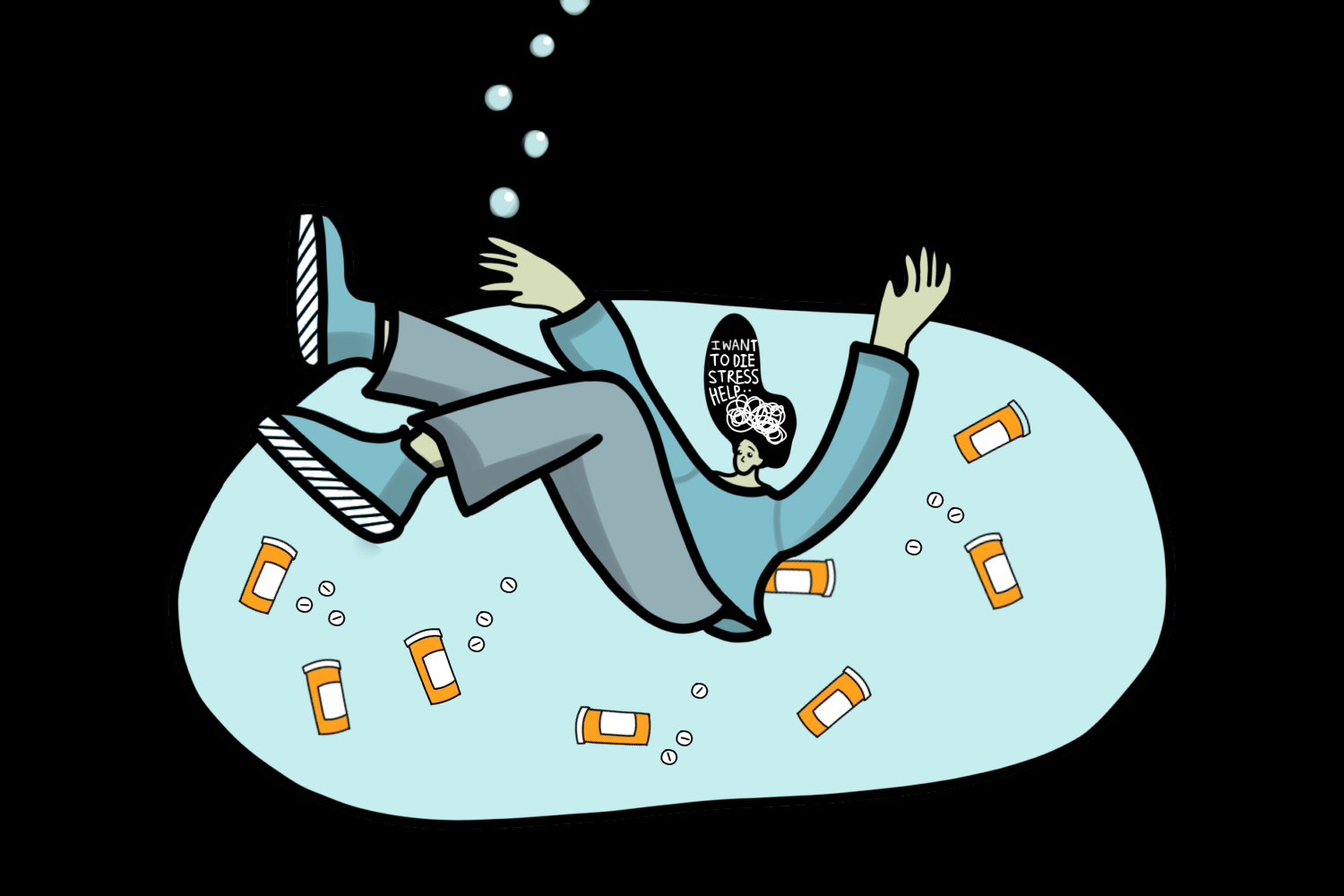
As soon as the pills hit the back of her throat, instant waves of regret poured in. Alissa Zhang* was only 15 years old when she attempted to take her own life using over-the-counter (OTC) medication. According to the Centers for Disease Control and Prevention, suicide-related calls involving OTC medications like acetaminophen and ibuprofen surged at an accelerated rate during and after the COVID-19 pandemic, especially amongst adolescent girls ages 12 to 17 years old.
The COVID-19 pandemic, according to studies in the PubMed Central COVID-19 Collection, was one of the most devastating events affecting adolescent mental health. With young children isolated during quarantine, many adolescents struggled with disruptions in peer and family relationships, screen addiction, and other challenges. In 2020, 56.7% of adolescents were put in the subclinical or clinical range for internalizing problems, compared to just 31.7% in 2018.
“Since people weren’t connecting as much in real life, they turned to online platforms, especially social media, like TikTok and Instagram. Social media significantly worsens mental health issues because of the unrealistic portrayals of other people’s lives, which leads to issues with body image, depression, and so on,” said Addya Agarwal, a youth leader at GoodforMEdia, a youth-led peer mentoring education program that explores how media affects mental health.
Even after the pandemic, various mental health problems remain unaddressed. In 2023, a staggering 8.4%, or 5.3 million adolescents in the U.S., were diagnosed with clinical depression, according to the National Survey of Children’s Health. Given that these numbers only account for diagnosed clinical depression, there may be even more adolescents with undiagnosed depression, who often aren’t able to receive proper treatment due to the stigma surrounding mental illness.
“My mom is not a big believer in the whole mental health thing, which I feel like is seen in a lot of Asian families. A lot of parents aren’t big on mental health in general, so when people are actively trying to reach out to their parents with how they’re struggling mentally, and when they sort of invalidate that, it is very damaging to their well-being,” Zhang said.
Shirley Chu, a crisis and outreach manager at the Behavioral Health and Recovery Services (BHRS) of San Mateo County, entered this field of work due to the existence of stigma in her own Chinese culture. Stigma around mental health in Asian families often stems from the value of “saving face,” which is the importance of maintaining a harmonious public appearance, according to the Western Journal of Medicine. In Asian cultures, mental health illness is often considered a weakness in the family lineage.
“At the time, when I started as a youth out patient therapist, it really started within my own culture, Asian culture, specifically Chinese culture. There were, and still are, a lot of stigmas about mental health, stigmas about reaching out for help and reaching out for support. So I think wanting to do something about that and wanting to help brought me into the field,” Chu said.
Now, Chu provides and manages a vast range of clinical services for the residents of San Mateo, including the management and support of mental health outreach teams for homeless populations. BHRS also provides mental health screening with its ACCESS Call Center, where clinicians offer professional screening and intake appointments through the phone. The ACCESS Call Center is the first publicly funded entry point for individuals in the county seeking accessible mental health screening, but many people are unfamiliar with it.
“We always say we’re not underresourced, we’re underutilized. I think San Mateo does have the resources, but there’s a lack of trust in the system because too many people have been let down one too many times,” said Aris Payan, the programs manager for SafeSpace, a youth-driven prevention and early intervention mental health organization in San Mateo and Alameda County.
When children are unable to receive proper mental health support and treatment, whether that is due to stigma or shame or a lack of trust, depression and negative emotions can build up and erupt into something even more deleterious: suicidal ideation.
“It was not just because of one thing. There were multiple contributing factors that led up to my decision to attempt suicide. I feel like the main thing for me was just stress and that feeling of hopelessness, per se. I was under a lot of pressure, and it made me panic and make decisions that I normally wouldn’t have made,” Zhang said. “But still, it was something I decided on after thinking about it for many days. It wasn’t an all of a sudden decision.”
The Nevada Division of Public and Behavioral Health lists multiple risk factors for suicidal ideation: major depressive disorders, strained peer or family relationships, sociocultural disruption, and poor coping mechanisms. Nonetheless, as seen in Zhang, there often isn’t one singular factor that leads to suicide. Suicidal ideation can be caused by an avalanche of different situations, emotions, people, and sometimes, it can even be hard for an adolescent to navigate what exactly in their life is making them feel a certain way.
“These suicide thoughts or ideations, they don’t just come and happen out of the blue. There is always something that is bothering and happening in the life of the youth, and it is very important for the youth to take a proactive approach when they are experiencing challenges or difficulties in life, such as difficult emotions, relationships, or academics,” Chu said.
For Zhang, it felt like the personal hardships that she was struggling through were having an adverse impact on the people around her. The feeling of burdensomeness is common in teenagers who are struggling with their mental health, and Psychology and Aging finds that it is the leading factor that contributes to suicide, more than depression and hopelessness.
“A lot of the time, it just felt like the things that I was going through personally were also negatively affecting the people around me. So in a sense, it kind of felt like I was burdening the people around me, and that it might lessen the load on them if perhaps I wasn’t around,” Zhang said.
Zhang considered attempting suicide for about a month prior to making the final decision. According to the Journal of Neurosciences in Rural Practice, the duration of the suicide process, which is defined as the progression from ideation to execution, lasts for less than 10 minutes in about 50% of suicide attempters. However, the ideation phase can persist for weeks or even months beforehand and linger as a constant, repeated thought pattern before building up to suicidal action.
“In the moment, where I really decided that I was full on going to go with it, I was very emotional. I had just gotten out of an argument, and at that moment, it just felt like I didn’t have any other choice,” Zhang said. “It wasn’t something that I actively wanted to do, but it felt more like something that I had to do. The few days leading up to it, I was very depressed and hopeless. I wasn’t really trying anymore for anything.”
Being able to spot the signs of suicidal ideation is one of the most essential steps in preventing potential suicides. According to the National Institute of Mental Health, the biggest signs to watch out for are behavioral changes, including: if someone is researching or making plan about how to die, if someone is withdrawing from friends, saying goodbye, or giving away personal possessions, if someone is exhibiting risk-taking behaviors and extreme mood swings, or if someone is engaging in excessive substance use.
“Look out for changes in someone’s mental status, in terms of how they talk, what they talk about, how they present themselves, and their emotions and expressions. These are very important to identify and also identify if someone has additional layers of stressors at school or at home,” Chu said.
Before Zhang attempted suicide, the biggest thing that made her reconsider was how her death would affect her friends, her mother, and her older sister. According to the National Institute of Mental Health, the first thing that loved ones can do to support someone who is struggling with suicidal thoughts is to ask and start a conversation. Adolescents who are suicidal might not bring up their ideations for the fear of further burdening their loved ones, so it is imperative to initiate the conversation. Contrary to popular belief, studies show that asking people about suicide does not increase suicidal behavior.
“While I sort of knew that they loved me, it still felt like I was burdening them, so I was very conflicted with myself about it. I knew that if I did it, it would affect my family members at first, but I felt like it would just be better for them in the long term,” Zhang said.
Zhang’s method of attempting suicide, which was poisoning through the overdose of acetaminophen, takes around 3 to 4 days to become lethal. In the first 24 hours, an acetaminophen overdose causes tiredness, nausea, and vomiting. Without emergency treatment, this can lead to severe liver failure and, consequently, death, according to the Merck Manuals.
“I feel like the mindset of thinking about doing it and actually doing it is different. I was very insistent on doing it before I took any action, but when I actually took the pills, I felt a lot of regret afterwards,” Zhang said.
Zhang had thought about dying for a long time, but the weight of her decision did not hit her until the pills were already down her throat.
“I just started thinking, ‘Oh, I’m actually going to die.’ The possibility that I was never going to be conscious again in just a few days, never going to grow any older or experience anything, suddenly became real,” Zhang said.
Because of the regret, Zhang ended up admitting to her mother that she had taken the pills before they could fully take effect. After her attempt, Zhang was sent to the emergency room (ER) for the night, where emergency providers inserted an IV in her arm and conducted various blood tests to monitor the state of her kidneys. According to the Journal of Clinical Psychiatry, after a suicide attempt, the top three priorities of emergency providers are to first save the patient’s life, then assess the patient’s condition, and finally stabilize the patient’s emotional state.
“I spent that night at the hospital, and then I ended up spending a week in the mental hospital. My mom was trying very hard to not show that she was very affected by it. She automatically asked, ‘How many did you take?’ She was searching up if it was lethal, and she was very erratic on the way to the hospital. I just felt really incredibly guilty about it, for making her worry, I suppose,” Zhang said.
Before mental health challenges progress to a life-threatening stage, Chu encourages adolescents to engage with local resources and mental health clinicians who are trained to de-escalate suicidal thoughts. People can call 988, which is the National Suicide and Crisis Hotline. San Mateo County also has its own local crisis line, which can be called at 650-579-0350.
“If at that moment, the person is really in a state of crisis, and all they are thinking about is to harm themselves, it’s important to encourage the youth to stop and pause for just a minute or two. Pause and think of something positive, and think of someone they can reach out to,” Chu said. “If there is no one that they can think of, of course, they can always call our 24/7 crisis hotline.”
For the San Mateo BHRS crisis hotline, there is always a life counselor or clinicial who is on call. If needed, there is also a 24/7 mobile crisis team that can provide in-person intervention.
Although hotlines can be effective, their position as a useful intervention strategy is mostly catered to adults. Various clinical studies demonstrate that adolescents tend to shy away from hotlines due to feelings of self-reliance, shame and social stigma, concerns about anonymity, and the belief that their problems aren’t serious enough to be discussed. According to these clinical studies, only 2.1% of adolescents in crisis choose to utilize traditional call-based hotline services.
“It’s really hard to get people to use a service that doesn’t always have an efficient process. Sitting on the phone for an hour waiting for someone to answer a hotline is really hard for someone who is in crisis because that person may need support immediately,” Payan said.
Rather than sitting on call, youth tend to prefer chat lines or non-clinical support from friends.
“Telling people I trusted and having an outlet where I could talk about how I felt without the fear of being judged for it was very helpful. Because then you have people who can actually support you through it and acknowledge the fact that you’re going through a lot, when you may not feel recognized in the grand scheme of things,” Zhang said.
Like hotlines, non-clinical support has both its benefits and drawbacks. According to KDH Counseling, using a friend in place of clinical treatment can lead to what is known as a “therapist friend,” where an unbalanced dynamic damages the mental health of both the friend and the individual who is struggling with their mental health. Hence, it is essential to strike a balance between the two.
“Clinical services are absolutely needed, but non-clinical services create a unique kind of benefit where prevention and early intervention are at the forefront,” Payan said. “Clinical services can become a barrier sometimes because not everyone is ready to see a doctor or clinician yet, but they still want to talk about it. What we provide is peer-to-peer connection and a safe space where teens can come together and learn how to help each other through their challenges in a low-pressure way.”
Many people who attempt suicide are not fortunate enough to survive. Kevin Hines, a mental health advocate and survivor of a suicide attempt from the Golden Gate Bridge, describes feeling instant regret the millisecond his hands left the railing. His survival was a miracle. Before the anti-suicide net was established at the Golden Gate Bridge in 2023, it was one of the most common destinations for suicide jumpers in California, with an estimated 30 suicides each year and a 98% mortality rate. Today, Zhang is grateful to be alive to share her story.
“I feel like my life has improved since, and I’ve had a change in mindset. It was that week in the mental hospital that sort of gave me a lot of hope,” Zhang said. “I spent the week bonding with my mom when she’d come to visit, rather than fighting all the time. That itself shined a light for me to show that she really did love me, and it mattered to her that I would stay by her side.”
Zhang confided in her friends afterward, instead of keeping her emotions to herself. Friends and family can be vital sources of support for an adolescent who is struggling with their mental health, so it is crucial that they know how to approach the situation with sensitivity. Sometimes, someone who is struggling simply wants to be heard and acknowledged for their efforts.
“The number one thing that I would say for someone who is trying to provide some kind of support to someone who might be struggling is to listen non-judgmentally. Because as soon as there is some slight judgment, it’s going to close that person off completely. As someone who cares for that person, we just want to fix whatever they’re going through, but sometimes that’s not what’s needed. Sometimes they just need to feel heard,” Payan said.
Western Michigan University advises people to refrain from persuading or arguing with someone who is considering suicide. Rather, letting them know that someone is there for them and simply being empathetic is more than enough.
“Never tell someone who’s struggling that they’re overwhelming you, they’re overreacting, or invalidating how they feel about something. Because at the end of the day, no matter how a person feels about something, it’s their feelings, not yours,” Zhang said. “If anything, just provide unconditional support.”
After Zhang was released from the psychiatric hospital, she started engaging in therapeutic treatment. While the care of friends can be comforting, they are not professionals and cannot supplant professional treatment.
“Peers aren’t therapists, it’s not your responsibility as a peer to be a therapist. It’s not something that should weigh you down. If you can’t support that person to the extent that they may need, it’s better to inform yourself about the tools around you, the trusted adults that you can go to, the resources on campus, and having a general idea of who you can talk to,” Payan said.
According to Shared Vision Psychological Services, in therapy, the therapist’s sole focus is on the patient. But therapists do not have to be robotic clinicians; they can also act as a friend. The difference is that therapists are professionally trained with a clinical foundation to identify stressors, repeated patterns, and potential mental health disorders.
“The one thing not to do is assume that the crisis is smaller than it is. You might want to stay quiet because the person tells you something like ‘I’ll never trust you again.’ But if you feel it in your gut that something is wrong, speak up. It’s too often that a lot of the tragedies we’ve seen happen are because no one spoke up,” Payan said.
The Youth Action Board that Payan oversees at SafeSpace offers various programs for the early intervention and prevention of mental health challenges. For example, the youth create their own mental-health-related short films and host interactive discussion panels.
“If there is a student who is in crisis or is just looking for a space to be supported, they’d be welcome onto our Youth Action Board and build from there,” Payan said. “When we come out and do projects, initiatives, and action-based work, it showcases to people that they’re not alone. We have a lot of youth who are open and ready to be on the forefront of the mental health conversation, and it has really opened doors for people to engage and participate with us.”
From her experience working in the non-profit mental health sector, Payan has gained an understanding of the importance of youth perspectives in the mental health conversation. Behavioral and social sciences researcher Gabriela Martinez-Jothar finds that youth in contact with social services are often overshadowed by the backdrop of adultism, as adult voices are often emphasized more. But Zhang believes that youth experiences like her own highlight unique and holistic approaches to healing.
“One big game changer for me in my mindset is that at the end of the day, the way you feel about something is not going to last forever, and it does genuinely get better. You may feel a certain way about something that’s happened now, but guaranteed, whether it takes a few days or maybe a few years, you will overcome it, even if it seems impossible at the time,” Zhang said.
Zhang’s experience with suicide has taught her a lot about how to be mindful when approaching mental health conversations. She has learned that sometimes, even the smallest things make a big difference in someone’s life, like something as simple as the phrase, “I’m proud of you.”
“It’s when you just tell someone that you’re proud of them for going on, for enduring everything that they’ve endured,” Zhang said.
Zhang feels like people who don’t have a clear understanding of mental health can sometimes make unfair assumptions about those who are struggling.
“A lot of the times, people who suffer from mental health feel like their efforts aren’t really seen. Someone who’s struggling with depression will lose motivation for a lot of things, and people will ask, ‘Why have you given up on yourself?'” Zhang said. “So when someone hears that someone else is proud of them for actually actively staying alive and trying to get by, that itself is very encouraging.”
Payan reminds people to regularly check in with their close ones, because even if someone seems fine on the outside, they may not be. A study published by the Archives of Suicide Research demonstrates that 80% of suicidal individuals deliberately mask their intentions.
“A lot of the kids who seem like they’re okay, the ones who have it all put together, are the ones who are struggling the most. Checking in constantly, just by asking ‘How are you doing? How’s your day going?’ can be so much more impactful and preventative than just waiting until someone is truly showing you how much they’re struggling,” Payan said.
