

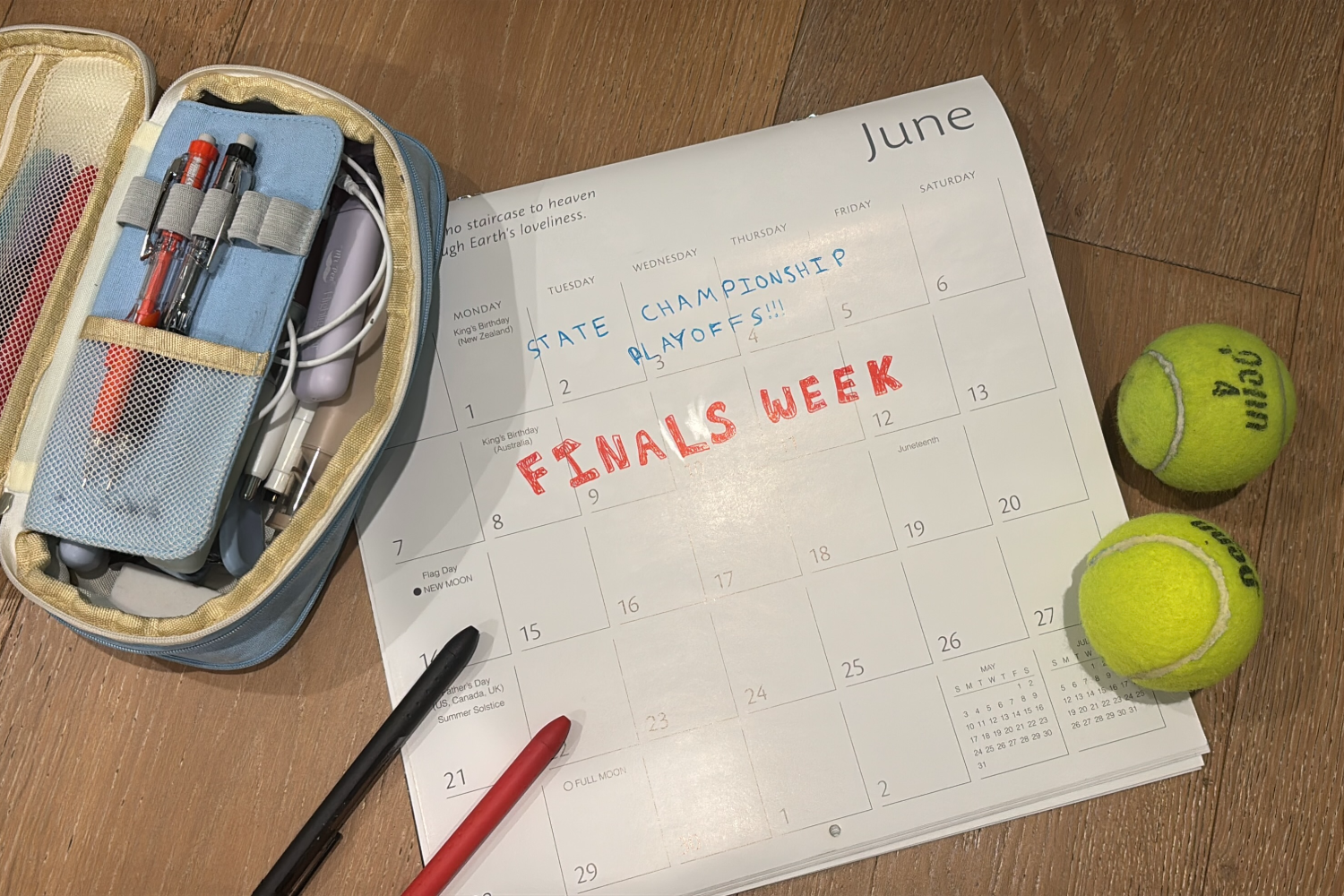
The bus ride home from practice ends after sunset. Homework still waits, a test looms the next morning, and another game is scheduled for the weekend.
For many student-athletes, the pressure doesn’t stop when practice ends – it follows them into the classroom, onto the bus, and into their daily lives.
For nearly half a million collegiate student-athletes in the National Collegiate Athletic Association (NCAA), that toll can be significant.
A 2024 study by the Multidisciplinary Digital Publishing Institute (MDPI) found that 22.3% of collegiate student-athletes were at risk for depression, and 12.5% for anxiety.
Balancing academics with elite-level competition can amplify these pressures. From anxiety and burnout to injuries and intense performance expectations, athletically and academically, the mental health of student-athletes is often an overlooked issue.
A balancing act: Academics and athletics
For student-athletes, excelling in sports comes with a high cost: the constant struggle to balance elite practices and competitions with the demanding weight of academics.
“You need to be able to balance school work with performing well in your sport, and if you don’t know how to balance those, it can wear you down fast. The harder classes you’re taking and the higher level you play, the more pressure you may have,” said Lorenzo Bianchi, a high-school soccer player at Carlmont High School.
Bianchi, who competes in the MLS next league, one of the most competitive junior soccer leagues in the country, spends multiple hours each day on the field. Compared to his classmates, Bianchi has far less time to manage his demanding schedule.
“The biggest sacrifice I make is time. It takes me at least one hour to get to practice Monday through Thursday, so I’m spending five hours every day playing soccer,” Bianchi said. “You cannot procrastinate, and you need to plan at least a couple of days ahead of when you are going to finish your work.”
Transitioning into college, the workload and difficulty of managing athletics only become more challenging.
Cade Miller, a freshman at New York University and a member of the men’s volleyball team, spends much of his time outside the classroom on the court.
“Between practices and workouts, altogether I spend around 14 to 15 hours every week playing volleyball. Then, in the spring, we’ll have games too, many of which we’ll have to travel for. So the time will be even longer. Time management is super important, as there are so many limits on things we can do,” Miller said.
Miller’s heavy practice and game schedule is similar to that of other college athletes. According to a 2019 NCAA study, Division I student-athletes spent an average of 33 hours per week on sports-related activities, including practices, workouts, games, and travel. Division two and three players spent an average of 31 and 28 hours, respectively.
Dr. Nicholas Bisconti, a sports psychologist at Stanford University, noted the pressure that falls on elite college athletes.
“They’re expected to maintain their academic standing, but it certainly makes it harder if you’ve got midterms and finals at the same time that you’re traveling across the country to play games,” Bisconti said. “They’re managing their studying and staying on top of their coursework while also preparing for some of the biggest games of their seasons. And it’s so hard.”
The pressures faced by these college athletes are highlighted in a 2023 study by the NCAA. The article reported that, among 23,272 student-athletes, 44% of women and 17% of men felt overwhelmed, while 35% of women and 16% of men reported feeling mentally exhausted.
At top universities like Stanford, juggling rigorous academics and high-level athletics may seem impossible to the average student.
“We have three teams currently in NCAA championships, and we’ve got finals next week,” Bisconti said.
Recent Stanford graduate and former member of the Stanford men’s tennis team, Filip Kolasinski, reflects on the pressure student-athletes face when attending prestigious schools like Stanford.
“There’s a lot of pressure because you want to do really well in school and you have people questioning whether you got into the school because of your own merit or because of your sports,” Kolasinski said.
The pressure to perform
A 2020 article published by the National Institute of Health (NIH) found that college athletes face immense stress and pressure related to their athletic performance. This pressure comes not only from coaches and teammates but also from personal expectations, the media, and the athletes’ own drive to succeed.
For Vivian Ovrootsky, a collegiate tennis player at Arizona State University and a former player at the University of Texas at Austin, the transition from junior tennis to college-level competition brought a new dimension of pressure: playing for a team rather than just herself.
As a junior tennis player, Ovrootsky reached the top of the country’s rankings, attracting considerable attention and expectations when she transitioned to the college level.
“When you come in as one of the highest-ranked juniors in college, there are a lot of eyes on you to see how you’re gonna perform. I wasn’t aware that there were social media pages discussing it. I wasn’t sure if anyone was saying anything about me. But for me personally, I set, like, a really high bar for myself,” Ovrootsky said.
With the weight of expectations and the transition from playing for herself to now playing for a team, Ovrootsky felt the added pressure of these adjustments.
“The competition ultimately got harder, and I felt more pressure, because there’s more on the line than when you’re playing just for yourself, but you’re actually playing for your team,” Ovrootsky said. “It was almost as if, like, if you don’t win, the whole team loses. I had to tell myself it’s okay,” Ovrootsky said.
Similarly, when Miller arrived at New York University, he felt a pressure to prove himself on the court.
“I feel this pressure of needing to prove that I belong here and that I’m one of the team,” Miller said. “Every time I don’t play up to a certain level, I feel like I’m letting my team down.”
A 2017 mental health survey conducted by Alston for Athletes (AFA), a sponsored project of the Players Philanthropy Fund, and an organization promoting student-athlete mental health, found that 96% of college athletes experience stress related to their athletic performance. Of those surveyed, 27% reported feeling stressed sometimes, 51% reported feeling stressed often, and 18% reported feeling stressed most of the time.
Bisconti explains that the sources of pressure vary for each athlete, and many high-achieving athletes often tie their self-worth or identity to their performance.
“There’s pressure that comes from the people closest to student-athletes, their coaches, parents, teammates, the media-but it can also come from outside of that as well,” Bisconti said. “When you grow up playing a sport and being good at a sport, that becomes a really big part of who you are and how you see yourself. It can affect someone’s well-being when they start to associate who they are with the sport they play.”
Internal struggles
Even from a young age, many athletes experience burnout due to the overly demanding nature of their sport’s workload.
“I wanted to quit tennis when I was 13 because I felt really burnt out,” Ovrootsky said. “So I took a month off. When I came back, it was still tough, but it got better.”
Burnout and anxiety define many young athletes’ careers. A survey conducted by the NIH of 200 high school athletes aged 16-17 found that 91% experienced some level of sports-related stress.
Similar to Ovrootsky, Bianchi also faced struggles in the early years of his athletic career.
“My sophomore year was the hardest year for me. It was super stressful. Since I was the best player on my team. I put way too much pressure on myself to do well in school and to perform athletically. I ended up having massive anxiety problems,” Bianchi said.
Along with anxiety and burnout, a common struggle many high-level athletes face is injuries. According to Skagit Valley College, 90% of college athletes face some type of injury during their college career.
During Vivian Ovrootsky’s second semester in college, she got a season-ending injury that required surgery.
“It sidelined me for six to eight months,” Ovrootsky said. “I was watching my teammates train, and my coaches weren’t paying much attention to me. It was a very tough time.”
Even after coming back, for many, the journey is not nearly the same.
“Coming back, I felt out of shape. I would play points in practice, and I would lose a lot, and my body just didn’t feel the same,” Ovrootsky said. “I started getting this moment in my head where I was thinking, ‘What am I doing? Is it worth it? I feel so bad right now.’”
Similarly, Kolasinski experienced a similar season-ending injury. He described it as one of, if not the most, challenging parts of his career.
“When I got seriously injured for the first time in my career, there was no clear path to recovery or an obvious path to recovery. Once your body starts to fail, it becomes more of a trust issue. It felt like a sense of betrayal,” Kolasinski said.
During Kolasinski’s injury, which kept him out of college tennis for over a year, he described himself as questioning whether tennis was even worth it anymore.
Despite both being high-level athletes who had been competing at the top since a young age, severe injuries could cause doubt in their minds, plaguing their belief in returning to their old top form.
While injuries often affect athletes physically, they can also leave lasting mental and emotional challenges long after recovery.
Colby Altorelli, a physical therapist at Stanford Healthcare, works with recovering athletes of all ages and witnesses their physical and mental journeys.
“It definitely takes a toll on the athlete’s mental health and overall identity because realistically, your world is going to shrink down because you’re not going to be as mobile and you’re going to be limited to some capacity, and it’s going to be a flip of a coin where one day you’re moving around doing a bunch of things and the next you’re not,” Altorelli said.