

Similar to any type of addiction, it feels almost impossible to quit procrastination.
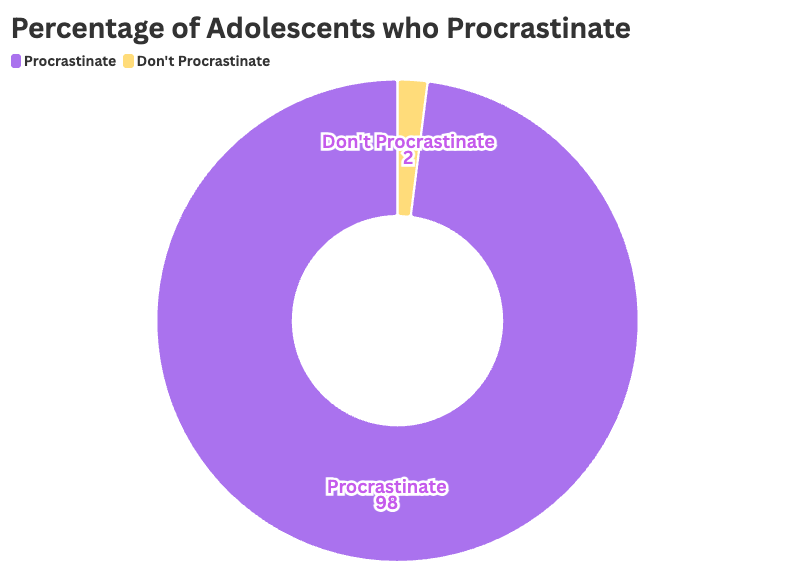
This is not simply the result of being lazy or absent-minded, but rather a habit that has been normalized and pushed by psychological and social processes. Mass General Brigham McLean defines procrastination as a self-defeating behavior pattern marked by short-term benefits and long-term costs. Yet, despite being aware of deadlines looming ahead, around 98% of Americans admit to procrastination, according to Solitaired, which surveyed Americans in every state.
“I don’t mean to procrastinate, I don’t think anybody means to,” said Isabelle Lolos, a freshman at Drexel University.
Background on the brain
Procrastination occurs when the limbic system, the emotional component of the brain responsible for processing pleasure, pain, and reward, overpowers the prefrontal cortex, the logical component that governs executive functioning.
The limbic system comprises four main structures: the hypothalamus, thalamus, hippocampus, and amygdala. The amygdala, in particular, processes emotions such as anxiety and anger, making it prone to favor short-term satisfaction the moment it becomes overwhelming.
“I’m always saying, ‘Oh, I’ll do it tomorrow, I’ll do it tomorrow,'” Lolos said. “Until it gets to be the day before it’s due, and I realize now I really have to do this.”
During moments of procrastination, the prefrontal cortex struggles against temporal discounting, the tendency to devalue future rewards and prefer smaller, immediate gratification. This is what allows awareness of one’s actions while actively working against their long-term success.
“A lot of people feel that in order to start a task, a lot of folks feel they need to be already motivated to start that task, and until they’re motivated, they look for ways to avoid doing it,” said Reginald Parquet, a Tulane professor in the School of Social Work and a licensed clinical social worker.
Addiction
The brain is equipped with its own reward system, which is mediated by dopamine. This neurotransmitter is associated with pleasure and satisfaction, and when triggered, it releases immediate gratification. Now, with the introduction of Artificial Intelligence (AI) procrastinating assignments has become even easier.
Every time a task is avoided and replaced by video games or scrolling on social media platforms, dopamine is released as a short-term “reward” for the brain. According to the National Institutes of Health (NIH), through consistent avoidance and increased dopamine, one undergoes classical conditioning, an unconscious learning process in which a biologically potent stimulus, such as dopamine, is paired with a neutral stimulus, like avoidance.
Over time, this builds an unhealthy habit of consistent procrastination and an inability to follow through. Additionally, the guilt and stress as a result of specific tasks being pushed aside take a toll on one’s mental health.
According to the NIH, procrastination may be associated with a range of health outcomes, including worsening mental health, unhealthy lifestyles, and worse levels of psychosocial health factors like higher loneliness and economic difficulties.
The side effects of procrastination manifest physically, including sleep disturbances, high blood pressure, and a weakened immune system, according to The Echo.
Yet, all these symptoms have become even more frequent. It’s common to hear peers complain about their lack of sleep or declining health due to cramming after procrastinating.
“It’s almost like casual conversation with friends to talk about how stressed out you are or how you’re procrastinating your next assignment,” Lolos said.
An individual’s surroundings and environment are significant factors in determining the likelihood of procrastination.
“A lot of folks who end up engaging in procrastination, many of them grew up in families, grew up in environments that were not very intellectually or emotionally, or socially, or even spiritually validating and supportive,” Parquet said. “So they were in these environments growing up during their developmental years, and there was all this doubt because the family never affirmed or validated the things they thought about and believed in.”
According to Fuschia Sirois, author of “Procrastination: What It Is, Why It’s a Problem, and What You Can Do About It,” procrastination is a problem driven by emotions, not laziness, and learning to manage negative emotions effectively can help us overcome it.
However, misjudgment is one of the most common driving factors behind putting off certain activities.
“I think we procrastinate because people always think there’s more time, and we just never have enough time,” Lolos said.
This judgment often leads to false beliefs that it’s “too late to start an activity now,” or “it’ll get done eventually.”
Breaking the cycle
Being able to overcome any false beliefs and take action on the item at hand is essential in building the strength to resist further procrastination. Nonetheless, the methods for stopping procrastination are fairly straightforward.
“Like any behavior, any pattern, any habit, the first step is owning it. Because if you don’t own something, you can’t change it because it’s not yours,” said LeeSun Clark, a self-love coach specializing in hypnosis and Neuro-Linguistic Programming (NLP) to help with self-acceptance and confidence.
There’s a tendency to associate dealing with procrastination with punishment. According to the Greater Good, it’s problematic to self-criticize when you’re trying to avoid procrastination. Being harsher allows self-deprecation to support one’s negative perception of their own abilities.
“Approaching procrastination from a much more compassionate point of view makes it a lot easier to actually do those things instead of having this constant inner battle where one part is trying to overcome the other,” Clark said. “When people try to quit smoking, for example, it often fails because the pressure is too much and you can’t sustain it.”
Clark explained how, by practicing self-compassion, motivation shifts from pressure to genuine desire. This understanding reveals how the brain’s naturally seeking tendency conflicts with its more deeply ingrained goals.
“Your psychology is all equipped to really draw you towards things that you want to do,” Clark said. “Often people can’t tell the difference between what they feel like doing in the moment and what they actually desire for their lives.”
Procrastination can be an unwanted experience, but it’s not a permanent mindset.
“Individuals who experience procrastination have to take what appears to be an overwhelming task and break it up into small, manageable pieces that they can consume one bite at a time,” Parquet said. “That’s not any really deep theoretical scientific perspective. It’s common sense.”
