
At too many high schools across the nation, getting an A — or even straight A’s — doesn’t feel like an achievement, but the bare minimum.
Inflated GPAs have become the norm in college admissions, as students, parents, teachers, and the broader college-preparation culture push for higher grades without a corresponding increase in academic achievement. As one ACT-sponsored study shows, the average high-school GPA has risen from 3.17 in 2010 to 3.36 in 2021. That steady rise in GPA, however, has not been backed by more objective, standardized measures; in fact, average ACT scores over that period have actually declined slightly.
Similarly, a report from George Washington University found that while only 48% of incoming freshmen at the university had GPAs above 3.59 in 2014, by 2024, that figure had increased to 73%.
On the surface, grade inflation might seem harmless — what’s wrong with allowing more people to do well? The problem is that when so many students graduate with perfect or near-perfect grades, their GPA stops being a useful indicator of academic prowess in college admissions, becoming a mere checkbox. Rather than meaningfully distinguishing students, grades now serve as a threshold to even be considered at elite universities.
The core problem, grade inflation, appears to be part of a self-feeding cycle. As grades increase, students come to expect A’s on their report cards, and when teachers’ jobs rely on, at least in part, keeping students and their parents happy, they are incentivized to give out those high grades.
This trend extends beyond high school and into higher education, including institutions such as Harvard University. A report sent to Harvard faculty and students found that nearly 60% of grades awarded to students were A’s, compared to only a quarter of the grades twenty years ago.
Washington University professor Ian Bogost, in an interview for NPR, described the cycle of grade inflation at the collegiate level.
“There’s an incentive for them to give higher grades because students love getting higher grades,” Bogost said.
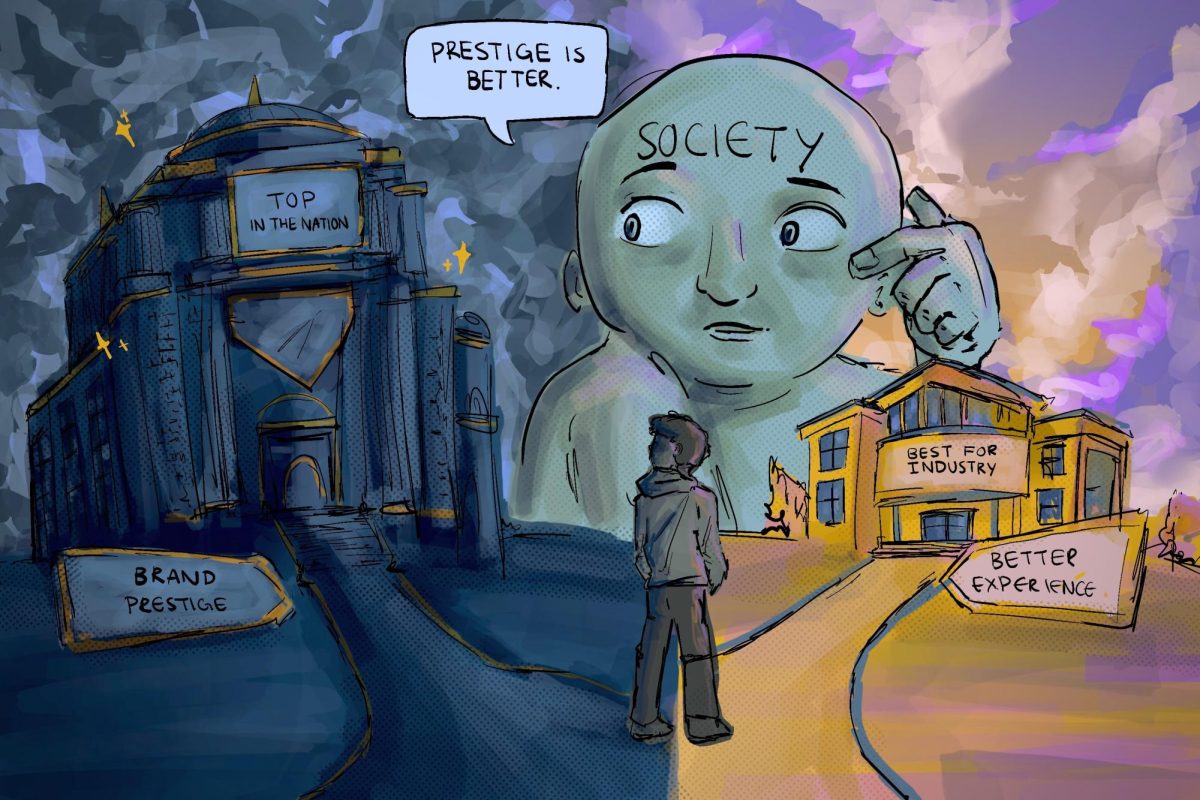
This broad shift is highlighted by the disappearance of the concept of the “well-rounded” student. Since grades hold significantly less weight, students are told to stand out in other ways, mainly through their extracurricular activities.
Colleges increasingly demand that students “show their passion,” or “find a spike,” leading high schoolers to overload their resumes with extracurriculars that are largely for show: starting clubs, organizing “impact” projects, or chasing leadership positions. Students feel pressured to choose a direction — pre-med, engineering, business, whatever it may be — for their futures as early as freshman year, with many even being told that colleges don’t want to see well-rounded students.
While early specialization may benefit a small minority of deeply driven students, for the majority, schedules, after-school activities, and summer plans are often built around careers that are arbitrarily chosen without a chance to truly explore what they want to do for the next decade or so of their lives. While high school used to be for students to discover their interests before specializing later, inflated grades have shortened that timeline. Waiting until junior year, for example, to decide what to focus on, feels risky compared to peers who have been building their resumes in specific fields for the past two years.
This narrowing undermines genuine growth, as students lose the chance to experiment, make mistakes, and backtrack. Instead, they shape their identities around what will appear impressive on their applications. This grade inflation bubble, which many believe will lower stress and support students, ends up having the opposite effect, making academic achievement less meaningful and increasing the demands of college admissions.
While reducing grade inflation will not solve every problem in education, redefining what grades really mean would help bring clarity to the admissions process. More importantly, though, it would give students time to figure out who they are before having to present themselves as polished candidates.
This editorial reflects the views of the Editorial Board and was written by Andrew Liang. The Editorial Board voted 8 in agreement, 7 somewhat in agreement, and 2 refrained from voting.