


As the college application season winds down, seniors are refreshing their email inboxes as they play the dreaded waiting game to open the letter that will decide their future.
Every year, students face mounting pressure to attend a four-year college, spending many hours stressing over and preparing their applications in hopes of gaining acceptance to a top university. However, many overlook their readiness or personal goals, simply because a university degree is often seen as the default path to success.
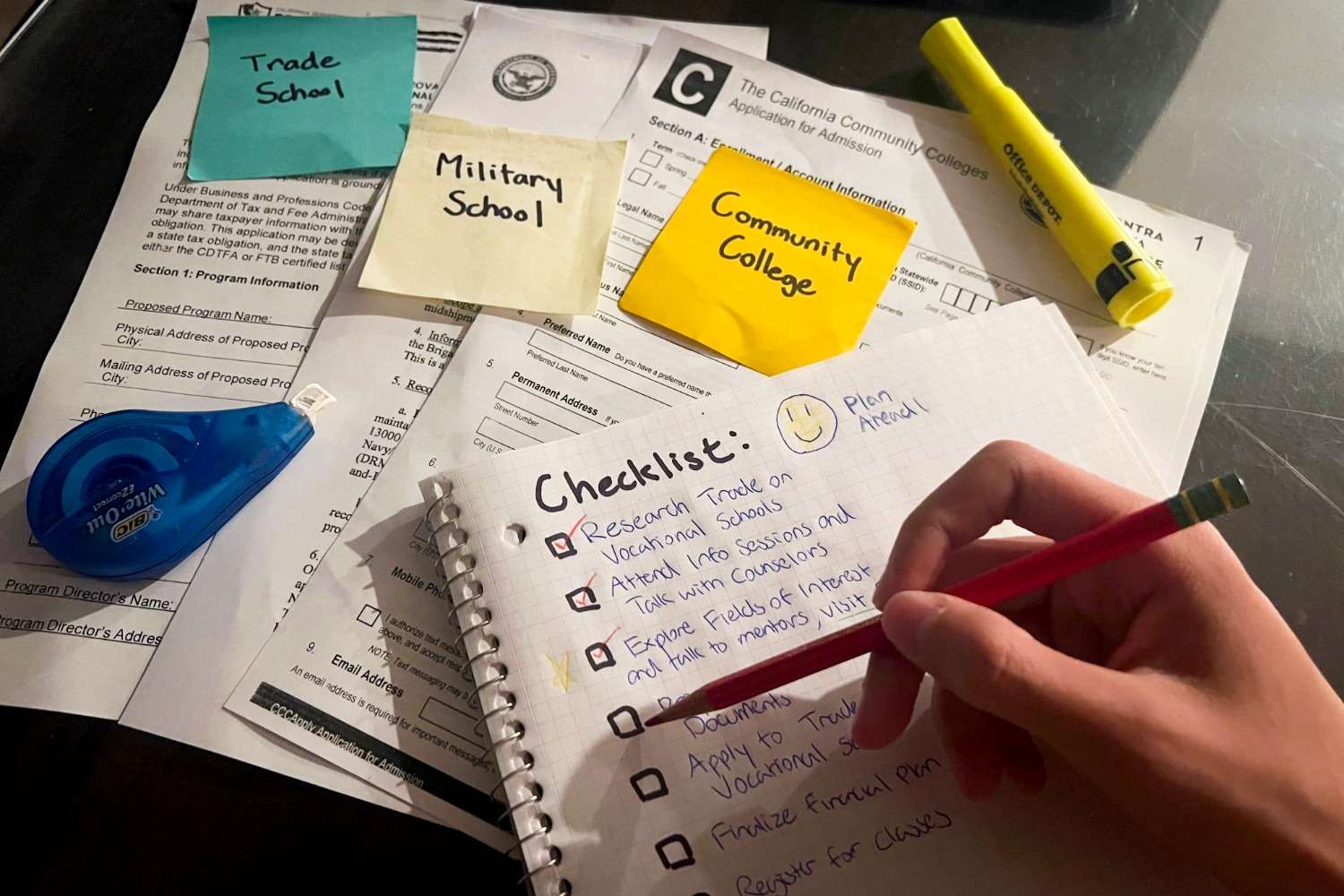
But success after high school doesn’t have to be defined by a single path. While many students still aim to attend university, an increasing number are also exploring alternatives, such as taking a gap year, attending trade and vocational programs, enrolling in a military school, or entering the workforce directly after high school.
In fact, as tuition costs rise and concerns about return on investment emerge, students and families are reconsidering their higher education choices.
“Some are looking for a more affordable option, prefer hands-on learning, want smaller class sizes or a more flexible schedule, or simply aren’t ready to commit to a four-year environment right away,” said Akia Washington, a Carlmont counselor who has worked with several high school students committed to different post-grad pathways.
According to a 2025 Pew Research study, only 53% of teens plan to attend a four-year college, while an increasing number are exploring alternative options: 10% plan to attend a two-year college, 9% a technical or vocational school, 6% plan to enter the workforce directly, and 3% are considering the military.
Rather than simply following the traditional route, students are choosing paths that align with their skills, interests, and goals. Especially as many employers continue to relax degree requirements, students are beginning to view these paths as a means to avoid debt while quickly gaining skills. For some, these paths offer a more affordable and flexible alternative.
The opportunities of community college
A community college is a two-year public institution that offers associate degrees, vocational training, and certificates to prepare high school students for entry into the workforce. Unlike a university, it maintains an open-admissions policy, serving a more local and diverse student body.
In some states, community colleges offer a transfer system that allows students to earn their bachelor’s degree by starting at a community college with lower-division coursework, before transferring to a four-year university. At community colleges in California, students are guaranteed transfer to a University of California (UC), a California State University (CSU), a Historically Black College or University (HBCU), or another nonprofit university.
Every year, nearly 80,000 California community college students transfer to a UC or a CSU, and 40,000 earn an Associate Degree for Transfer (ADT).
Additionally, it offers a cost-effective and fast alternative, especially for many socioeconomically disadvantaged families, often providing a quicker entry into the workforce. It also enables high school students to establish a stronger academic foundation, with smaller classes providing additional support.
After starting at UC Davis, Will Steinberger quickly realized that the large classes and limited flexibility didn’t meet his expectations.
“It’s just hard to get personal attention. I felt that it made the material less approachable because you sit in a huge lecture hall with a few hundred students, and then you just leave, with nothing really personal about it. It didn’t really feel like it mattered if you were in class or not,” Steinberger said.
After his first year at UC Davis, the lack of interaction, combined with professors who weren’t invested in introductory classes, made him realize that he was forcing himself through an experience that wasn’t working. This recognition ultimately pushed him towards an alternative path: enrolling in community college.
“I have good things to say about community college. There were much smaller classes, and the teachers were more engaged and helpful. From a quality of education perspective, I felt it was, at least the same, if not better than university,” Steinberger said.
Steinberger’s perception of community college was permanently altered, despite facing challenges with commuting and living off-campus.
“You get a good education through a really good value in classes that are small. It made me think more highly of community colleges because they can have some good teachers,” Steinberger said. “Moreover, there’s no denying that college is very expensive. You can save a ton of money and learn basically the same things.”
Steinberger also emphasized that community colleges can provide enormous value if students approach them with intention. According to the California Community Colleges, the system has helped improve the future opportunities and standard of living for its alumni, with alumni supporting over 1.7 million jobs in California alone.
“A lot of people waste time there because they don’t want to enter the real world yet, which is one of the reasons for its bad reputation,” Steinberger said. “But if you do community college well — get good grades and sign a transfer agreement — it can be a great launching point.”
By approaching community college with that mindset, Steinberger eventually earned the credits to transfer to a four-year university, where he went on to earn his bachelor’s degree. His experience at a community college ultimately provided him with a stronger academic foundation and direction that he had been missing at university.
Pursuing military school
A military school is an educational institution that combines traditional academic coursework with a military-style structure, emphasizing the building of character and discipline in its preparation of cadets. Unlike a university, this military-focused path typically begins with enlistment, followed by basic training and then technical school, which prepares students for specific careers.
Additionally, for some students who feel unprepared for college, the military offers an alternative experience that preserves the on-campus experience, which many consider an integral part of transitioning into life after high school.
Kaleb Abdullah didn’t initially plan to join the military. After graduating from high school, he enrolled at the University of Texas at Dallas, intending to follow the traditional four-year route — a path his family expected would lead to a stable career.
“I had extremely high expectations for myself because in high school, I was an all-A student, so I thought in college, it shouldn’t be any different,” Abdullah said. “My family expected me to become a world-famous physicist right away.”
However, the transition from a small rural environment to a large university hit harder than anticipated. Unable to financially support himself through college, he found himself slipping academically and struggling to stay afloat, eventually dropping out after his first semester of freshman year.
“It was a big shot to my ego,” Abdullah said. “Coming from a poor community really hurts, because you have to constantly worry about how you’re going to pay while keeping your grades up, and I found it difficult to view myself in a different role.”
Upon leaving college, Abdullah faced financial instability.
“I was homeless for about nine months, just couch surfing and working at the grocery store. I needed to find a way to make money that did not require me to go back to school,” Abdullah said.
It was during this time that he discovered the military. This opportunity would provide both practical training and financial support through the GI Bill, allowing him to return to college without the burden of tuition and living expenses. He approached a military recruiter, hoping to become an air traffic controller, and joined the Air Force in December, 11 months after dropping out of college.
Alongside the financial benefits, Abdullah also learned many skills and lessons that he felt he would not have acquired in a college environment.
“In air traffic control, everything is dependent on the team working together. If one person falls behind or makes a mistake, then you’re all failing. You have to support each other, which taught me the value of teamwork.” Abdullah said.
He also highlighted the ways the military forced him to confront personal challenges.
“Before joining, I was extremely socially anxious. But in air traffic control, you have to answer phone calls all day long. You’re constantly talking to people. If you’re socially anxious going in, that’s going to just get beaten right out of you if you’re in that environment long enough,” Abdullah said.
Abdullah emphasized the other practical skills he gained in the military, which he credited to the strict scheduling and high demands, even surpassing those of his college experience. According to the Federal Aviation Administration, cadets in technical training for air traffic control work tirelessly, dividing their time each week between classroom instruction, simulator training, and mandatory independent study.
“If you create a schedule and wake up an hour earlier, you would be surprised how much time you can save, just by doing that every day. You have way more time than you think. The military definitely gave me that skill of time management,” Abdullah said.
Beyond finances and social growth, spending time in the military helped Abdullah rethink his identity and resilience.
“Part of my suffering was that I was so married to this idea that I had to be this exact one thing, that any deviation was a failure. And I think that’s a horrible way to see yourself,” Abdullah said. “Don’t assume your self-identity is just this one thing because it isn’t. Everybody is a multitude of so many different things, so the military definitely helped disconnect that image of myself from my job because I am not my job.”
Ultimately, Abdullah’s military experience provided him with benefits that extended far beyond training for a career.
“The military leaves you with all this new training and all these new resources,” Abdullah said. “It’s a great way to restart life if you feel like you’re stuck.”
Directly entering the workforce
Some choose to enter the workforce directly after high school or start a business, rather than follow the traditional route of continuing their education. This path often allows individuals to gain practical, hands-on experience, build professional networks, and develop entrepreneurship skills that a college setting may not fully provide.
For Adam Khan, this route began after he started his initial studies at the University of Illinois Chicago as an electrical engineering and physics major. Rather than immediately continuing his education, Khan chose to devote his time and energy to researching lab-grown diamond technology, eventually founding Akhan Technologies.
“If I didn’t start actually working on the material and trying to evolve the materials development status, I was going to miss the boat,” Khan said. “I felt that if I stayed in my academic studies, somebody else would come in and essentially scoop the advancements that we were pursuing in diamonds.”
By entering the workforce directly, Khan gained invaluable, real-world experience with advanced technology that most students typically encounter only later in their academic journey.
“I was always doing the kind of research that I would have seen as a graduate student, learning directly with some of these advanced synthesis tools,” Khan said.
Additionally, entering the workforce early helped Khan build a professional network that would have been difficult to develop solely through coursework.
“Even though I went through this unconventional route, I ended up winning the Forbes 30 Under 30, being featured on Bloomberg, and a number of high-profile media outlets. I had a profile and a network that I certainly wouldn’t have had going the direct undergraduate route,” Khan said.
Running a business at such a young age has also helped Khan develop valuable real-world problem-solving and leadership skills. However, managing a team has also brought Khan many challenges and pressures.
“The biggest challenge I faced while working was that I didn’t have a degree to fall back on. I had to make this a success,” Khan said.
Despite the struggles, Khan emphasizes that running a business was an enriching experience, leading to both professional and personal benefits.
“It was extremely worthwhile to have what I was working on reviewed by such prestigious customers and brilliant individuals. It’s a feeling you can’t describe where you know the customer is into what you are creating and sees the extreme value in your research,” Khan said. “It was also rewarding to see the impact it had on my local community in Northern Illinois.”
The next steps
As students prepare to leave high school, experts stress that the real challenge is helping them step back and see the broader landscape of choices ahead.
“In reality, there are multiple paths that lead to success, but the pressure to meet that traditional standard can definitely weigh on them,” Washington said. “For many Carlmont students, these alternatives actually end up giving them the space and support to grow at their own pace while still moving toward a solid future — they’re affordable, direct, and highly successful routes.”
Especially as the job market evolves, opportunities that once seemed unconventional are becoming increasingly valuable. According to S&P Global, demand for skilled laborers remains steady, while job postings that require a college degree have fallen by nearly 3%.
“Families sometimes underestimate the value of trade programs and apprenticeships, especially in industries with high demand for skilled workers,” Washington said. “I’ve seen students who are very practical and career-oriented gravitate toward these options, as they give real-world training, paid experience, and a straightforward path into competitive careers.”
Aligning with the shift, Carlmont counselors have stepped up as advocates, emphasizing the importance of helping students explore all options and make choices that best fit their learning styles and intentions.
“As counselors, we’ve been increasing the number of presentations we give on all post-secondary options, including community colleges, trade schools, and apprenticeship programs. We want students to feel informed about every possible path, not just the traditional four-year route,” Washington said.
Ultimately, the message remains clear: students don’t need every step of their future planned out to succeed. Each path can offer valuable experiences and skills that contribute to their overall success.
“I wish students understood that they’re going to be okay — they will survive life after high school,” Washington said. “There isn’t just one right path, and choosing community college, a trade program, a gap year, or anything else doesn’t mean their future is doomed. They’re not signing a lifelong contract. They’re choosing a starting point.”
