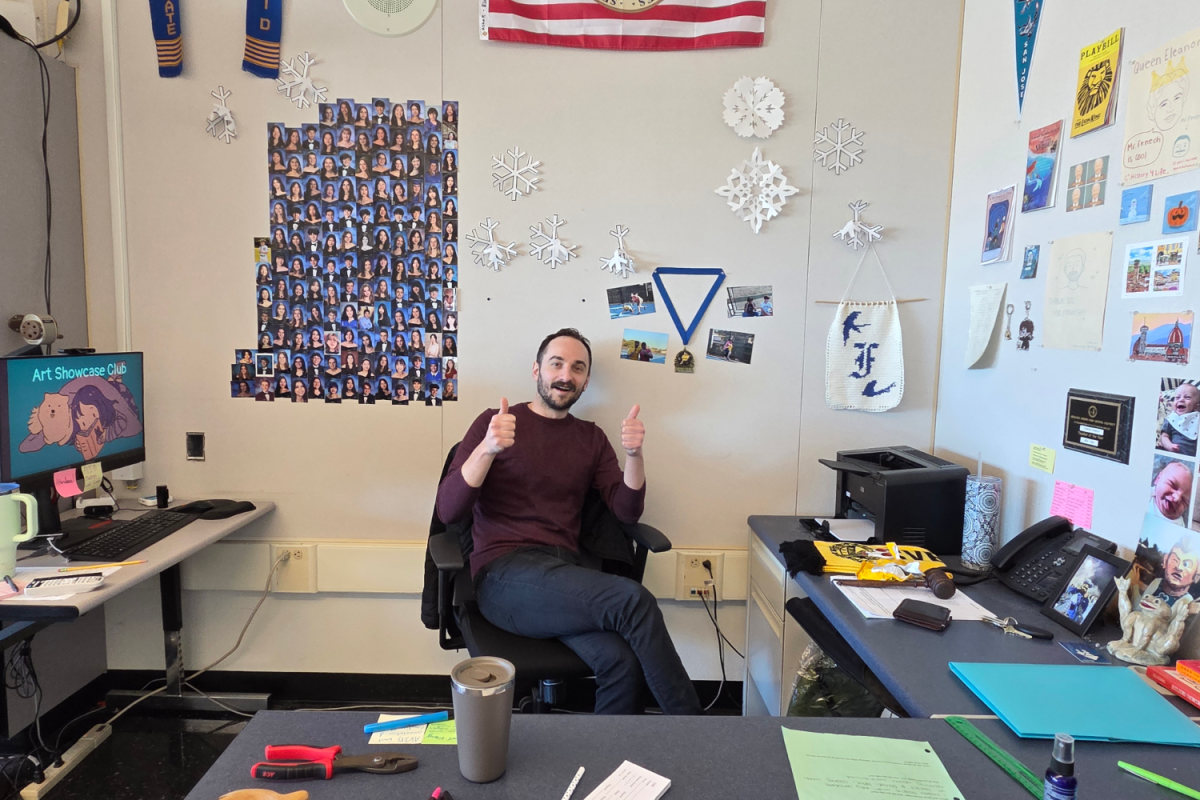
Connor Fenech, a Biotechnology Institute (BTI) World History, Advanced Placement (AP) U.S. Government and Microeconomics, and Advancement Via Individual Determination (AVID) educator at Carlmont High School, uses his experiences and creativity to engage students in his classes.
Fenech started out coaching hockey and gradually worked his way to his current position. He now teaches various classes and previously had teachers who helped him learn and grow, which has guided his creative approach to teaching.
“I’m terrible at science, and that was my worst subject in school, so I liked the idea of a challenge and being a little bit more creative, because I’m not necessarily teaching regular world history,” Fenech said. “I like that sort of freedom, that creativity, and that challenge behind it.”
Fenech takes a more interactive approach to learning, assigning projects and simulations so his students can experience the historical science he teaches and apply that same challenge to his lessons.
“His class is different because everything is very hands-on and more project-oriented, which is different from any other history class I have taken,” said Naura Saleem, sophomore BTI student, “Usually, I would have tests and quizzes every week and essays all the time, but he rarely ever gives us any of those and instead checks our progress and understanding through our notes and projects throughout the units.”
“We did this thing where we were simulating trench warfare, and we set up desk forts and threw paper balls at each other,” said Hanna Wee, another BTI sophomore in his class. “He implements a lot of details that make us able to understand certain things that happen and certain decisions that were made.”
That sort of hands-on learning is particularly helpful for some of his students in absorbing the content. Fenech believes this method works because of what students take from others and themselves.
“I do a lot of things in groups, too. I think what they really do is take bits from each other, and usually they end up with something that balances everything, which I think is representative of how work is done in the real world. That’s another thing I like about it.”
Fenech’s interactive approach to new subjects and territories has a positive effect on his students, creates an educational yet light environment, and teaches valuable lessons.
“I have learned that sometimes the best way to understand something is to look at it from another perspective and to understand what it was like,” Saleem said. “For example, when we learn about people involved in a specific event, we think about why they did what they did because of the situation they were in, and look at the whole picture without carrying any biases that would affect judgment.”