The Sequoia Union High School District (SUHSD) has removed the overgrown eucalyptus trees behind Carlmont High School as part of a campus safety project that has been underway for the past three weeks.
The work began after safety concerns emerged regarding the risk of falling trees and potential fire hazards. According to Carlmont Vice Principal Gregg Patner, the district initially planned for the project to take about two weeks. However, the schedule was extended, allowing crews to complete the removal safely and thoroughly.
The area had been a concern long before the project first started. Carlmont Plant Manager Jerome Clarke, one of the project leads, said discussions with the district began nearly five years ago regarding the removal of these trees.
“We’d had a couple fall over, actually, and destroy a fence that was back there,” Patner said. “Thankfully, nobody got injured, but staff parked and students walked back there. This has been a project we’ve been wanting to pursue to create a safer campus.”
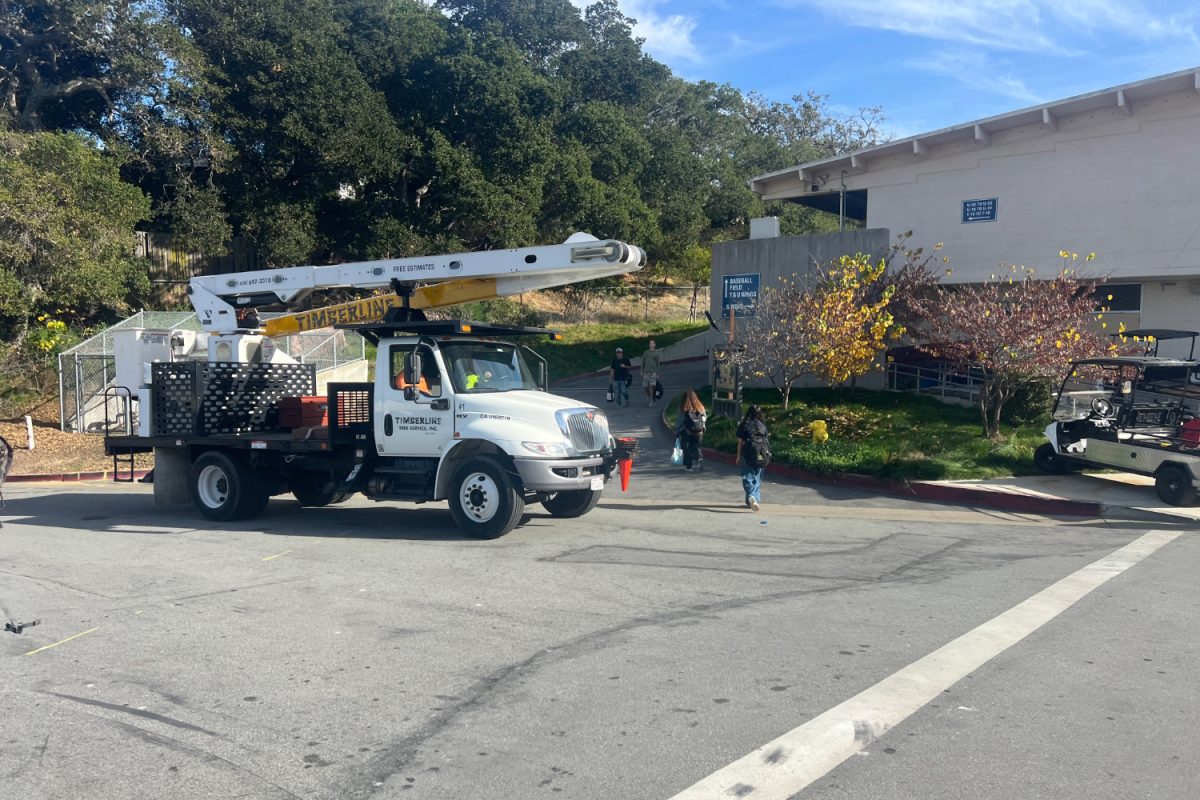
To carry out the work, the district hired Timberline Tree Services, Inc., a licensed company based in Burlingame, California, specializing in hazardous tree removal and safety maintenance. Much of the work centered on addressing the fire hazards associated with the eucalyptus trees.

Clarke emphasized the fire dangers posed by the eucalyptus. Fire incidents involving eucalyptus trees have become increasingly common, particularly in recent years, with bushfires. Often arising from the tree’s high concentration of volatile oils, the eucalyptus’ leaves and bark ignite quickly and can intensify fires.
“Eucalyptus trees are highly flammable because they have an oil on them that’s highly flammable,” Clarke said. “We cut back approximately 85 feet of vegetation from the fence line. That’s a safe distance, so in the case of a fire, it wouldn’t really damage the school.”
In addition to fire dangers, several trees have fallen due to soil erosion, caused by eucalyptus root systems. While the canopy was removed, the tree roots were left intact to stabilize the soil and prevent further erosion.
“Some trees fall because of the way they grow, which erodes the soil,” Clarke said. “It wasn’t a safe distance away from the campus, so they had to remove the trees.”
While the project aimed to improve campus safety, many students felt unprepared for its sudden disruption.
During the removal, access behind the school was blocked off, forcing students to reroute through already crowded hallways during passing periods.
“They blocked off the entire area, and everyone had to flood the hallways,” said Carlmont junior Jessica Sun. “It caused a lot of traffic, and I had no idea what was going on or why they had to cut down the trees.”
Moreover, the noise from the project affected nearby classrooms, resulting in frequent disruptions.
“In my APUSH classroom, it was extremely loud and disruptive,” Sun said. “Our teacher would be trying to teach, and you’d keep hearing background noises. It was hard to focus, especially since we’re in a classroom that’s really close to the site.”
Although the administration informed staff of the landscaping changes, many students felt left out and unaware of the new developments. While Carlmont Principal Gay Buckland-Murray sent updates, students like Sun wished that the school had been clearer with its communication to students.
“They should have just informed us of what was happening. It made more sense to be able to know what was going on and understand the purpose of this entire project,” Sun said.
Some students also raised concerns about the environmental impact. Sun said she was disappointed to see the eucalyptus grove removed, even as she acknowledged the safety rationale behind it.
“Trees are really important in shaping the school environment, so I felt pretty disappointed that they removed all those trees, especially as the area didn’t seem to cause much interference,” Sun said. “However, California is very fire-prone, so in that sense, it was a good decision.”
Despite the short-term impacts, administrators emphasized their goal in mitigating further harm and risks that the trees pose to the school.
“Safety is our number one concern, and advocating for a safe campus is really important to us. That was what this project was in a nutshell,” Patner said.
With the project in its final stages, the administration hopes that it will provide the campus with long-term safety protection for years to come.
“People can relax easier,” Clarke said. “If there’s a fire or high winds, we won’t have trees falling on cars or anything threatening students.”