

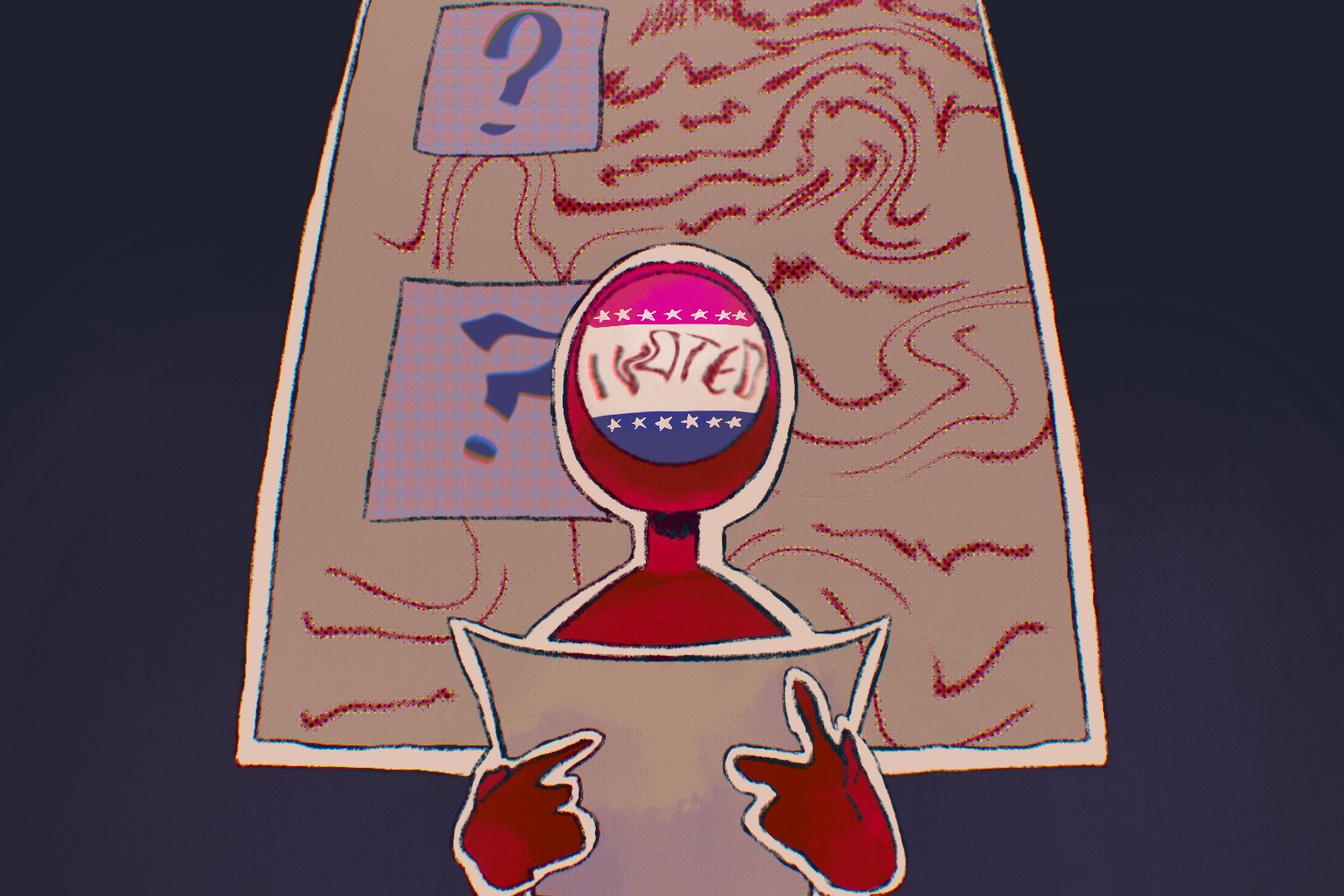
At the polling station, a voter stares at the ballot, each sentence blurring into a string of words. In the grocery store, someone else struggles to make sense of the labels and ingredients that others scan without a second thought.
For many adults, reading is not an automatic skill, but rather a daily obstacle that limits independence. This becomes even more dangerous when considering the implications of low literacy in a democracy.
“If we cannot read accurately and carefully, we miss a lot of important information, and we have to have the basic skill of processing words. We have to see what’s in them and what’s lying behind them, what the nuances are,” said Thomas Foster, author of “How to Read Literature Like a Professor.”
In a country where knowledge is power, millions of adults remain barred from access to opportunity and participation in everyday life. Whether it is reviewing a new credit policy for their credit card or understanding a candidate’s stance on healthcare reform, literacy and critical thinking skills play a vital role in shaping America’s democracy.
The state of reading today
According to the U.S. Program for International Assessment of Adult Competencies (PIAAC) in 2023, the percentage of low-performing adults, scoring Level 1 or lower, increased from 19% in 2017 to 28% in 2023. Additionally, the percentage of high-performing adults, scoring Level 3 or higher, decreased from 48% in 2017 to 44% in 2023.
These levels are characterized by differing degrees of proficiency in literacy. Someone with a Level 1 proficiency level is able to locate information on a text page, understand the meaning of short texts as well as lists, and multiple sections within a single page, among other things. In contrast, someone with Level 3 proficiency is able to evaluate meaning across a longer text, interpret one or more pieces of information with varying levels of inference, and compare and evaluate information across multiple sources for credibility, among other things.
The slight increase in low-performing adults reflects a larger trend in the United States, where literacy and critical thinking skills are in decline, posing a threat to democracy and people’s understanding of complex issues.
There are several possible causes for low literacy rates among adults, including education inequity, socioeconomic status, and a lack of engagement with reading and writing beyond the school setting.
A 2021 study published in the Public Library of Science (PLOS) ONE journal, analyzed data from the Survey of Adult Skills across 33 countries and found that the main factors influencing someone’s literacy skills in adulthood include formal education attainment, as well as experiential, parental, and filter factors.
Limited access to higher education, fewer cultural and familial values in education, and little to no literacy or numeracy skills related to work can all contribute to lower literacy rates.
Beyond the literacy itself, what is more important is how people choose to use information. Reading and critical thinking go hand in hand, shaping how individuals can make informed decisions.
“Literacy practices are not so much about whether people can read or write something. It’s more about what they do with it and how it’s incorporated into other things they do in their lives,” said Stephen Reder, a professor of Applied Linguistics at Portland State University.
Whether it is an institutional disparity or the result of childhood development, the persistence of low literacy reflects systemic issues that extend beyond the classroom.
Barriers for adult learners
However, significant challenges remain for adult learners who want to improve their literacy. From managing a job to having a family to personal finances, adults have numerous responsibilities that can impede their literacy journey.
“We have many learners in our program who are pregnant or have become pregnant and may have to step away for a bit while they’re caring for their young one. It can also be challenging for learners to get to their local library,” said Araceli Efigenio, a Community Program Specialist for the adult literacy program at San Mateo County Libraries (SMCL).
In addition to socioeconomic factors, there are cognitive barriers that make it more difficult for adults to develop literacy skills than it is for children to learn them.
According to an article by the Center for Global Development, the human brain undergoes changes throughout life, a phenomenon known as brain plasticity. While there are variations in when a brain is most adaptable, it is often considered most “plastic” during early and mid-childhood, suggesting that these periods are best for learning foundational skills.
In adulthood, the dominant theory is that brain plasticity decreases as the brain becomes specialized towards adult functions. It is more difficult for the adult brain to develop and process new foundational skills, such as reading, than for a child’s brain.
“Some of the phonological skills that children grow up with are less mobile, less tractable, and less adaptable when they’re older as adults. It’s not true for all adults, but many find it difficult to learn a new sound structure or a new graphing phonics relationship,” Reder said.
As a result, in addition to the extra responsibilities of adulthood and potential socioeconomic factors, it may be more challenging on a cognitive level to develop fundamental literacy skills in adulthood.
Turning the page
Although low literacy rates present a serious challenge, numerous local initiatives aim to address this issue by providing free services to support literacy development.
The adult learning program spans across the SMCL system and offers one-on-one tutoring services to help adults improve their reading and writing skills. Further, the adult learning program offers additional helpful aids for individuals developing literacy skills or learning English.
“Learners work on a variety of different goals. Some new parents and grandparents are inspired by their newest family members and want to be able to read them a book in English. We have some people studying to pass their citizenship test, license tests, and community college classes, so we have quite a variety of learners in our program,” Efigenio said.
Programs like these demonstrate how adult learning initiatives go beyond literacy skills. They help learners achieve personal, professional, and civic goals, all of which are vital to functioning in society.
Further, it takes significant courage and determination to pursue this journey. In addition to typical adult responsibilities, developing complex literacy and critical thinking skills and actively practicing them is taxing and time-consuming, a testament to the perseverance of adult learners.
“I’m inspired by the tenacity and motivation that our learners come to us with, the bravery to get ahead in life, not just for them but for their families and future generations. It’s something that’s really special,” Efigenio said.
Beyond the words
All of this reinforces the importance of literacy and its function in society. A lack of literacy poses a threat to democracy and endangers people’s freedoms and civil rights.
Democracy is based on the idea that citizens are informed and have autonomy to vote and participate in the government, making decisions that they completely understand. If they are unable to access and process valuable information such as policy and current events, they are at a disadvantage and cannot make truly informed decisions.
“The type of cognitive independence and open-mindedness that a democracy takes for granted in how its set up is challenged when adults can’t read and write well. It limits things,” Reder said. “Information literacy has to do with questioning and piecing together information sources you’re exposed to, and I think those are posing a real challenge to our democratic institutions.”
Moreover, if people lack the critical thinking skills necessary to gauge nuance and tone, they put themselves in a vulnerable position, taking information at face value without considering the context of the text, underscoring how literacy is more than just reading words — it is about understanding, interpreting, and applying information effectively.
“To put it in stark terms, democracy doesn’t work without literacy. In all of its forms, literacy is about separating the wheat from the chaff, getting rid of all the stuff that’s noise, and getting down to the heart of the matter. Those kernels of information that we need, and how we use them, are important, but we don’t come into this world knowing how to do that, so that’s what makes teaching such an important activity,” Foster said.

