

National Teen Driver Safety Week, observed from Oct. 19 to 25, brought renewed attention to the dangers teen drivers face every day, from distracted driving to speeding and inexperience.
In California, the new “No-Touch” Cell Phone Law, which went into effect in July 2025, adds urgency by making it illegal for any driver to hold a phone behind the wheel. Parents and law enforcement are using this week to remind young drivers that no text, notification, or social media update is worth risking a life.
This law builds on earlier rules. In 2008, California banned talking on a handheld phone while driving (Vehicle Code §23123) and later banned texting (23123.5). Assembly Bill (AB) 1785 in 2017 allowed limited use of mounted phones, but many drivers still held their devices. In 2025, a court clarified that holding a phone for any reason while driving is illegal.
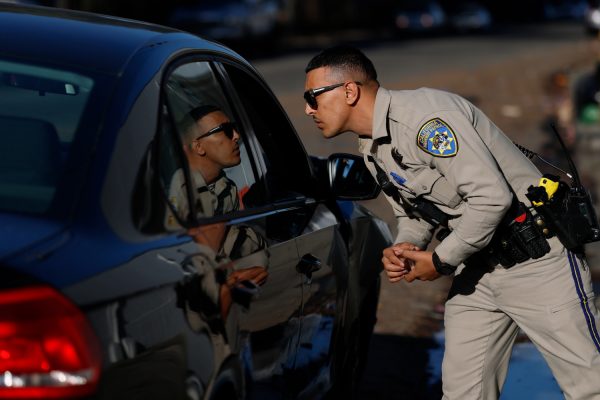
“The ‘No-Touch’ Law sends a simple message that driving requires your full attention. It’s not about punishment, but about protection. Specifically for teens, it shows that driving isn’t a casual activity. Driving is a serious responsibility, and even one moment of distraction can change everything,” California Highway Patrol (CHP) Officer Adib Zeid said.
Belmont Police officers participated in special Teen Driver Safety Week patrols and educational events, focusing on high-traffic areas near schools to remind students of the new ‘No-Touch’ Law and the dangers of distracted driving.
Similarly, the San Mateo County Sheriff’s Office issued a news release, encouraging parents and teens to have open and honest conversations about safe driving. The Sheriff’s Office emphasized the importance of setting clear rules, modeling good driving behavior, and understanding California’s graduated driver licensing laws.
The rising issue of teen distracted driving
Car crashes are the leading cause of death for American teens, according to the Centers for Disease Control and Prevention (CDC). Factors like inexperience, risk-taking behavior, alcohol use, and speeding make young drivers particularly vulnerable.
A 2025 study from the Harvard Gazette found that seven out of 10 young people use their cellphones while driving. The problem worsens during the summer months, referred to as the “100 deadliest days,” when unsupervised driving and risky behaviors increase the likelihood of accidents.
According to the American Automobile Association (AAA), over one-third of each year’s fatal teen driver crashes occur during the summer due to more unsupervised driving time, increased traffic, and risky behaviors like speeding and distracted driving.
Junior Amber Chow, a Carlmont student driver, agrees that phones are the biggest distraction compared to other factors like music or passengers in the car.
“My phone distracts me the most. Music doesn’t tend to distract me, but rather helps me from spacing out. I’ve heard small bits about California’s new ‘No-Touch’ Law, but I’m not too informed on it. I think it’s a good law to have in place, as I see way too many drivers on their phones,” Chow said.
Chow said that whether teens follow driving laws often depends on the individual, and teens struggle more than adults because social media is shortening their attention spans.
“When teens first get their licenses, I think they are more cautious, but as time goes on, lots of teens start to use their phones,” Chow said.
Since many teens may see phone use as harmless, officers work not just to enforce the law, but to help young drivers understand the risks.
“We get that phones are part of everyday life, but we also understand how detrimental distracted driving can be. We encourage drivers, especially teens, to minimize distractions for their safety and the safety of others. If whatever is on that phone can’t wait, we encourage drivers to pull over safely. While enforcement is important, the main goal is to create that behavior change, not tickets,” Zeid said.
Local enforcement follows a similar approach, focusing on education and keeping drivers aware of the law. Traffic Unit Officer Tayler Kerrigan from the Belmont Police Department (BPD) shared a firsthand example of the law’s importance.
“Last year, I responded to a collision involving a teen driver on Ralston Avenue near Alameda de las Pulgas. The teen was looking down at her cellphone when the traffic in front of her came to a stop. She didn’t see that the car in front of her had stopped, and she rear-ended the other car. She was only driving about 10 – 15 mph, but the impact of the collision caused the airbags to go off. Since she had her cellphone in her hand, the airbag caused the cellphone to hit her on the face and cut her face. The car she was driving needed to be towed and was totaled,” Kerrigan said.
Zeid also shared this sentiment, voicing the same feelings and the emotional toll of distracted driving.
“I’ve stood on crash scenes where a simple text led to irreversible loss, and the hardest part is knowing it didn’t have to happen. It’s not the big decisions that cause tragedy — it’s the small ones we think won’t matter,” Zeid said.
Although awareness has definitely grown, and more drivers know the rules now, violations still happen every day.
“Some people try to hide it by holding the phone low, but distraction is distraction. The CHP keeps enforcing because every crash we prevent means one family that doesn’t get that phone call no one wants to receive,” Zeid said.
Local enforcement is focusing on education and keeping drivers aware of the law. Kerrigan said that BPD regularly participates in a countywide S.T.E.P. (Saturation Traffic Enforcement Program) each month, which is centered around educating the driving public about distracted driving and traffic violations. This department is also grant-funded to work on directed traffic enforcement for distracted driving several times a year, demonstrating that even beyond Teen Driver Safety Week, local authorities are taking extra measures to keep roads safe.
Under the new law, drivers can only interact with phones that are mounted and controlled by voice commands, or a single tap or swipe, all of which must be set up before driving. Even when stopped at a red light or in traffic, or looking at the screen or map, holding a phone is prohibited. Many teens are still unsure about what the law actually means.
“There is still a knowledge gap,” Kerrigan said. “I have a lot of teens tell me, ‘I was at a stop light’ or ‘It was on a mount.’ Many teens don’t know that the law prohibits touching their cellphones at any time – viewing GPS, text messages, or videos, touching or manipulating the phone while driving, and looking at a phone’s screen while holding it, even without actively using it. This all applies even at red lights.”
Drivers breaking the law face immediate penalties. A first offense carries a fine of around $136, escalating to $272 for a second violation within 36 months. Points may also be added to a driver’s Department of Motor Vehicles (DMV) record, which can lead to higher insurance rates or even license suspension. The law is under “primary enforcement,” meaning officers can stop drivers solely for violating it.
Even with these strict consequences, holding drivers accountable after a crash isn’t always simple. Because distraction is hard to observe in the moment, confirming it as the cause of a collision is often challenging.
“It’s hard to prove, because nine times out of 10, the driver isn’t going to admit to using their cell phone. But we often have witnesses or other drivers who tell us they saw the person using their phone,” Kerrigan said. “It’s especially difficult in a school zone. If someone gets injured, it’s usually because a driver was looking down at their phone. We don’t want a distraction like that to cause more harm than if they had just been paying attention.”
Officers often arrive at tragic crash scenes caused by distraction. These experiences can affect them personally and motivate them to keep raising awareness.
“Responding to crashes caused by distraction never gets easier. You see families show up on the worst day of their lives. You think about your own family, and it stays with you. That’s why so many of us are vocal about it, because if speaking up stops even one crash, it’s worth it. We will sometimes get the occasional driver who is unhappy that they were stopped for being on their cellphone, and they usually respond with something along the lines of ‘why don’t you go stop real crime,’ clearly showing that they don’t understand the tragic results that can arise from distracted driving,” Zeid said.
While Zeid hasn’t identified specific areas or intersections in San Mateo County where distracted driving incidents are most common, he has observed other patterns.
“There isn’t one single ‘hot spot,’ but we tend to see more distracted driving in high-traffic areas like stoplights, congested corridors, and places where people think it’s ‘safe’ to glance at their phone. The truth is that distraction doesn’t care where you are. It only takes a second,” Zeid said.
Belmont police see similar issues happening in their own community, with many teens getting distracted on local streets.
“We tend to get a lot more accidents or rear ends along Alameda de las Pulgas, a lot of those areas where the stop signs are, like Chula Vista, Alvarado, or even Carlmont Drive. And then along Ralston, in front of Notre Dame High School, there’s a lot of rear ends,” Kerrigan said.
In 2022, a collision on the same stretch of Alameda de las Pulgas left a Carlmont student’s car seriously damaged and forced the school to go on secure campus.
“I do see when school is out, I don’t get as many citations, but when school comes back in session every year, with more traffic and congestion, I see a lot more violations of distracted driving on the road. Since school has gotten back in session, in August, I’d say I probably received 20+ citations or warnings in those last few months,” Kerrigan said.
These patterns aren’t just seen on the streets, but they’re also shown in research on how teens process risk, attention, and decision-making.
Research and behavioral insights
According to Lucia Ornelas, a program and policy analyst at the Safe Transportation Research and Education Center (SafeTREC) at the University of California (UC), Berkeley, teens are particularly at risk due to inexperience and cognitive development.
“Even in situations where teen and adult drivers may be distracted at the same level, factors specific to novice teen drivers, such as developing hazard perception and situational awareness, may compound the risks associated with distracted driving and lead to more severe consequences,” Ornelas said.
Ongoing research is important in decreasing these risks.
“Research that focuses specifically on young driver behavior and safety to address this issue is currently in the works at UC Irvine. Dr. Federico Vaca, professor and executive vice chair of emergency medicine at UC Irvine, is conducting research that examines young driver behavior to better understand injury risk and crash prevention. Dr. Vaca and his team are working at the intersection of technology and behavioral science towards the goal of improving teen and young adult safety behind the wheel,” Ornelas said.
Peer pressure and social media can further worsen the dangers, as some individuals may feel compelled to respond to messages or engage in risky behavior to impress their friends. Certain driving environments can make these behaviors even more dangerous.
“Engaging in distracting behaviors like dialing, talking, or texting increases the risk of getting into a crash by three times. Teenagers are also more likely to engage in risky behavior when driving with teenage passengers compared to driving alone,” Ornelas said.
Although these behaviors are especially common among teens, distracted driving is a widespread issue affecting drivers of all ages. Ornelas said that distracted driving can stem from a variety of causes and take many forms.
“The 2025 Traffic Safety Public Opinion Study surveyed drivers aged 18 and older to determine which distractions they view as most serious on California roadways. From most to least frequently cited, respondents ranked the top distractions as: texting or checking phones while driving, talking on the phone, rubbernecking at crashes, eating, using dashboard or navigation systems, interacting with passengers, and noticing roadside billboards,” Ornelas said.
Education and community programs
Understanding the risks is only the first step. National Teen Driver Safety Week highlights strategies that turn research into real change, including education and community outreach programs that reach teens where they are.
“We work hard to reach young drivers early,” Zeid said. “Programs like Start Smart and Teen Impact Driving allow us to talk directly with teens and their parents about the real consequences of distraction. We use videos, survivor stories, and honest conversations because when teens see what can happen, it hits differently.”
During the awareness week, campaigns like Go Safely, California, encourage a traffic safety culture that encourages all drivers to be safe around pedestrians and cyclists. Additionally, the Distracted Driving Kills initiative shows the dangers and consequences of texting or engaging in other distracted behaviors behind the wheel.
Local partnerships, like Carlmont High School’s collaboration with the BPD, also take center stage.
“Our School Resource Officer, Officer Tagilala, also meets with Carlmont and other schools to educate students on the importance of distracted driving and traffic violation laws,” Kerrigan said. “The BPD and the schools already have a strong partnership with open communication.”
SafeTREC also uses tools like the Safe Systems Pyramid, which focuses on strategies that help whole communities rather than just relying on laws or infrastructure. Education is important, but it works best when paired with wider, system-level approaches.
“We offer various programs at SafeTREC, one of which is the Community Pedestrian and Bicycle Safety Program (CPBSP),” Ornelas said. “This program aims to improve road safety through the development of a community-driven safety action plan that helps communities identify and develop their safe walking and biking goals. The CPBSP worked on many Safe Routes to School-focused initiatives this past year, including conducting walk or bike assessments and arrival and dismissal observations near schools. The findings highlighted pedestrian and driver behaviors, roadway conditions, and community concerns relating to a lack of infrastructure to support safe walking or rolling to and from school.”
While Ornelas’ team has yet to research the law’s direct impact on distracted driving due to its recent implementation, data reveal what teenagers themselves consider their most pressing safety concern.
“The 2025 Traffic Safety Public Opinion Study, a study conducted for the California Office of Traffic Safety and SafeTREC, presented study findings on traffic safety perceptions and concerns, and included 2,319 responses from drivers across California ages 18 years or older. A multiple-choice question in this study asked survey respondents what they perceived to be the biggest safety problem on California roadways. Distracted driving because of texting, distracted driving because of talking, and internal car distractions were ranked third, sixth, and seventh, respectively, as to what survey respondents identified as the biggest safety problem on California roadways. Among the age group of teens and young adults ages 18 to 24, distracted driving because of texting ranked third out of the top five safety concerns identified on California roadways,” Ornelas said.
But awareness alone isn’t enough to prevent crashes. Keeping teens safe on the road needs collaboration.
“It takes all of us, from parents, schools, and local leaders, to make distracted driving prevention more than a law. We work with schools to educate students, with parents to model good habits, and with our community partners to spread awareness. Changing culture requires teamwork,” Zeid said.
Locally, the San Mateo County Sheriff’s Office Teen Defensive Driving Program offers free instruction during summer and special events, including awareness weeks, teaching teens to identify hazards, avoid accidents, and understand the risks associated with driving while distracted or impaired.
Student drivers like Chow use built-in car features to manage notifications. This system reads messages aloud and allows for responses via Siri. When a notification appears on the large screen, a simple click activates the function.
However, Zeid says that technology alone isn’t enough. With systems like autopilot modes and Bluetooth connectivity, many drivers may start to think that the technology can handle driving for them.
“Cars today can be safer, but can also be more distracting. Big touchscreens, apps, and driver-assist features can create a false sense of safety. Technology can help, but it can also pull focus away. The next challenge is reminding people that no matter how advanced the car is, you’re still the driver and responsible for that vehicle,” Zeid said.
Organizations like Impact Teen Drivers provide additional resources for teens and parents, including campaigns during National Teen Driver Safety Week and student ambassador programs that train teens to lead safety initiatives among their peers.
With distracted driving remaining a national issue, even a brief glance at a phone can pose a serious threat. As teens and parents reflect on safe driving, these programs and laws aim to keep everyone on the road alive and aware.
“Before you start the car, make the choice to drive fully present. Everything else can wait. Your choices can have real-life-changing consequences. Be smart, remove distractions, and drive to arrive,” Zeid said.