
“Smile. You’re on camera.”
At Carlmont High School, that cheerful store-decal on the attendance window is one of the few indicators that a student is being watched by security cameras. Alongside a faded sticker for Ojo Technology — a now defunct security company that the Sequoia Union High School District (SUHSD) hasn’t contracted for eight years — and two signs posted at two of the school’s entrances, these notices serve as the only public face of a sophisticated surveillance network sprawling across the campus.
The technology itself is anything but outdated: a fleet of Avigilon cameras with 4K resolution, infrared capability, and built in artificial intelligence (AI) analytics.
This Scot Scoop investigation has found that this district-wide overhaul was funded by $678,676 in public bond money. From inconsistent signage to the undocumented practice of emailing student images to staff for identification, the system remains largely invisible to the public that paid for it.
The current landscape
The district operates 280 cameras across its four campuses, 75 of them at Carlmont alone. The 2021 overhaul added 117 AI-powered Avigilon units to a network of 166 older cameras, with the most advanced ones concentrating coverage at choke points like gymnasium lobbies, building entrances, and the approaches to every campus bathroom.
The district has disabled facial recognition across all four campuses. The remaining active analytics are listed below.
‘Including, but not limited to’
The system was funded by Measure A, a 2014 bond, or voter-approved loan repaid through property taxes, intended to “support high quality education and upgrade local high schools.”
The bond’s full project list authorized spending on “technology equipment and infrastructure acquisition, upgrades and repairs, including, but not limited to, computer systems, networking infrastructure, cabling, and wireless.” That open-ended language, “including, but not limited to,” was later used to fund the cost of the Avigilon camera installation.
In May 2021, the board approved a $43,490 design contract with Guidepost Solutions LLC for the replacement of surveillance cameras at all four high schools. Six weeks later, in June 2021, the board approved a $577,442 installation contract with Johnson Controls Security Solutions, plus a $57,744 contingency, for the same project.
The two contracts were approved via the board’s consent agenda — a governance tool that bundles items deemed routine into a non-debatable vote — and no trustee or member of the public requested they be pulled for discussion.
During the June board meeting, the board president described the agenda as “jam-packed with a lot of housekeeping items” and called it “a lot of stuff that moves our district forward in important ways.”
Naomi Hunter, the district’s public information officer, said the expenditure was consistent with the bond’s terms.
“Measure A authorized the district to issue general obligation bonds to update, renovate, repair, construct, and purchase district facilities and technology,” Hunter said.
Sophia Cope, a senior staff attorney at the Electronic Frontier Foundation, said the bond measure’s language, while arguably broad enough to cover the expenditure as a legal matter, does not appear to have contemplated surveillance infrastructure.
“The language of the bond measure seems to contemplate bringing iPads into schools, for example, to enhance the teaching and learning experience,” Cope said. “Surveillance technology seems outside the spirit of the bond measure, even if the ambiguous language could arguably include surveillance tech.”
Cope said that when government agencies adopt surveillance technology, there should be an opportunity for community input regardless of whether existing legal procedures require it.
Hunter confirmed that the Measure A Citizens’ Bond Oversight Committee, a volunteer body that reviewed bond spending, eventually audited the surveillance system expense, but only after the fact — the committee’s role did not include reviewing contracts before they were signed.
Policy versus practice
Board Policy 3515 establishes the framework governing video surveillance on district campuses, requiring regular review of the surveillance system, posted signage with specific mandated language at conspicuous locations, and prior written notice to students and parents or guardians.
However, the policy has not been updated since 2019. The district’s 2021 overhaul is therefore operating under rules designed for a previous generation of technology.
Hunter confirmed that while policy updates have been drafted, they have yet to be submitted for board approval.
The signed design contract between SUHSD and Guidepost Solutions contains what appears to be the only written directive in any district document regarding the intended use of the camera system’s AI capabilities.
“Avigilon analytics shall be utilized enhancing the end user experience and serve as a force multiplier to strengthen the SUHSD security posture,” the contract states.
The contract offers no further specification, lacking any list of approved analytics or use restrictions.
The district also falls short of its own transparency standards. Policy 3515 mandates that signs be posted at “conspicuous and targeted locations” and state that the equipment “may or may not be actively monitored.”
Of the campus’s three entrances, only two have signs with the district’s mandated language. The only other notices — a smiley face decal and a sticker for Ojo Technology — are affixed to the administration building.
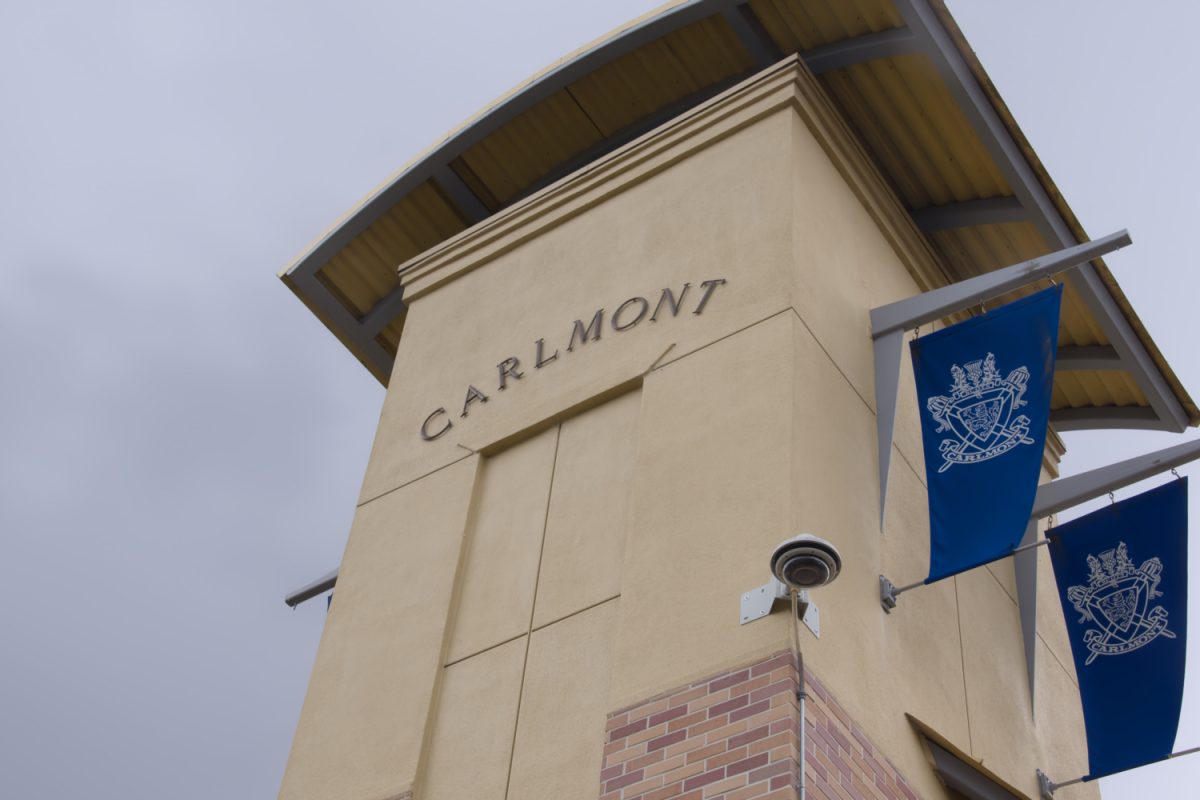
When asked about the signage gap, Gregg Patner, the administrative vice principal at Carlmont, did not directly address it.
“I am not certain if all of our signage is up to date with the language that replicates the Board Policy, but I can assure you that we have been and will continue to be transparent that we have cameras on campus to help us with managing a safe environment,” Patner said.
The written notice requirement was met. The district’s primary method of notifying the school community is a small disclosure buried on page 102 of the annual Parent Notification Letter, stating that video surveillance systems are used to monitor public areas and recordings may be used in disciplinary proceedings.
The letter, however, makes no mention of an additional practice used at Carlmont: administrators emailing screenshots of unidentified students to staff and asking for help identifying them, according to Carlmont staff member Kate Lawrence*.
“I would occasionally receive an email asking if I recognized any students that were in screenshots from the cameras,” Lawrence said, noting she received approximately three to four such emails over the course of a year. “It would just be a very brief ‘Let us know if you recognize any of these students.’ And that was it. We didn’t get any context.”
The practice at Carlmont raises questions regarding the Family Education Rights and Privacy Act (FERPA), the federal law protecting student records. FERPA allows schools to designate certain “directory information,” or basic information that can be shared without parental consent, provided that parents are notified and given the chance to opt out. Furthermore, FERPA explicitly lists photographs as a category schools may designate as directory information.
SUHSD, however, does not appear to have done so. The Parent Notification Letter defines directory information as a student’s name, address, phone number, email, date of birth, major field of study, athletic participation, dates of attendance, degrees, awards, and the most recent prior school. Notably, photographs are not included.
The letter also enumerates seven categories of authorized recipients: Parent-Teacher Associations, news media, other schools, scholarship nonprofits, certain local government agencies, military recruiters, and approved district vendors. School staff identifying unknown students from surveillance footage does not appear among them.
“There is no policy that supports or prohibits sharing surveillance footage with staff for unidentified students,” Hunter said.
What’s next
Hunter said draft revisions to Policy 3515 exist but have not been brought to the board yet. The SUHSD Board of Trustees meets once or twice monthly, and any community member may request that an item be added to the agenda or speak during public comment.
Parents who wish to opt out of having their student’s directory information shared can submit a written request to the district at the start of each school year, as outlined on page 26 of the Parent Notification Letter.
*This source’s name is changed to protect them from loss of employment. For more information on Carlmont Media’s anonymous sourcing, see Scot Scoop’s Anonymous Sourcing Policy.