

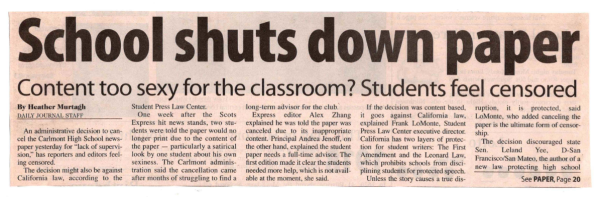
While digging through the Belmont Historical Archive of old newspaper articles about Carlmont High School, I found an article about the Scot’s Express, a student-made newspaper (a prototype of the Highlander), which was shut down as a result of its content: it featured a satirical article praising the author’s uncompromising sexiness.
All I could find of Jack Dooley’s 2008 piece was an extract featured in the San Mateo Daily Journal: “I am sexy. And I don’t mean that like my physical attributes can be described as sexy — that’s a given. What I mean is, I embody sexy. I am that word. That word is me. I am sexy.” The Daily Journal also shares that Dooley describes taking off his shirt and lathering himself in baby oil, and then again declaring his sexiness.
Dooley’s article got his paper shut down, but it led to the birth of the journalism program as it is at Carlmont. You could trace every serious Scot Scoop article about nationwide protests, surviving suicide, or JD Vance to some junior talking about his uncontrollable sexiness.
While the Carlmont program may have a dumb and hilarious origin, high school journalism as a whole is pretty different. As media historian Caitlin Cieslik-Miskimen explains in the Journalism History podcast, early programs were essentially vocational training disguised as “freedom of the press.” She also describes its function for marketing: if students can get some hype for the school, it benefits the institution.
I am disappointed by this drab fact, that journalism programs are just an institutional tool. Why wasn’t high school journalism a true movement of students who felt the need to express their ideas, free their voices, and unleash their revolutionary minds and weird ideas upon the pearl-clutching masses? Why wasn’t every writer like Dooley?
Cieslik-Miskimen isn’t pessimistic, though. She maintains that underneath the “institutional overlay,” the writers are, in the end, high schoolers.
“If you’re lucky and you can read between the lines, there are very subversive jokes that get through publication, that can find themselves in newspapers,” Cieslik-Miskimen said.
Are some “subversive jokes” the best we can do as journalists, though? What about trying to embody the magnanimous youth journalistic voices of history, like Chen Duxiu’s 1915 New Youth magazine, which challenged the intellectual remnants of the conservative, ineffective imperial order that had ruled China for a thousand years? Or Ida B. Wells-Barnett, who at just 22 became a pioneer of modern investigative journalism, fearlessly using data and on-the-ground reporting to expose the truth about lynchings in the post-Civil War South?
Or even more: shouldn’t every writer try to be the Martin Luther King Jr. of their generation? Or the Tupac Shakur? Not everyone has the courage to say what they feel should be said the way they did. They were not as idolized and appreciated then as they are now. President Donald Trump wouldn’t think of quoting King’s “I have a dream” speech had he been alive in our times (the way he did in January of this year). Actually, maybe he’d angrily tweet a bit.
But sometimes it seems, as a society, we forget that aspect. When you think of these two figures, you don’t think “scandalous” or “radical.” No one would haughtily call them out for being anti-capitalist, in the case of King, or communist, in the case of Shakur.
Being revolutionary and being palatable are incongruent.
When you’re a student journalist, you don’t have to be King or Tupac to feel what happens when your words cross a line someone else drew for you. Here at Carlmont, publishing a controversial opinion piece can get you hate comments, a trip to the office, or threats to be sued.
You may have heard the phrase “the medium is the message.” When Marshall McLuhan coined the phrase in 1964, he wrote about how the format in which we communicate has a greater consequence on our lives than the “message” or the content of what we are attempting to communicate.
If high school journalism is a medium, what do we, as journalists, receive as the message?
At Carlmont, we have distinct categories in which we can write: features, opinion, news, campus, entertainment, and sports. Looking through the Scot Scoop website, there are some tried-and-true formats to get an article done.
And sometimes we find comfort in that monotony. We build our own invisible barrier, pieced together from the expectations surrounding the status quo: what others publish, what receives awards, what writing is “acceptable” to put out there.
When we write to please an invisible audience, we lose a core part of what makes writing human. Journalism is the practice of communication, investigation, and presentation.
What happens when the habit of conformity we learn here follows us into adulthood? If high school journalism teaches us to write within invisible boundaries, to avoid offense, to choose polish over passion, what kind of journalists, artists, or citizens will we become?
When Dooley was writing “I am sexy,” he could have had some greater point: people are too self-obsessed nowadays, the expectation of masculinity is ridiculous, teens are melodramatic. But if we’re being honest, what it could be is that Dooley just had no point.
He probably thought, “Wouldn’t it be hilarious if someone just wrote about how insanely hot they are?” Maybe all that matters is that we write anyway. Even if it’s just to declare with reckless honesty that we are, indeed, sexy.