For many students, ski week sits at an awkward intersection in the school year. It arrives during one of the most academically demanding stretches, packed with Advanced Placement (AP) classes, tests, and long-term assignments.
Yet instead of doubling down on productivity, many choose to step away entirely.
“I was definitely making a conscious decision to give myself a little break from all the work,” said Kellen Kato, a sophomore at Carlmont High School. “I understood that it would be a tradeoff in the fact that I would have to cram in my schoolwork at other times.”
That tradeoff defines ski week. It is not a carefree escape, but a calculated shift in priorities. Students are not ignoring their responsibilities. They are postponing them.
“It was a bit of a relief, but also something kind of different. Everybody needs time for themselves. I understand that I need my break,” Kato said.
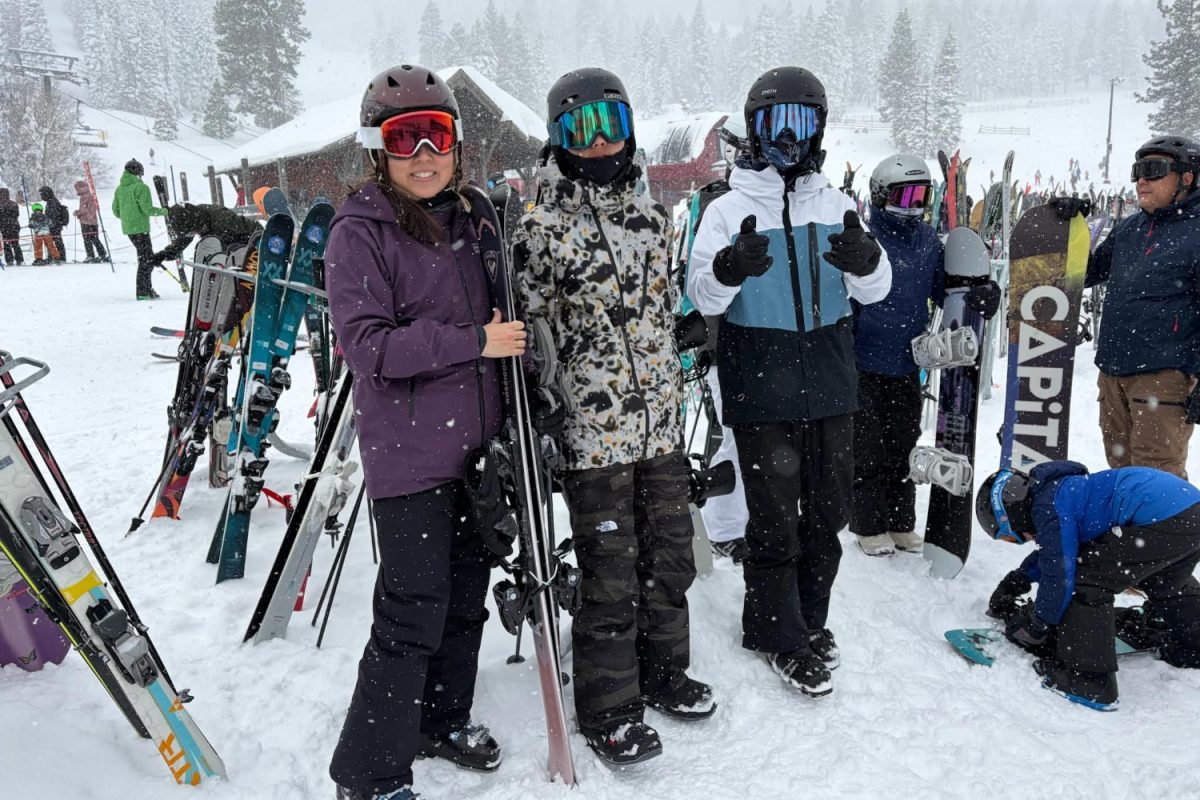
On the mountain, that shift becomes tangible. Academic stress does not disappear completely, but it fades into the background.
“There was always the lingering thought, but when I was actively doing something and really enjoying myself, it didn’t follow me that much,” Kato said.
Instead of thinking about deadlines and assignments, his focus narrowed to immediate, physical decisions. That contrast highlights something school rarely provides: a complete mental disengagement from obligation.
“When I was skiing, I didn’t think about school or all the prior commitments that I had even once, I just focused on the things before me,” said Gregory Duffy, a senior who also skied over break.
He pointed out that this kind of mental separation is almost impossible within a school environment.
“I don’t think that there is any time in school where you aren’t thinking of the things that you have to do,” Duffy said.
While he acknowledged that providing that kind of escape is not the role of school, the absence of it is still significant. It made him wonder whether ski week should be seen as a luxury or something students need.
“I think it’s a necessity. If we don’t have our breaks, we’re going to get overwhelmed,” said Nickan Shakeri, a sophomore who also went skiing.
That perspective reframes ski week not as lost academic time, but as a structural release valve in an otherwise continuous cycle of stress. Still, the break comes with consequences. Students return knowing that the workload has not disappeared. It has accumulated.
Kato acknowledged this tension from the start. Going into the trip, he was concerned about having to return home and finish his work. By the end, however, his perspective shifted.
“I definitely felt like that was a good break. I needed it,” Kato said.
The stress did not vanish. It was delayed. But the delay changed how he approached it.
“I don’t know if I could say it made my academic performance necessarily all that much better, but I definitely feel better about doing my schoolwork. Now I’m more willing to take it on because it feels less taxing,” Kato said.
Duffy experienced a similar reflection, though in a different context. During his return from the trip, he reconsidered how he structured his time entirely.
“It gave me this sense of dread for school,” Duffy said.
That realization led him to rethink his routine: work more consistently during the week, and preserve weekends for recovery and enjoyment.
Even outside academics, ski week offered forms of learning that classrooms cannot replicate.
“It’s taught me how to properly assess if I’m ready for certain challenges,” Shakeri said, drawing a parallel to evaluating readiness for skiing harder slopes.
The value of the break, then, is not purely academic or purely recreational. It sits somewhere in between. It delays stress, but also reshapes how students respond to it.
Ultimately, ski week exposes a tension that runs throughout high school: the balance between constant productivity and necessary recovery. Students are not choosing between working hard and not working at all. They are choosing when to do each.
Kato’s reflection captures that balance clearly. The work still exists. The deadlines remain. But after stepping away, the weight of it changes.
“It’s time to go back to doing my work,” Kato said. “But now, I’m feeling better about it.”