
When Elana Zizmor, a chemistry teacher at Gunn High School, first started teaching, she didn’t feel that students were motivated to learn.
“Students played the game, and they became very good at the game,” Zizmor said.
Zizmor noticed that students would progress from one year to the next without retaining much information. Students would do well in tests, but as the material got harder, they stopped learning. When she realized this problem, her next step was to figure out how to create a system that would motivate students to engage in learning and improve their skills as well.
Gunn transitioned its chemistry department to using a grading system called Evidence-Based Teaching and Learning (EBTL).
“Instead of having students collect points over time, the purpose is to break it down to the skills we want our students to know when they leave our class,” Zizmor said.
The work done every day, such as worksheets, labs and discussions, is recorded in the gradebook as formative practice. Formative practice consists of low-stakes assignments that help students build skills through feedback. Students are expected to make mistakes and revise their understanding.
At the end of each unit, students take summative assessments, which are higher-stakes tests scored on a rubric. Unlike formative work, summative assessments show a student’s final level of mastery. Through this new learning style, Zizmor ultimately started having better interactions with her students.
“Now, my conversations with my students are way richer and really grounded in how they can improve their skills,” Zizmor said.

At Carlmont High School, chemistry teacher Michael O’Neall, along with his colleagues Alyssa Lu and Hai Nguyen, has moved towards a similar goals-based approach. However, the grading environment of Carlmont’s chemistry department varies from Gunn’s EBTL system.
“Alignment in grading practices and policies is encouraged across same-level classes, but not required,” said Sara Shayesteh, chair of the Carlmont science department.
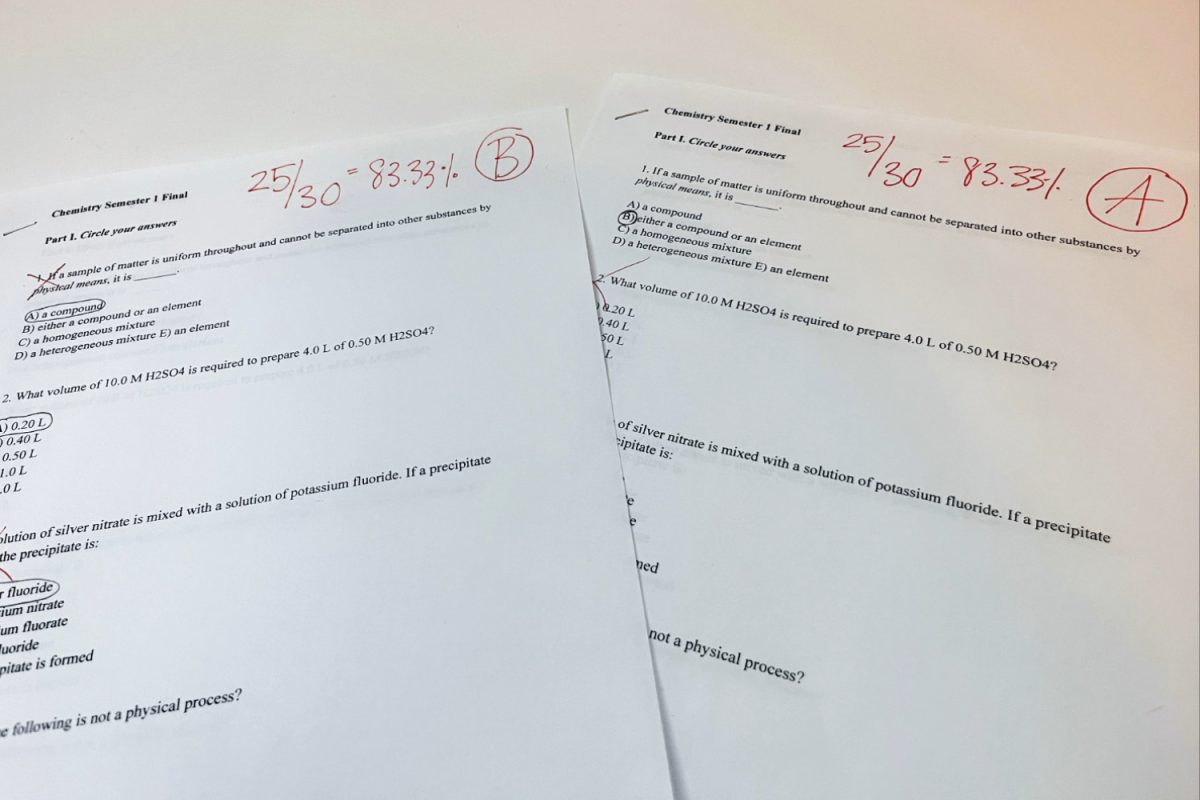
In O’Neall’s classes, an 85% or above is considered an A. In Lu’s classes, the cutoff is 80%, while in Nguyen’s, an 88% or above is an A, according to their respective syllabi.
“It’s very difficult to require something when it comes to grading scales,” O’Neall said. “When you require it, it does cause a lot of issues because there are pros and cons of good arguments for very different scales, so saying you have to do it a certain way can be a problem.”
With this in mind, O’Neall also emphasized that he and his colleagues worked together to standardize reference materials and weighting.
“I know our percentages are a little different, but for the most part, we are all moving towards assessments being the brunt of understanding,” O’Neall said.
Even with attempts at standardization, grading can remain a complex process. Zizmor noted that inconsistencies can spark complaints from both students and parents.
“I could see that being a huge can of worms for the teachers. You’re going to have kids complaining and parents complaining, saying, ‘Oh, if they were in this class and they got this teacher, they’d have an A, but in your class they have a B.’”
The impact of a rubric
A paper published in the International Journal of STEM Education revealed that teachers were inadvertently more lenient towards male students when they submitted partially correct math answers.
These findings highlight the subjectivity of grading without transparent and standardized criteria. In grading systems where scores rely on teacher interpretation, two students can receive different scores depending on a teacher’s disposition.
“I wish grading were more standardized and there would be more indicators on what was expected from you,” said Carlmont sophomore Daniel Tolkachov. “Last year in science, I would get marked off on assignments without any explanation on how the assignment was expected to be done.”
Bringing structure to grading
Challenges like these highlight the importance of structured grading systems. Both Gunn and Carlmont have implemented systems designed to make grading more objective and skills-focused, although they approach it differently. Carlmont students still see grades in familiar percentage terms.
Some, like Zizmor, dislike the emphasis on point collection. Others, like O’Neall, believe grading comes down to the teacher’s gut.
“Many of us will use the same system that we grew up in because that’s what we’re comfortable with,” Zizmor said.
However, outdated grading practices have the potential to harm a student rather than help them. An article from the National Library of Medicine found that students following a mastery learning model, where they take both summative and formative assessments and can retake them to achieve mastery, perform better academically than those in non-mastery grading systems.
“I know it’s confusing for some students, because if you’re used to doing the 100 point scale, it’s hard to do something different,” O’Neall said.
Even with the struggle to transition, using standardized learning practices that value rubrics and objectives has long-term benefits.
“There’s really good value in thinking about and being thoughtful about your practice and seeing if you can find a system that matches where you want students to go,” Zizmor said.