The California state government recently approved $59.6 million in grants for the California Wildlife Conservation Board (WCB) to distribute toward biodiversity preservation and expanding public access to nature.
WCB is a state agency within the Department of Fish and Wildlife that assesses biodiversity-related programs in California to provide grants and connect diverse stakeholders, from tribal governments to conservation organizations.
This funding will support 27 environmental projects in 18 California counties, targeting several aspects of ecological restoration. Some project locations include Watsonville Slough, Pepperwood Preserve, Joshua Tree National Park, and Beaver Valley Headwaters Preserve.
By improving habitat connectivity and rebuilding degraded ecosystems, the projects aim to support California’s many native species while also increasing public consciousness of climate needs.
“California is so beautiful and so diverse. It’s important to protect that,” said Natalie Dias, the fundraising and logistics co-lead at the Bay Area Youth Climate Summit and a junior at San Mateo High School.
The funding allocation has been generally uncontroversial. Those who know about it feel positively about its impact on California wildlife and the environmental movement, while those who typically oppose environmental actions have not spoken out.
Specifically, supporters anticipate benefits for the growth of environmentalism and for the protection of California’s many natural habitats.
“It doesn’t surprise me that California, which has more national parks than any other state and millions of acres of protected land, has decided to provide this money. We have many different biomes that deserve protection, and we’ve seen firsthand the environmental pressures we’re increasingly likely to face, such as atmospheric rivers and droughts. We need that investment if we want to preserve the biodiversity that we have now,” said Jaziel Salomón, a Carlmont Advanced Placement Environmental Science and Biology teacher.
Investing more in biodiversity also has economic effects, such as increasing local revenue and creating jobs through ecotourism.
Among the initiatives intended for publicization, many focus on restoring habitats and creating wildlife corridors not just to protect species now, but also to increase engagement with climate initiatives moving forward.
“People care about places that they have a direct relationship with. If you hike regularly and find an area that’s been deforested, or if you live near wetlands and see different organisms there, and you understand how rising water levels will affect them, you are far, far more likely to care, because it becomes so personal,” Salomón said.
Environmentalists see the WCB funding as useful for environmental education. According to Salomón and the Ukrainian Journal of Ecology, increasing public access to cultural ecosystem services — the recreational, aesthetic, spiritual, and health benefits of nature — is likely to foster deeper connections among California residents, tourists, and the climate movement.
Carlmont senior Abdus-Sami Khalak experienced this himself. Partially because of his childhood exposure to nature, he has become a leader of the Sequoia Union High School District Sustainability Council and is part of Silicon Valley Youth Climate Action.
“I never really tried to get into climate activism. It was just something that kind of fell upon me. My mom would always take me camping and on hikes, and as I progressed through high school, I realized that those natural systems are breaking down because of human actions,” Khalak said.
It is hard to find criticism regarding the recent funding round. Generally, opposition to environmental spending comes from differing budget priorities, disagreement with the taxpayer burden, or disbelief in the tangible returns. As such, conservation can be seen as nonessential spending.
WCB’s supply typically comes from voter-approved bonds and some specialized funds. Propositions 84, 1, 68, and 4 are all voter-approved bonds that contributed to the 2026 funding round.
However, the benefits of funding like this aren’t abstract. They have resonant effects on both ecosystems and humans. Healthy, diverse ecosystems perform critical climate functions, such as increasing climate resilience, regulating natural disaster risks, and helping species affected by human expansion adapt.
According to a study by Bronson Griscom et al. in the Proceedings of the National Academy of Science of the United States of America, natural climate solutions like conservation, restoration, and improved land management can “provide over one-third of the cost-effective climate mitigation needed between now and 2030 to stabilize warming to below 2 degrees Celsius.”
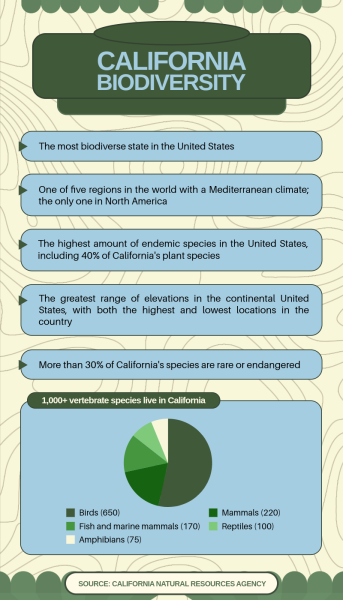
According to the California Natural Resources Agency, California is one of the world’s 36 biodiversity hotspots and has regions with significant biodiversity that are threatened by human habitation. This makes investment in organizations like the WCB crucial.
“Our climate discussions usually focus on fossil fuels and energy policy. These are important, but not the only elements in the climate discussion. Healthy forests can sequester carbon and affect local climates. Wetlands are among the most productive ecosystems on Earth. They play a role in regulating the climate,” Salomón said.
While this round of funding does not allocate any funds to San Mateo County, it could still impact local initiatives.
According to Sustainable San Mateo, San Mateo County is a biodiversity hub with 42% of its land protected, the second-highest percent in the Bay Area. But it faces threats from climate change, urban sprawl, and invasive species.
Organizations like the Mid-Peninsula Regional Open Space District, San Mateo County Resource Conservation District, and San Mateo County Parks could seek future funding from the WCB for projects such as sea-level rise mitigation through wetland restoration and wildfire prevention through redwood forest maintenance.
“Habitat restoration is essential for climate mitigation. San Mateo County is the most at-risk county in California for sea level rise. We need to have these wetlands and mitigation techniques, or else houses in Half Moon Bay are going to go underwater,” Khalak said.
Additionally, marginalized communities in areas like East Palo Alto and North Fair Oaks, where unequal housing and economic inequality intersect with the worst effects of climate change in the county today, could benefit from increased environmental funding.
Their residents have lower life expectancies and higher rates of pollution-related health issues, and the cities are expected to face sea-level rise and extreme heat. Plans outlined by the San Mateo County Office of Sustainability would benefit from funding from the WCB or similar organizations.
In the context of national politics, many see the WCB funding as an important symbol.
“With Trump, we’ve seen a lot of cutbacks in spending for programs like national parks and things that would help protect biodiversity, so this counteracts that and shows that we are still trying to help the environment, even if there are others that aren’t,” Dias said.
Due to the political climate, many believe youth should be aware and engaged with issues like this.
“You are the generation that will have to deal with the long-term consequences of today’s decisions. It’s hard not to lose hope, but you can affect meaningful change. Remember that this decision was from the state government. We focus a lot on federal elections, but local and state elections can often lead to faster local change,” Salomón said.
According to Dias, youth can play a more significant role in local politics, as her own experience as a youth climate advocate has made clear.
“I do a lot of public commenting, and I’ve found that elected officials tend to perk up a bit more when I speak, because it’s kind of unusual for youth to speak out, and that makes them listen more,” Dias said.
Often, youth may be more focused on other, more scandalous issues or overwhelmed by their personal lives. Climate advocates urge them to seek out news nonetheless, especially environmental news.
“We get most of our news from social media, which tends to push sensationalist stories that will generate discourse. Stories like this, which are generally uncontroversial and positive, don’t make the news the same way. Personally, I sometimes go to government websites and read the recent updates there, which I wouldn’t say everyone needs to do, but people need to at least actually read the news,” Khalak said.