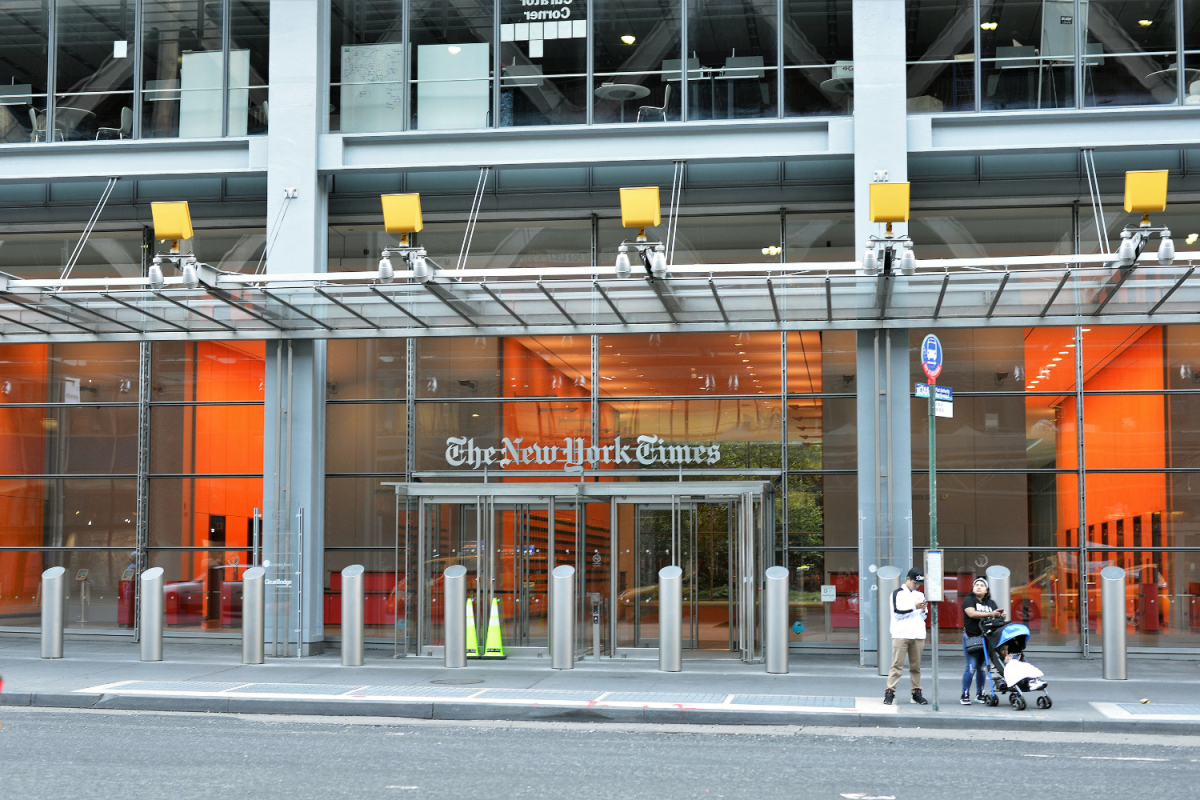
The New York Times was accused of violating federal law by discriminating against a white male employee for a promotion based on his race and gender.
According to a lawsuit filed by the Equal Employment Opportunity Commission (EEOC), the newspaper’s diversity, equity, and inclusion (DEI) policies may have affected the decision. In the 2021 “Call to Action” plan, the company stated plans to increase the number of women and people of color in leadership positions.
To meet these goals, the company left a longtime New York Times editor, a white man with extensive experience in real estate journalism, out of its final panel interviews for a vacant Deputy Real Estate Editor position in early 2025. Every candidate who advanced through to the final interview process was not a white male. Instead, the company gave the role to a non-white female with little to no experience in real estate journalism, although such experience was a requirement for the real estate editor position.
The hiring manager allowed the female candidate to move forward to the final interview stage without going through the usual interview process. The New York Times ultimately selected the woman for the role, even though the final interview panel had rated her lower than two other candidates.
“The EEOC is prepared to root out discrimination anywhere it may rear its head. No matter the size or power of the employer, the EEOC under my leadership will not pull punches in ensuring evenhanded, colorblind enforcement of Title VII to protect America’s workers, including white males,” said EEOC Chair Andrea Lucas in a statement.
According to the complaint, the final candidates included a white woman, a Black man, an Asian female, and a multiracial female. The EEOC says that the situation violates federal law under Title VII of the Civil Rights Act of 1964, which prohibits employment decisions based on race or sex. After trying to resolve the dispute through its standard pre-lawsuit process, the agency brought the case to the U.S. District Court for the Southern District of New York.
“Employers who engage in unlawful discrimination in the name of diversity, equity, and inclusion or other similar motivations should understand that they face significant litigation risk. The Commission will continue to enforce Title VII’s protections to ensure equal opportunity for all,” EEOC General Counsel Andrea Lucas said in the same statement. “The agency is proud to file a case that demonstrates the United States of America’s commitment to ensuring victims of unlawful DEI-related race and sex discrimination see their day in court.”
Many critics see this as problematic because diversity programs fix past discrimination and help create fair workplaces. It allows organizations to retain top talent from previously underrepresented groups by removing systemic barriers in hiring.
Meanwhile, some officials, like Lucas, say diversity programs can sometimes lead to unfair treatment of white men, such as admitting individuals based on demographics rather than merit; in fact, a study found that almost 70% of white men feel “forgotten” by DEI efforts.
“Some people are incredibly resilient, and they can brush it off and move on, but for other people, the same mistreatment might cause them to be demotivated, not look for opportunities or advancement, or cause them to give up on certain things. The psychological ramifications of discrimination on an individual can be incredibly damaging,” said Jeffrey M. Curtiss, a California-licensed employment and commercial litigation attorney.
On March 26, 2026, President Trump sought to draw attention to this issue by issuing Executive Order 14398, “Addressing DEI Discrimination by Federal Contractors,” which prohibits federal contractors and subcontractors from participating in DEI activities that discriminate based on race. If they violate it, they could face penalties like False Claims Act liability, losing their contracts, or being suspended or banned from future contracts.
The ongoing debate over DEI is causing controversy, especially as more organizations, including Nike, Disney, and IBM, are under scrutiny for breaking the law, with lawsuits alleging that their DEI programs amount to “reverse discrimination” and violate federal employment and civil rights laws.
“It seems that those in power are now using liberal affirmative action arguments to counter what they deem to be “reverse discrimination” towards non-minorities, like white heterosexual men. It is reminiscent of cases such as Regents of the University of California v. Bakke, 1978, where the Supreme Court ruled that quotas to promote affirmative action policies were unconstitutional,” said an adult staff member*.
Similar issues have also appeared in higher education, where some universities have faced lawsuits over their admissions policies.
For example, the David Geffen School of Medicine at the University of California, Los Angeles, was accused of violating anti-discrimination laws with admission policies that favored Black and Hispanic applicants over qualified white and Asian students.
Shortly after, Yale School of Medicine was also accused of discriminating against white applicants on May 14, 2026.
This issue raises the larger question of whether true fairness can ever fully exist for everyone.
“Hiring and education are two major areas in society where opportunities have historically not been equal, based on race and gender. Those areas in particular pertain to one’s livelihood (jobs, career, promotions), so to keep ‘have-nots’ down, ‘haves’ have historically restricted fairness (equal opportunities in those two areas) and many others,” the adult staff member said.
While this discussion continues in theory, it is also playing out in real legal disputes over how far institutions should go in considering race in decision-making.
In February 2026, the Justice Department sued Harvard University for withholding race-related admissions documents to determine whether its admissions process discriminates against white applicants. Federal investigators say they need the data to check whether Harvard is following the Supreme Court’s 2023 decision banning race-based admissions. Harvard argued that the government’s requests were too broad and unnecessary, and said it was already complying with the law. The dispute has escalated as both sides continue to disagree over how much information Harvard must provide.
“If you talk about female representation in STEM, if you talk about the lawsuit against Harvard over Asian American underrepresentation in the student body, schools are another hotbed for anti-discrimination law,” Curtiss said.
Evolution of DEI and its modern impact
DEI and DEIA are not new, though they have been called different things throughout history. For example, the federal government has taken steps to ensure equal employment opportunities for decades.
“Simplistically, history is the struggle between haves and have-nots. Political issues/politicians often reflect this struggle. DEI promotes opportunities/rights for racial/gender minorities, often perceived to be denials of such for the “majority,” in whatever the case may be,” the unnamed source said.
DEI programs experienced the largest and fastest expansion in 2020 after major social justice movements across the country. Many companies also invested heavily in diversity programs, racial equity centers, and hiring quotas. However, since 2022, DEI growth has slowed due to economic challenges, political changes, and an increase in anti-DEI state bills. As a result, many large companies and universities have reduced or removed their diversity programs.
“There’s a split: while I’ve seen some employers adopt a kind of DEI paradigm, others have not. Now I would say the trend is that it’s kind of falling out of favor,” Curtiss said. “One example would be the University of California, San Francisco. I’d see DEI-related literature from them, but now they’re being attacked by the administration, and so there’s been a little bit of a retreat away from that. There is this human desire for representativeness; there will be that kind of tension.”
Most businesses are continuing DEI work, but more quietly and with less public attention. Despite this lower visibility, the industry itself is still projected to grow significantly. According to Business Wire, the DEI industry is expected to increase from about $9.4 billion in 2022 to around $24.4 billion by 2030.
“I’m optimistic about the economy and about our workforce. The civil rights statutes were passed in 1965, and thereafter, our economy is a lot different from what it was in 1965. These anti-discrimination lawsuits are based on working for an employer, having some type of management role within that entity, and being a subordinate W-2 employee. I think, as we move forward, more people will be self-employed and entrepreneurs, able to access employment opportunities worldwide.
As people become more empowered and wealthier, they don’t have to put up with as much. It doesn’t mean there aren’t serious cases of discrimination, harassment, and retaliation. There’s plenty of that going on, but I think that going forward, individuals, just through advances in technology, are more and more able to navigate those situations and push back on them,” Curtiss said.
For example, Curtiss mentioned that advances in technology allow people to create their own platforms, such as YouTube channels or self-published content, which can be used to combat workplace mistreatment.
Government actions on DEI are also affecting how organizations function, leading to confusion and cuts in public health programs. Some workers have lost jobs, and some agencies have reduced or removed programs about health equity. Even organizations outside the federal government are being more careful about DEI work because they are worried about losing funding or facing penalties.
Arguments supporting DEI
However, according to the National Institute of Workers’ Rights, discrimination in the workplace still affects women, people of color, religious minorities, some ethnic groups, and LGBTQ+ individuals, making equal opportunities harder to achieve. Even with laws meant to protect workers, discrimination continues in many parts of the hiring and employment process. Last year alone, the Equal Employment Opportunity Commission recovered almost $700 million for more than 21,000 workers involved in discrimination cases.
According to the Harvard Business Review, diverse teams are often better at checking information and forming new ideas, which can help businesses succeed.
Diversity can also enhance creativity and problem-solving, while helping companies reach a broader range of talented people with diverse skills and experiences. In inclusive workplaces, employees may feel more welcomed, respected, and comfortable being themselves without fearing judgment.
If DEI programs are reduced or removed, groups that currently benefit from them may lose opportunities, while people in the “majority” group may gain greater access to them. History has shown that progress toward equal opportunity can sometimes face reversals over time.
“Perhaps it could be compared to the progress made for African Americans after the Civil War through the 13th, 14th, 15th Amendments, but then denials and restrictions on opportunities, rights, voting, employment, education, etc, with the Jim Crow Laws that emerged in the U.S. in the 1870s that persisted until the 1960s,” the adult staff member said.
Impact on workplaces and employers
Curtiss said that wealthier companies often have greater hiring flexibility, while smaller businesses usually do not have the same resources or choices. This is especially true in industries like logistics, food service, construction, and other labor-intensive jobs.
He said most businesses cannot afford to reject qualified workers because doing so would hurt the company itself.
“Unless you’re a Meta, a Google, or a Stanford, you don’t have this opportunity to turn away qualified people because of prejudice. You’ll harm your home and business. So what most employers are trying to do is apply anti-discrimination laws; they’re trying to be compliant with the law, be race-neutral, and they don’t have the luxury of hiring a bunch of people to enforce a kind of DEI paradigm. I would say that most employers, like if you’re running a restaurant, you probably don’t have a DEI program,” Curtiss said.
Most employers are trying not to discriminate, but organizations are made up of people, and sometimes individual biases can affect workplace decisions when they are shared by management.
Impact on schools, workplaces, and youth
There have been past controversies surrounding admissions policies at Lowell High School, a selective public high school in San Francisco, whose competitive admission process is based on academic aptitude. Curtiss explained that the school has long faced debates over merit-based admissions, representation, and fairness because its demographics differ from the city’s overall population.
“Historically, within San Francisco, Asian Americans have been overrepresented in the student population compared to the overall population of San Francisco. For example, I’m just making up numbers here, but the student body might be 60% Asian, whereas the overall Asian population in San Francisco is maybe 30%. This has been an ongoing source of conflict in the city, and there have been lawsuits over it,” Curtiss said.
This imbalance has led to continued discussion in the city, with people divided over what fairness in school admissions should look like.
“On the one hand, you have a lot of people saying we want the best possible students to be at Lowell: we want a meritocratic admissions process, and if you earn your way in, you’ve earned it. If the school happens to be 60% Asian, 80% Asian, it really doesn’t matter, because we’re here for the meritocracy. On the other hand, you have people who say, Lowell is the scarce resource, it’s an excellent public school, and there’s a problem if the student body becomes too dissimilar from the overall population of the city,” Curtiss said.
As a result, in 2021, the San Francisco Unified School District temporarily moved away from merit-based admissions to increase representation for underrepresented groups. However, the decision later faced political backlash and public criticism.
“Some school board members were recalled, and now you have the resumption of this meritocratic admissions process,” Curtiss said.
He sees this pattern as a continuous cycle that tends to repeat in highly competitive spaces where opportunities are limited.
“I almost see it like a dialectic. We’re going to go back and forth for elite-level opportunities. For the opportunities that are scarce, when there’s only a certain number of chairs to go around, then people care a whole lot,” Curtiss said.
Curtiss said he sees similar tensions appearing in DEI-related workplace lawsuits, including the case against The New York Times.
“I think that’s what this New York Times case is about, at least ostensibly,” Curtiss said.
These arguments about fairness in education are not limited to past cases like Lowell High School, but continue to influence how younger people think about their future opportunities. This concern is especially relevant for students preparing to enter the workforce.
“I think that it will definitely affect the younger generation, as people who don’t have the same opportunities or lack the skills due to inaccessibility may not be considered for the job,” said Breanna Zarzar, a junior at Carlmont.
Even though lawsuits and courts are important, they can’t fully eliminate discrimination on their own because real prevention has to come from how society and institutions behave every day.
“Unfortunately, the law is sort of a last resort when it comes to helping us move towards a system that creates a norm, a culture where people don’t want to be discriminatory. The court system has limited resources, limited ability to hear cases, and a limited number of attorneys, so the court system can catch some discrimination, but ultimately, preventing discrimination is a lot broader than the legal system,” Curtiss said.
Success is no longer limited to a small number of elite institutions or organizations. With technology creating more ways for people to learn, share ideas, and build careers independently, people today still have opportunities to succeed even when facing setbacks or unfair treatment.
“There are many opportunities to learn, and if you’re resilient and push forward, I think you can get there,” Curtiss said.
*This source’s name is removed to protect them from legal consequences. For more information on Carlmont Media’s anonymous sourcing, check out Scot Scoop’s Anonymous Sourcing Policy.