
As the summer season and the end of the school year approach, local businesses must adapt to seasonal trends.
Carlmont junior Max Wallow works at the United Studios of Self Defense (USSD) karate dojo in the Carlmont Shopping Center. According to Wallow, they are already preparing for summer changes.
“There are a lot fewer kids there during the summer. We are preparing for a third of all of our students to leave for the summer because some of them are traveling, some of them have summer camps, so we’re preparing by laying off some instructors,” Wallow said.
Businesses like USSD that rely on students and families as customers typically see less traffic in the summer; however, they adapt by streamlining internal processes, such as downsizing staff, opening for fewer hours, and minimizing offerings.
Meanwhile, other businesses see a summer surge. Lorenzo’s Sandwich Shop, on a side street a two-minute walk away from USSD, has the most sales in summer.
“We see the same faces pretty often, but we definitely get much, much busier in the summers and around the holiday time when all the college kids are back in town,” said Greg Newton, Lorenzo’s store manager.
In response to this increase in customers, Lorenzo’s and similar businesses increase staffing.
“I try to keep at least one extra person on staff in the summer. Former employees who are off at college will also often come back and work for us during the holiday season, just to kind of help us weather the storm,” Newton said.
John Rowe, a Carlmont business teacher and DECA advisor, has observed that many downtown businesses see significant student traffic from Carlmont and other local schools. Specifically, he believes that more students shop downtown during the school year.
“It’s far enough away that it’s inefficient to go there for recreational reasons in the summer,” Wallow said.
A survey by MNTN Research found that overall buying does not decrease in the summer. Sixty-four percent of consumers surveyed planned to budget the same or more for the new season.
However, depending on the industry, this can change.
“Some of them are definitely seasonal, and they’re looking for students to work over the summer. But many businesses stay pretty consistent throughout the year, so they’re looking for students year-round. So it just depends on the type of business,” Rowe said.
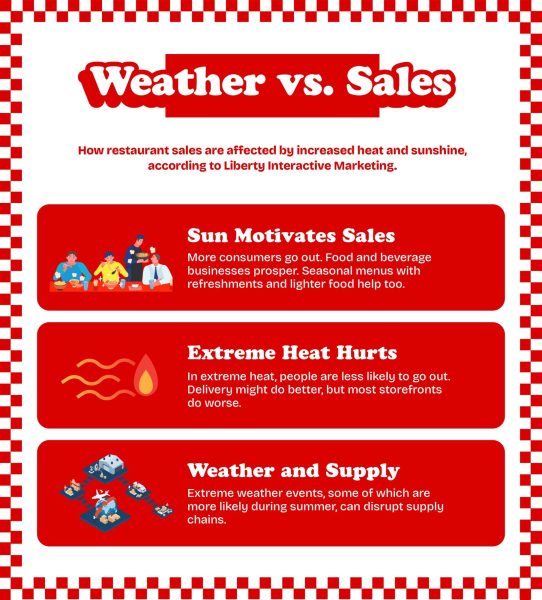
Analysis in Economic Perspectives, a journal from the Federal Reserve Bank of Chicago, revealed differences between the seasonality of selected industries. Without specifying whether it included an increase or a decrease, it noted the extent to which employment in those industries is affected by seasonal changes.
Construction, mining, education, leisure, professional and business services, retail trade, and government all had seasonality of over 1%, while manufacturing, finance, information, transportation and utilities, and wholesale were relatively stable at lower than 1%.
Ultimately, whether businesses change their staffing and stocking patterns for the summer depends on their individual trends.
“There was a definite upset during COVID-19, but I would say last year and this year I’ve seen what I’m used to from the trends,” Newton said.