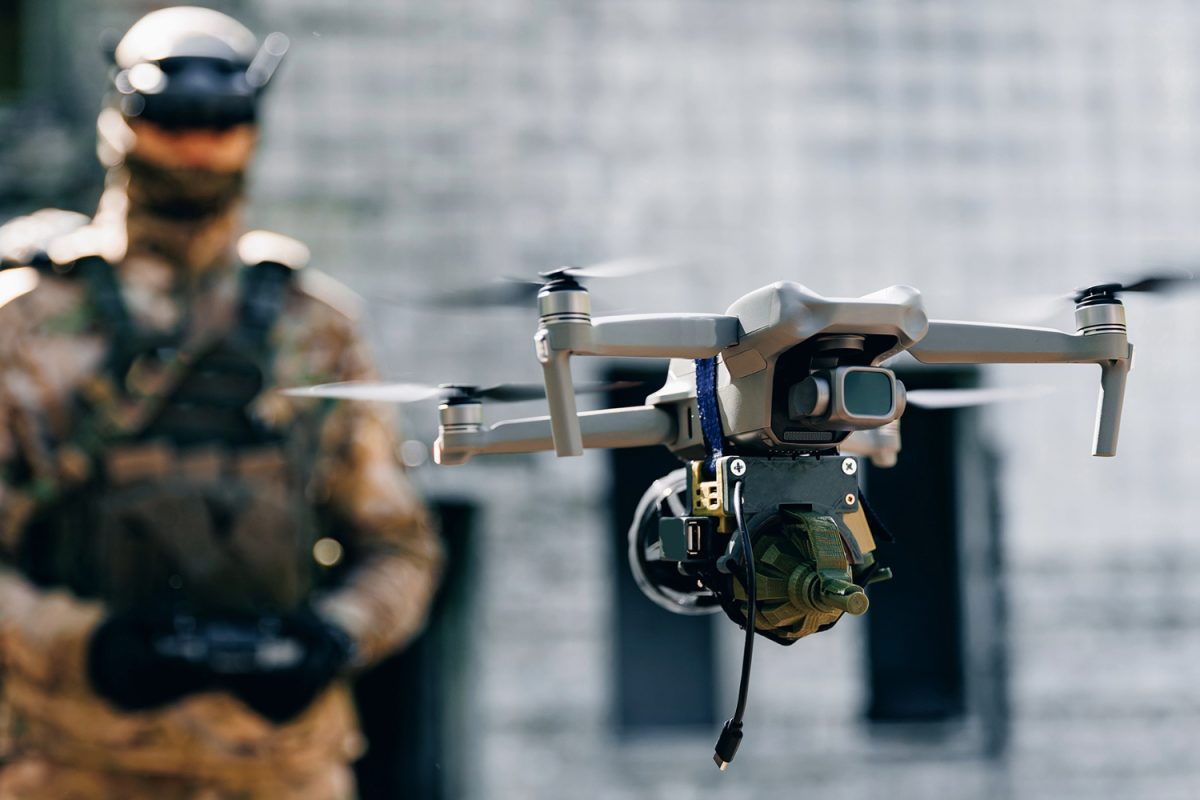
Washington’s recent decision to seek military help from Ukraine, a country it had long regarded as a recipient of American aid, became necessary when Iranian Shahed drones began breaching U.S. air defense systems across the Middle East.
The Trump administration, after several months of brushing off Ukraine’s flourishing defense expertise, formally requested its assistance in early March as U.S. military capabilities became severely outpaced by swarms of low-cost munitions.
Ukrainian troops arrived within days of this request to train American forces on detection systems they had spent four years perfecting while under fire.
This reversal, while certainly a shock to many, was predicted by defense analysts as inevitable, according to the Council on Foreign Relations.
“The fact that these drones have started to play a bigger part in the Russia-Ukraine war foreshadows that Ukraine’s status in politics will definitely become more important,” said Aditi Chaudhary, a Carlmont High School sophomore interested in technology and foreign relations.
Euromaidan Press says that since Russia’s full-scale invasion in 2022, Ukraine has built what analysts call the “Silicon Valley of warfare”: namely, a decentralized drone ecosystem that has outpaced traditional defense models by years.
Where a conventional weapons program might take months or even years to move from prototype to deployment, Ukrainian engineers have found it crucial to compress that process down to mere days. Through sheer wartime necessity, Defense One describes how a drone built on Monday can be tested in combat by Wednesday, and new changes are incorporated in the next batch the following day.
“Ukraine is showing the world how you can iterate really quickly and be successful in that way. In the near future, it will put pressure on other companies in the market to be more efficient,” said Manvir Narang, a junior at Carlmont High School interested in the aerospace field.
That agility has translated into staggering scale, with analyses showing that Ukraine’s output of 4 million drones in 2025 and projected output exceeding 4.5 million in 2026 outweighs the North Atlantic Treaty Organization’s (NATO) manufacturing capacity. A single Ukrainian manufacturer plans to produce more than 3 million first-person view (FPV) combat drones in 2026 alone, according to Aviation Week. The U.S., in comparison, produced approximately 300,000 in 2025.
“The military market has become very decentralized over the past couple of years, in contrast to the previous monopoly, which had 60% of the industry being driven by one company. Now that there are a lot of different players that are all trying to innovate at the same time, it forces everyone to move faster,” Narang said.
These unbelievable outputs from Ukraine have reshaped modern warfare, with drone units now accounting for more than 80% of enemy casualties recorded by Ukrainian military data, as described in Breaking Defense. These FPV drones, priced anywhere from $2,000 to $5,000, routinely contend with enemy Shahed drones that cost up to $150,000.
This critical cost asymmetry, which has defined Ukraine’s historic defense against invasion, now makes its technology commercially compelling to allies facing similar threats.
“A huge aspect of technological advancement in this field, especially in Ukraine, will be artificial intelligence. It can write your firmware rapidly, prevent attacks like signal jamming for autonomous drones, and allows you to make rapid iterations on design elements like frame structure,” Narang said.
Olena Zashko, a wartime reporter in Ukraine, illustrates how the need to develop this technology was directly influenced by the 2022 invasion and its subsequent power disparity.
“When we work with military or civilians, you can hear all the explosions, you can see the smoke from their glide bombs, and you can feel the emotions of people who struggle from these conditions,” Zashko said.
The leverage of technological progression has not been lost on Kyiv. Ukrainian President Volodymyr Zelenskyy has formalized a program dubbed “Drone Deals,” which centers on technology transfer and joint production in the context of defense agreements. According to Reuters, four agreements have already been signed, with more in preparation.
A significant deal is now in progress in Washington, where the U.S. State Department and Ukraine’s ambassador to the United States have drafted a memorandum outlining joint drone production and technology transfer between the countries.
The United States solidified this commitment when its military deployed Ukraine’s Sky Map counter-drone platform at Prince Sultan Air Base in Saudi Arabia in April, according to The Jerusalem Post.
The shift in power carries unmistakable political weight. Ukraine, for years framed both domestically and internationally as a dependent ally requiring Western support, is increasingly positioning itself as the next major player in military defense.
For Kyiv, every drone deal signed and every foreign soldier trained is leverage in peace negotiations, in potential NATO membership, and in the prolonged struggle over how history will remember this war.
While the skies over Lviv, Odesa and Kyiv remain dangerous, Ukraine finds itself with growing leverage to set its own terms.