

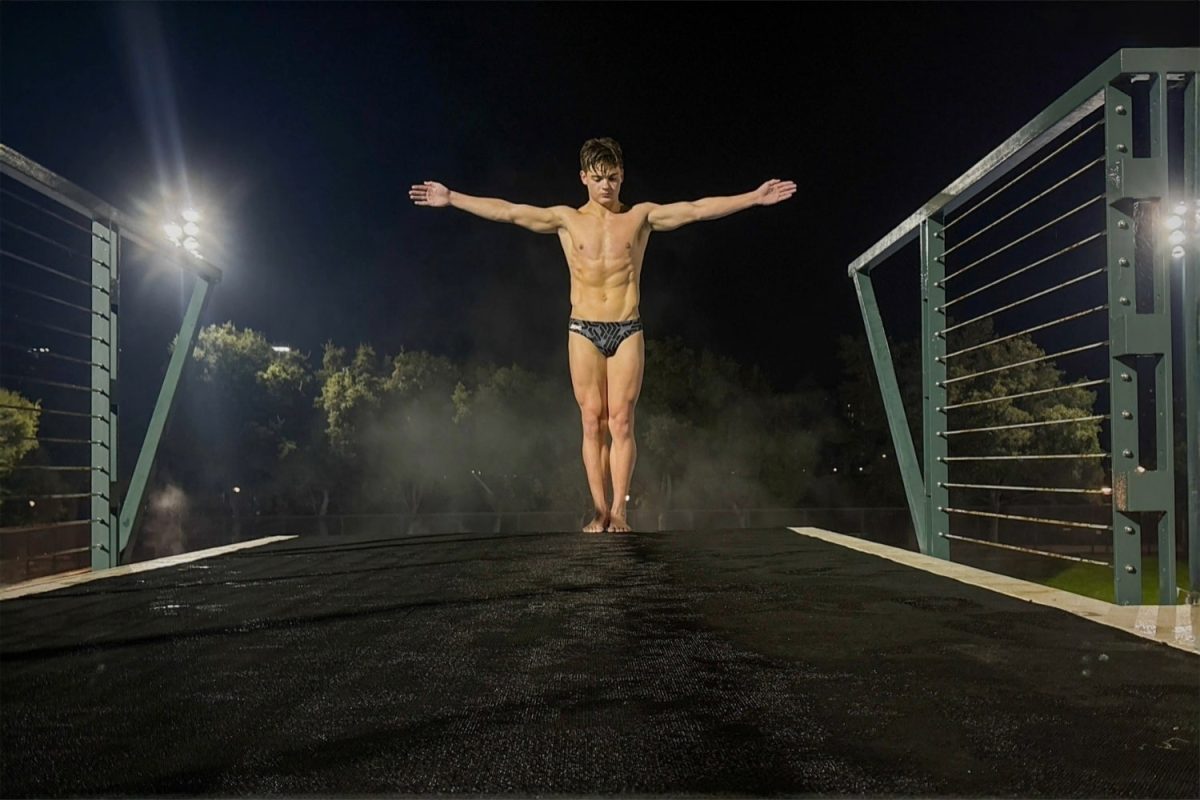
A diver stands at the tip of the diving board, shivering, trying to get into the water, but their mind acts like a wall, making it nearly impossible to jump.
This scenario is what athletes refer to as a mental block. Where they are physically able to do something, but they can’t get their mind to connect.
Mental blocks affect athletes across all sports and at all levels, hindering their confidence.
Oleg Andriyuk, a Ukrainian former professional diver and now elite-level coach, suffered mental challenges that ultimately led to the end of his career.
When Andriyuk was 13, he placed third at the 1989 Junior World Championships. He had the hardest 10-meter dive list in the world, being the first person to ever compete front four and a half tuck from that height.
Andriyuk’s favorite dive on his list was a back one and a half with three and a half twists off a 10-meter platform. He had completed it and trained it very frequently. One day, he went to practice a dive from a low 3-meter springboard.
He got lost in the air and smacked straight on his back.
After his failure, Andriyuk struggled to regain the confidence to do that particular dive off the 10-meter platform again. He stated that he could do it on a lower diving board, but when he reached the platform, he couldn’t bring himself to jump. He couldn’t imagine the dive without it going wrong.
“I tried different ways to start from the beginning. I was able to do it on a springboard, but as soon as I got up to 10 meters, my head would start spinning. I knew that if I just jumped and went, it would be fine, but I could not see myself doing it without failing,” Andriyuk said.
Mental blocks have various stages, the most severe stage being tonic immobility. According to The Athlete’s Mind, Tonic immobility is a rigid, unmovable state of intense fear. Scientists have stated that the body enters tonic immobility to prevent pain and suffering.
Mental blocks are common among athletes across all sports.
Jess Chao is a professional rock climber who has competed in various competitions, most recently at The North Face Climb Festival. Chao also faced various mental barriers, not triggered by a failure but more of an instinctual problem of anticipated anxiety and fear-based avoidance. Both of these symptoms are earlier stages of a mental block that results in overthinking.
According to a graduate research study from Ball State University, overthinking can be the first, and often the most impactful, stage within a mental block. Whether triggered by a painful memory or simply a lack of confidence, when athletes overthink, they usually create scenarios that lead to fear and a loss of confidence in performing or redoing a skill, ultimately resulting in avoidance.
Avoidance not only holds an athlete back from performing their best but can also trigger somatic anxiety.
According to Healthline, somatic anxiety is the body’s response to overthinking and intense fear, resulting in nausea, stomach cramps, sweating, shaking, and other symptoms.
As a bad memory did not directly cause Chao’s mental barriers, he was able to trick his brain into feeling comfortable with the idea of falling. Chao took an unconventional approach and went to a diving club to practice falling off the 10-meter platform. By falling repeatedly and in different ways, Chao became more comfortable with the feeling, rewiring his brain to think that nothing bad would happen. This led to a new confidence while climbing.
“I will climb to a height where I’m not afraid to fall, and then fall, and that will reinforce in my brain that I fell and I wasn’t scared and nothing happened,” Chao said.
Precision sports such as climbing and diving often involve numerous critical aspects for athletes to consider, which can sometimes lead to cognitive overload, as sports psychologist Lisa Sumii notes.
When a diver attempts to complete a dive with various twists, there are numerous aspects to consider, which may result in the athlete becoming confused or lost in the air.
“It’s like driving on the freeway in a fast car without a steering wheel,” Andriyuk said.
In the past, mental blocks and psychological problems were not taken as seriously as they are today, resulting in a lot of athletes never overcoming their barriers, including Andriyuk himself.
“To this day, I still wish I had somebody like a psychologist who could help to figure out my mental issues,” Andriyuk said.
Andriyuk has coached for various elite diving competitions, including the 2016 Rio Olympics. In his experience coaching, he said that every single diver has had mental challenges, whether it be a serious mental block or lesser developed. In coaching, Andriyuk’s biggest priorities are taking mental blocks seriously and giving athletes the tools they need to regain their confidence.
According to Andriyuk, Coaching athletes through mental blocks is a tedious process that is specific to the individual and the nature and intensity of the blocks they endure, especially during their teenage years as they transition into adulthood, because this is a critical time when their minds are developing.
Usually, when an athlete goes to Andriyuk with a mental block, he starts by having them go back to the basics and slowly working their way back up to the dive they are struggling with.
“We go back to the beginning, starting with just jumps. When the jump is good, we add a dive, and then we add flips and continue working until the diver becomes uncomfortable. After the diver gets uncomfortable, we must go back to dry land and train on dry boards and inside the belt to help the diver gain confidence to try again,” Andriyuk said.
According to Sumii, Mental blocks are no easy fix and can take anywhere between weeks and years to heal. A severe mental block often requires psychological training to fix the mindset, as well as physical training for confidence.
“Normalize check-ins, early intervention, and coach education so mental skills are part of skill training, not an add-on,” Sumii said.
When it comes to mental challenges and psychological barriers, it is essential for athletes to be open about their struggles so that they can utilize the available tools and resources.
“This is an injury, a brain injury, you can see someone’s broken leg, and that it’s injured, but with a broken brain nobody can see it, so I encourage all athletes to be open about this,” Andriyuk said.