Emily van Sebille thought her colleagues were immune to online self-censorship. Her research proved otherwise.
“Everyone says that they don’t censor themselves online, but they do,” said van Sebille, a Carlmont Advanced Placement (AP) Seminar teacher researching the impact of surveillance on teachers for her dissertation. “They’ll say, ‘Oh no, I don’t change my behavior online.’ And then throughout the interviews, they are reporting that ‘I just stray away from political content because I don’t want to ruffle any feathers.’”
This unconscious behavioral modification represents an underlying trend affecting both teachers and students: the invisible burden of perceived surveillance. As social media becomes inescapable, educators face heightened scrutiny, and students grapple with building permanent digital footprints during their most formative years.
The Charlie Kirk watershed
The assassination of right-wing activist Charlie Kirk on Sept. 10 crystallized educators’ precarious position online. At least 20 California teachers face disciplinary action for social media comments about Kirk’s death. However, state laws and union contracts have kept the numbers lower than in states such as Texas, where at least 280 teachers have been investigated, according to CalMatters.
“Every single teacher that I’ve spoken to addressed it without me even asking,” van Sebille said.
The incident occurred as she began collecting dissertation interviews, forcing her to add an entire section on what she calls “one of the first major backlashes that teachers have faced in quite some time.”
The legal landscape remains murky. The 1968 Supreme Court case Pickering v. Board of Education established that courts must “arrive at a balance between the interests of the teacher, as a citizen, in commenting upon matters of public concern and the interest of the State, as an employer, in promoting the efficiency of the public services it performs through its employees.”
The balance becomes increasingly difficult to strike in the age of social media. The Pickering decision emphasized that “teachers are, as a class, the members of a community most likely to have informed and definite opinions” on public matters, making it “essential that they be able to speak out freely on such questions without fear of retaliatory dismissal.”
Beyond the legal framework, Edith Salvatore, president of the Sequoia District Teachers Association, outlined the professional considerations that teachers face.
“Teachers have the same rights as any other private citizen to express their personal opinions on social media,” Salvatore said. “They should, however, be thoughtful about the extent to which their personal expression might impact the comfort of students who might become aware of their posts or comments.”
Merve Lapus, vice president of education outreach and engagement at Common Sense Media, pointed out that social media platforms exacerbate polarization.
“It is very easy for us to fall into a context that is very lopsided or one-sided,” Lapus said. “That’s how the algorithms work. It really puts you into a very extreme version of a perspective.”
But what’s the line between protected speech and violent threats?
“If you were just talking about the assassination of Charlie Kirk, then you should be covered,” van Sebille said. “But if you’re celebrating, then that’s where you go into the infringement on your First Amendment.”
Moreover, van Sebille predicts that the Charlie Kirk cases may lead to the first Supreme Court case on the true extent of teacher social media use, striking down or reaffirming Pickering’s protections for the digital age.
The polarization effect
Teachers are increasingly finding themselves caught between their rights as citizens and their responsibilities as public employees.
Approximately 50% of schools review social media as part of their employment decisions, according to a study on personnel practices in education. The study notes that “teachers are held to a higher standard due to the public nature of their employment” and “represent the school district not only during the school day, but beyond the work day.”
“Political polarization has also gotten worse in the last decade,” van Sebille said. “And that has also made it harder because, as teachers, if you are out of congruence with your school or school community, you are a lot more careful in what you post for fear of backlash.”
Principal Gay Buckland-Murray, who oversees the enforcement of the district’s policies, acknowledged the difficulty of defining the boundaries around teachers’ free expression.
“Teacher social media use on their own private time is outside the purview of the school board’s ruling,” Buckland-Murray said.
However, exceptions exist for posts that pose a threat to safety or disrupt the educational process.
A policy regarding district-sponsored social media explicitly states that users should “conduct themselves in a respectful, courteous, and professional manner.”
The scrutiny affects administrators, too. Buckland-Murray herself avoids social media platforms entirely.
“There are so many people who know me,” Buckland-Murray said. “I don’t feel like it’s important that I put my life out on Facebook or on Instagram or on TikTok.”
Students’ digital dilemma
For students, the stakes differ, but run equally deep. Bansi Balar, a University of Colorado Boulder sophomore and former member of the American Academy of Pediatrics Youth Advisory Panel, describes the pressure of social media during college admissions as relentless.
“Everyone was posting when they were getting into top colleges,” Balar said. “There’s not a lot of complete authenticity on social media. A lot of people don’t share the rough parts of the college admissions process.”
That pressure to post intersects dangerously with adolescent development. Balar references psychologist Erik Erikson’s identity versus role confusion stage, during which teens must explore their identity.
“The digital ecosystem is potentially an unsafe environment to explore your identity,” Balar said.
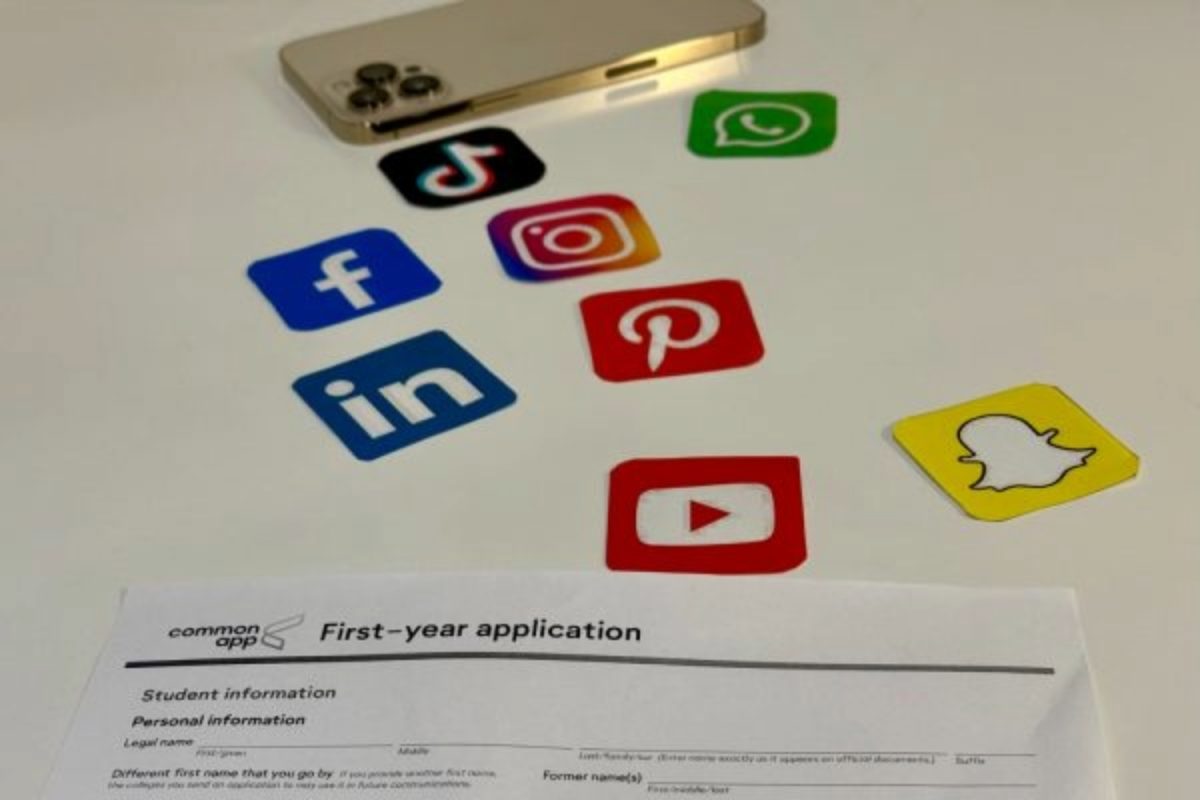
A 2023 Kaplan survey found that 67% of college admissions officers consider checking applicants’ social media “fair game,” although only 28% actually do so. A minority of 33% still views it as “an invasion of privacy and shouldn’t be done.”
“Your brain isn’t even fully developed yet,” Balar said. “It’s not the best idea to have something that’s going to permanently affect your entire life that you made when you were 14.”
The education deficit
Despite the high stakes, Carlmont offers limited social media literacy education. High school freshmen receive internet safety instruction during Life Skills classes, but the instruction is limited.
“We don’t have anything that’s integrated throughout your four years at Carlmont,” Buckland-Murray said.
Lapus sees it as a collective responsibility to integrate more education on social media literacy.
“Technology is a part of the fabric now in the way that we teach, learn, instruct,” Lapus said. “If we’re going to be providing students access to these tools, we want to ensure that we’re providing them all the resources, the critical skills to be able to leverage them for effective learning, for effective collaboration, and effective ways to really communicate with each other.”
Although there is widespread recognition of the need for digital literacy education, its implementation faces substantial obstacles.
“The biggest challenge is oftentimes it comes off to feel like one more thing for educators, even though they know that these are real stresses, real pressures, and real conversations for preparation that teens and kids should be exposed to and should be having,” Lapus said.
Van Sebille found that districts rarely provide explicit policies around personal social media use beyond their interactions with students.
“There is an implicit understanding that you should be careful about what you post, but the only real rule is that you can’t be friends with students online,” van Sebille said.
And even though technology companies have developed their own digital literacy resources, their distribution and awareness pose significant challenges.
“Snapchat just recently released Keys to Success,” Balar said, referring to short videos about misinformation and safety. “Pinterest also just released a program called Media Mindfulness. I think a lot of these programs do exist. I think there just isn’t a lot of awareness about them.”
The path forward
Van Sebille does not expect the moral scrutiny of teachers to diminish. “
For as long as there have been teachers, they’ve been on this moral high ground and this moral superiority where they’re expected to behave better than the normal citizen,” van Sebille said. “And I don’t expect that to change.”
California’s cell phone bill, which requires every school district to establish guidelines by July 1, 2026, represents one approach to managing the impact of technology. But Lapus cautioned against viewing device restrictions as a comprehensive solution, noting that any technology policy must also include education.
“We can’t just expect that keeping kids away from their devices for seven or eight hours is all of a sudden going to make them effective users of technology online,” Lapus said. “No one’s going to be taking their phone away from them when they get into a job in the real world. They’re going to have to learn how to navigate that experience.”
Buckland-Murray offered a more hopeful perspective.
“I like to celebrate the positive parts of social media,” Buckland-Murray said. “But I feel like I can’t do that without also recognizing the unfortunate harm.”