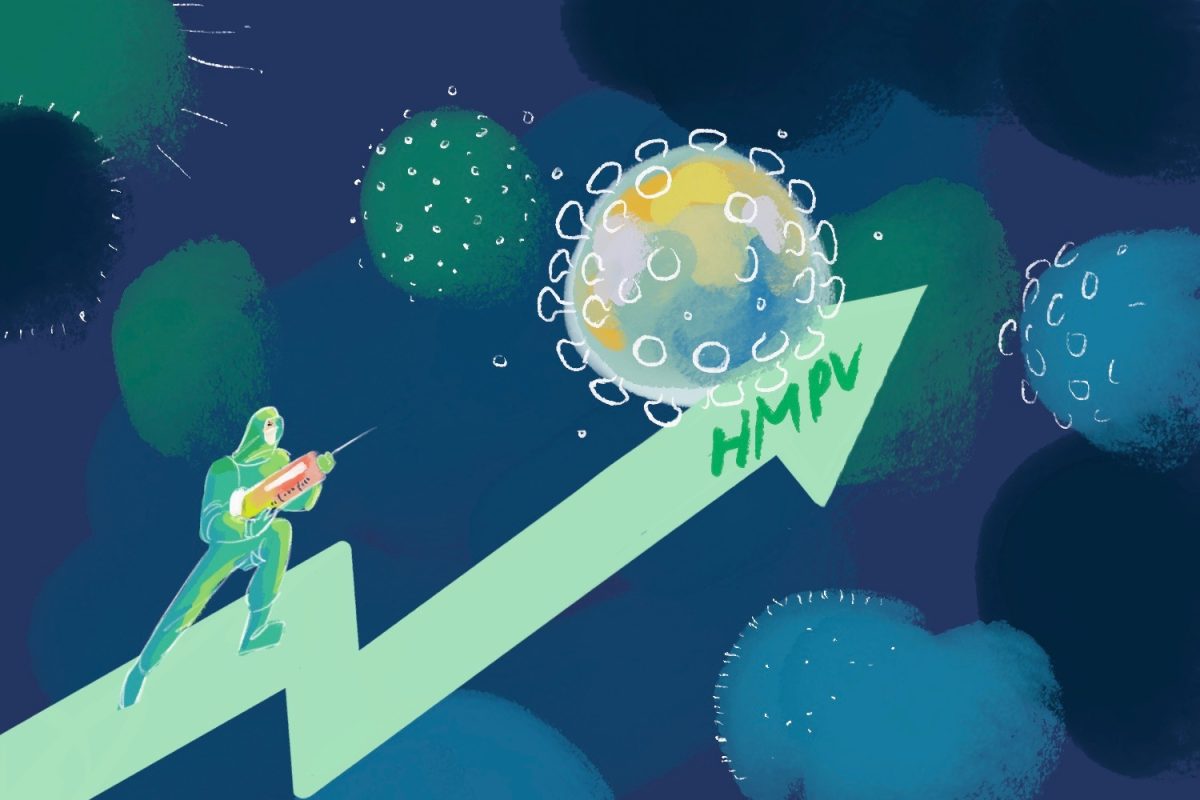
A respiratory virus many have never even heard of, human metapneumovirus (HMPV), is quietly spiking across Northern California, drawing new attention to its lack of targeted treatment and limited research as the annual respiratory virus season comes to a close.
While the flu, COVID-19, and RSV dominate headlines each winter, HMPV often circulates unnoticed despite infecting thousands of people each year.
“I did have a patient who was admitted at some point in the last year with an upper respiratory syndrome and tested positive for HMPV, but it’s not something that I come across frequently in primary care. It presents like a common cold most of the time,” said Dr. Karen Suskiewicz, who has been an internal medicine physician at Sutter Health for 17 years.
First identified in 2001 and closely related to RSV, HMPV is a seasonal respiratory virus that is typically rampant during the winter and spring months, like most others. According to research published by Oxford Academic, of all the acute respiratory infections each season, HMPV accounts for roughly 4.7% to 7.3% of them. Meanwhile, among children, it often takes up a significantly larger share of these cases, between 5% and 25%, according to the National Library of Medicine.
“It seems like there’s always something going around; it just depends on the season. Some viruses occur year-round, such as adenovirus and parainfluenza. Some occur in the winter, like RSV, COVID-19, and the flu, as well as HMPV. And some occur more in the summer, like enteroviruses, such as hand, foot and mouth disease,” said Dean Blumberg, M.D., a professor and the chief of the Pediatric Infectious Diseases division at University of California, Davis Health.
Not only does its seasonal pattern of infection overlap with other winter and spring respiratory illnesses, but HMPV’s symptoms often resemble those of the common cold or flu, so its contraction is frequently mistaken for or even impractical to identify over other viruses, according to Suskiewicz.
“They all act very similarly. RSV can cause a bad runny nose, a cough, and shortness of breath, but the common cold, which is usually a rhinovirus, can cause the same thing, and then HMPV can also cause the same type of symptoms,” Suskiewicz said. “It’s all part of one spectrum, so it’s not something as an outpatient primary care doctor that’s as important for me to diagnose because it’s not going to change my plan of action at all.”
In fact, it blends in so closely with these more widely recognized viruses that many people don’t even know it exists, as became evident last year when a sudden rise in cases in China sparked a brief public scare about another pandemic, before experts revealed that HMPV is actually decades old and common.
“I think we’ve heard more about it in the past few years because we have assays that detect it. We have respiratory viral panels and nasal swabs that detect about 20 different pathogens, while before, we didn’t really have a good test for it, so we didn’t pay attention to it,” Blumberg said.
However, unlike many of these other detected respiratory pathogens, HMPV currently has no approved vaccine or targeted antiviral treatment, leaving doctors to rely on other measures, like recommending rest, fluids, and over-the-counter medications.
“For COVID-19, you have Paxlovid, or for the flu, you have Tamiflu, but for HMPV, it’s just supportive care — treating the cough, treating a fever, and just trying to make someone feel better until their body fights the infection,” Suskiewicz said.
Blumberg believes this lack of specific treatment stems largely from how limited existing data on HMPV is.
“I think because we don’t know as much about it as we do for RSV, the research has lagged behind. Just now, studies are being done to try to figure out how important it is to develop a vaccine. What’s the morbidity? What’s the hospitalization? How many people die per year from HMPV? That data could spur vaccine development, as well as antiviral therapy,” Blumberg said.
Resources and public opinion also play a role in determining whether development for an HMPV vaccine will move forward.
“Part of it is probably the political climate. People are turning away from vaccines rather than developing more,” Suskiewicz said. “It’s very costly to develop a vaccine, and there’s a whole process involved with it. For COVID-19, it was really a push because people were dying, and people weren’t going to work because of the way all living stopped. That cost a lot of money, so not only was the vaccine developed to save lives, but I think there’s always an economic standpoint to it as well. But HMPV is just not as sexy a topic as RSV, COVID-19, or the flu is.”
However, this lack of preventive options may leave communities more vulnerable as the virus begins to circulate locally, a concern underscored by recent data from the WastewaterSCAN monitoring system, which detected elevated levels widely across Northern California. The surge, first noticed in early January, has continued to rise into March, with a positivity rate now almost double last year’s and matching that of COVID-19.
“I think it’s just how any sort of illness increases during the winter and into springtime,” Suskiewicz said. “Something will circulate, and I will see patients in the office who have similar symptoms, and I can say to them, ‘I’m seeing a lot of people with this.’ And probably what I’ve been seeing is HMPV.”
Residents in San Francisco, Vallejo, Napa, Santa Rosa, Sacramento, and Davis are specifically at high risk.
“It’s definitely not great. Knowing there’s no way to quickly recover from something can be a bit scary because of how much longer you’ll have it,” said junior Sequoia Leger.
Without antiviral therapy, residents are told to practice basic preventive measures, such as frequent handwashing, covering coughs and sneezes, and avoiding close contact with infected individuals, according to Suskiewicz, since HMPV spreads primarily through touching respiratory droplets and contaminated surfaces.
“We don’t have any specific treatment for many things, like the common cold and many other viruses, and it’s not like I’m having many, many patients end up in the hospital, very sick and dying from HMPV. So, I think we just lump it in with the other common, viral illnesses that we see, especially in the wintertime, and advise people to do things to prevent getting sick — get enough sleep, stay well hydrated, reduce your stress levels, and all of the usual advice,” Suskiewicz said.
Still, for most people considered healthy, the effects of diseases like HMPV are mild. But in some cases, particularly among young children, older adults, and those with weakened immune systems, they can progress into more serious conditions.
“It’s similar to the other community-associated viruses in that it affects the extremes of age the most,” Blumberg said. “So, the youngest children are more at risk for more severe disease because it might cause bronchiolitis or wheezing, which might require admission to the hospital. Or for patients with asthma or reactive airway disease, it might trigger an exacerbation. And then the elderly, those over 65 years of age, could get pneumonia, which might land them in the hospital too.”
As doctors and residents navigate HMPV without targeted treatment, Suskiewicz emphasizes that, while research continues to catch up, patients should remain diligent in protecting themselves against other respiratory illnesses.
“The most important thing is to get vaccinated against what we can protect you from, whether it’s COVID-19, the flu, RSV, or whatever might be appropriate,” Suskiewicz said. “That’s the best that we can do right now.”