
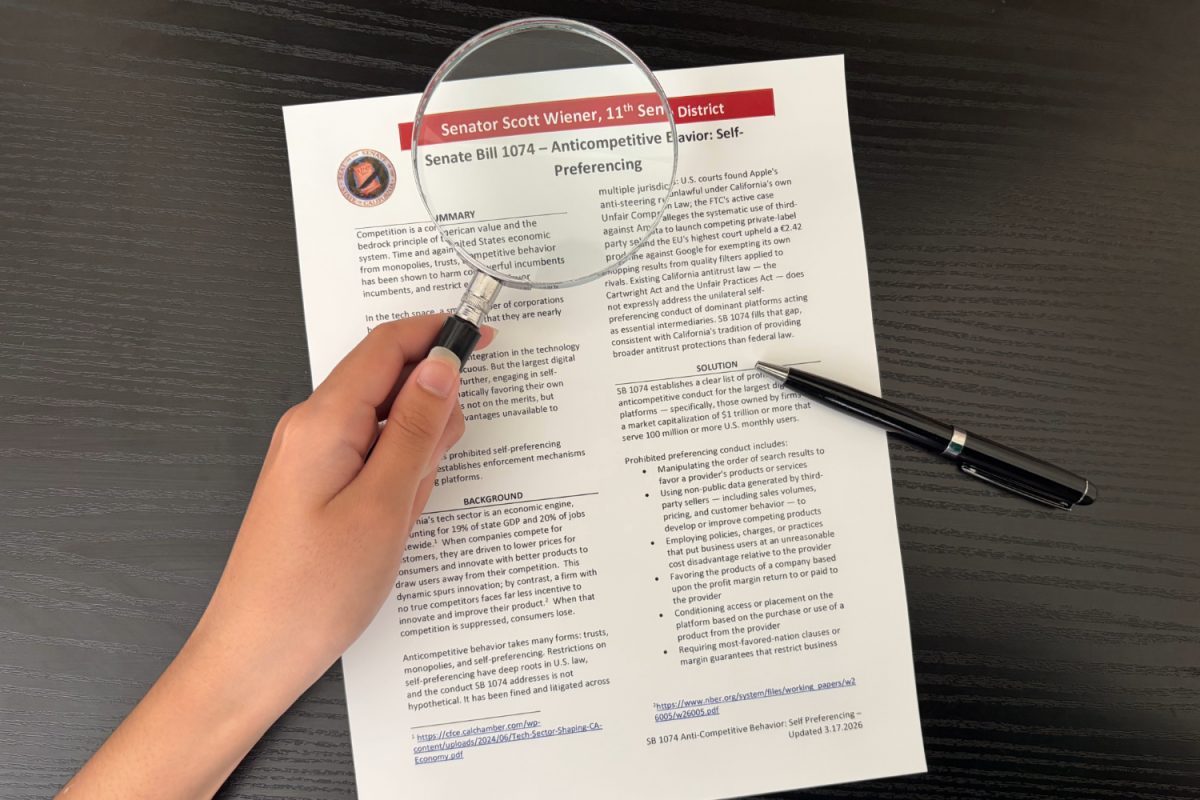
A new California bill could change how students download apps, shop online, and search the web by prohibiting technology giants from favoring their own products over smaller competitors.
Sen. Scott Wiener, D-San Francisco, announced Senate Bill (SB) 1074, known as the Blocking Anticompetitive Self-preferencing by Entrenched Dominant platforms (BASED) Act, on March 18. Co-sponsored by Y Combinator and Economic Security California Action (ESCA), the bill targets gatekeeper platforms with a market capitalization exceeding $1 trillion and at least 100 million monthly active users in the U.S. Industry titans like Apple, Google, Amazon, and Meta could face penalties of $6 million or more per violation for anticompetitive misconduct.
“We’ve had a pattern of Big Tech not creating new markets or opening the door for small entrants to give consumers choice,” said Y Combinator CEO Garry Tan.
While supporters argue the BASED Act would curb Big Tech’s anticompetitive self-preferencing to lower prices and drive innovation, critics warn it could break the secure, seamless digital ecosystems consumers rely on. For Carlmont students, the bill could fundamentally reshape their daily technology experience.
SB 1074 prohibits platforms from requiring proprietary payment systems, allowing developers to bypass app store commission fees and potentially passing cost savings to students through lower in-app prices.
“I’ve noticed some stuff like digital currencies are more expensive on the phone than on the computer, specifically the iPhone,” said Carlmont sophomore Alex Lam.
The BASED Act also mandates allowing downloads from third-party marketplaces, ending Apple’s exclusive control over iOS software.
“In theory, once you have a choice, artificial moats come down,” Tan said. “If you can choose which app store to use, then Apple loses its monopoly in that market.”
The act requires search engines and artificial intelligence (AI) assistants to return neutral results for queries, ensuring platforms cannot steer users toward their own brands at the expense of competitive alternatives.
“I buy stuff from Amazon Basics, but I also think it’s because Amazon makes it harder to find other stuff,” Lam said.
ESCA Vice President Teri Olle believes allowing platforms to use seller data to build competing products is similar to a rigged transportation system.
“If you’re the toll road operator and you also have a trucking company, but you treat your trucks the same as you treat anybody else’s, that’s fine,” Olle said. “If you start to use the tollway that you own to make it easier for your own trucks and make it harder on everyone else’s, common sense would just go, that’s just not fair.”
Critics argue that the lines between self-preferencing and helpful integration are blurred. The Chamber of Progress warns that students could face a fragmented experience if Google is barred from surfacing YouTube tutorials or Google Maps directly in search results.
While critics worry about fragmentation, Olle asserts the real issue is what students are currently denied.
“As consumers, we don’t even know what we’re missing,” Olle said. “That’s a real loss.”
The Chamber of Progress also cautions that requirements forcing platforms to grant external developers hardware and software access could bypass safety filters and expose students to insecure apps.
“I’d prefer the freedom to download anything I want, because I feel you have to be smart enough to know what to download and what not to,” Lam said.
The BASED Act builds on the European Union’s Digital Markets Act and the American Innovation and Choice Online Act, expanding their blueprints to include AI. The European Law took effect in May 2023, while the U.S. bill stalled in Congress following heavy industry lobbying.
Olle points to the stark difference between the domestic market and overseas alternatives.
“If you were in Europe right now, you would be able to have access to a whole bunch of other apps and products that you can’t get here because in Europe, there are regulations over those digital marketplaces,” Olle said.
While the BASED Act is currently a California-led effort, Wiener plans to bring the legislation to Washington, D.C., if elected to the U.S. House of Representatives.
He believes expanding the bill to the federal level is necessary to ensure the national digital economy is built on merit and robust competition.
“We just want open fair markets where people are offered choice,” Tan said. “Google exists today because Microsoft was barred from self-preferencing its Internet Explorer browser.”