
A lot of people seem to have this misconception that the American work culture is one of the most toxic in the world. After all, the masses are exploited and brainwashed to be 9-to-5 corporate slaves for elite families like the Rockefellers and Rothschild. Meanwhile, Greenstone and Water Asset Management continue to hoard water rights so that they can exploit American dehydration for their own benefit.
While all that might be true, the actual work culture of an average office worker in America isn’t so bad. Most corporations offer paid time off, health benefits, somewhat flexible hours, and telecommuting. Yes, some Americans have a live to work mindset, but the average American works to live. It sounds bad—spending 40 hours a week in our cubicles for 30 to 40 years in exchange for a nice retirement—but objectively, our work culture doesn’t even come close to countries like Japan, where karoshi, death from overworking, is not an uncommon occurrence. At least we’re not dying yet!
At this point in time, the problem with the American work culture is that there might not be enough workers in the near future to even generate a national sentiment about work. The idiom “to cut corners” means to discard important aspects of a project in exchange for the quickest results.
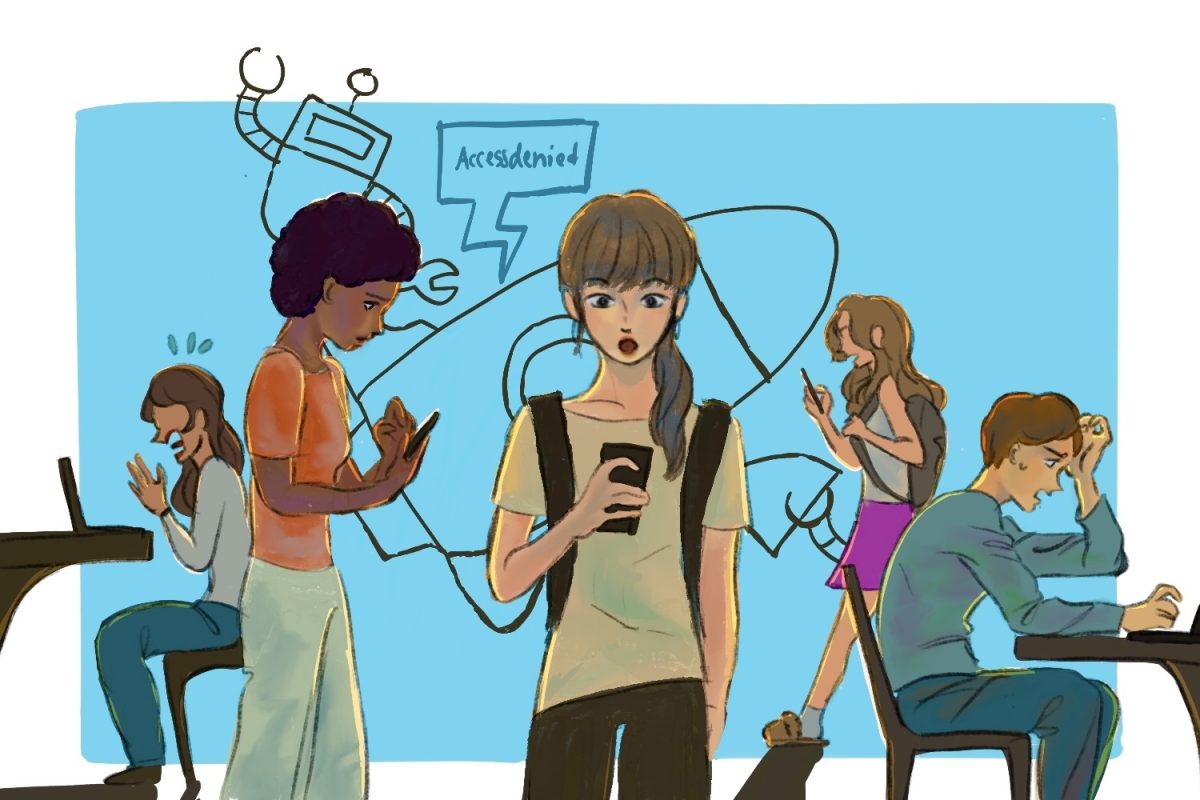
Right now, Big Tech is snipping off the corners of its corporate pyramid, substituting its human hands with artificial intelligence algorithms that will never sleep and never ask for a raise. In fact, according to Revelio Labs’ labor statistics research, 35% of entry-level jobs have been severed by the big AI boom.
Backed by the Trump Administration, whose one goal is to win the global AI race against the Chinese, Big Tech has government funding and venture capital firms wrapped around its finger. On Sept. 10, 2025, database trailblazer Oracle’s stock soared 36% overnight after flaunting significant contracts with key AI players, including OpenAI, xAi, Meta, and Nvidia.
What Big Tech doesn’t realize is that replacing their workers with robots will bite them in the back. Or maybe it won’t, because the multi-billionaires at the top will be just fine. But the people under them, the software engineers Palantir hired to allegedly track down Palestinian journalists in Gaza, will crumble.
The bargain of working for an evil corporation is that you must be prepared to face evil yourself. Get ready to witness the amputation of the human cognition, creativity, critical thinking, and collaboration that have supported our society for millennia.
As humans, modern consumerism, let alone AI, was never supposed to exist in our world. We were never supposed to become accustomed to such a streamlined production of goods and services. Sometimes, it seems we forget that we were once hunters and gatherers who foraged and fought for our resources. At the very basis, working for our survival and accomplishments is the foundation of what it means to be human.
Whether it be art, sports, cooking, or hiking, people’s common hobbies and interests are all mastered through two things: time and effort. To become a prominent artist, you have to start out with bad sketches. A good cook’s best friend is trial and error, and if you want to climb Mount Everest, don’t you have to start with smaller mountains to build up stamina?
Putting in time and effort to achieve an intended result is the epitome of human personhood. It is the epitome of being human in our most basic form, a living and working organism.
When I first started researching AI, I believed that there was nothing we could do about it. I thought that it was best to be smart about it and capitalize on the big AI boom. But it becomes a whole different situation when our human personhood, our inherent value as people, is threatened.
We are essentially building a global economy devoid of human value, the one thing that contributes to our shared identity – all 8.1 billion of us – as people. It makes me scared and sad that we, as a society, are complacent about a culture that quite literally is stripping us of our right to be human. We are letting Big Tech pacify us with short-term productivity gains, while the long-term cost of personhood goes unnoticed.
Technological institutions are deliberately and intentionally erasing the purpose of working humans. Accepting that is like waving a big green flag at Big Tech with the words “devalue us!” on it. It makes me scared for the children of the next generation, who will exist as nothing but the product of the data they produce. But for Big Tech, the more children to feed the large language models, the better!
It shocks me that there are even discussions about granting AI legal personhood. I’m sure there is a conglomeration of technological, economic, and commercial reasons that I can’t even begin to fathom, but does the mere concept of giving an artificial mind the same rights as a living human being not seem absurd? Must we call it “personhood” and further devalue human existence?
I do believe that there might come a time when AI is regarded as our human equals. With the way it’s going now, it doesn’t seem unrealistic. Software engineer Jonathan Lipps makes a good point in his blog about how we already speak to AI like it’s a customer service agent. There are even people who have developed parasocial relationships with AI chatbots, so nothing seems impossible from there. The future is uncertain — how exciting!
Hopefully, this generation that is stereotyped as being “woke” can find it in them to resist AI from a more critical and philosophical perspective. Hopefully, we can stitch the workforce together well enough so that chatbot Karina and large language model Steve don’t become the new top earners of this nation, and maybe then we’ll still be able to have a nice retirement.