
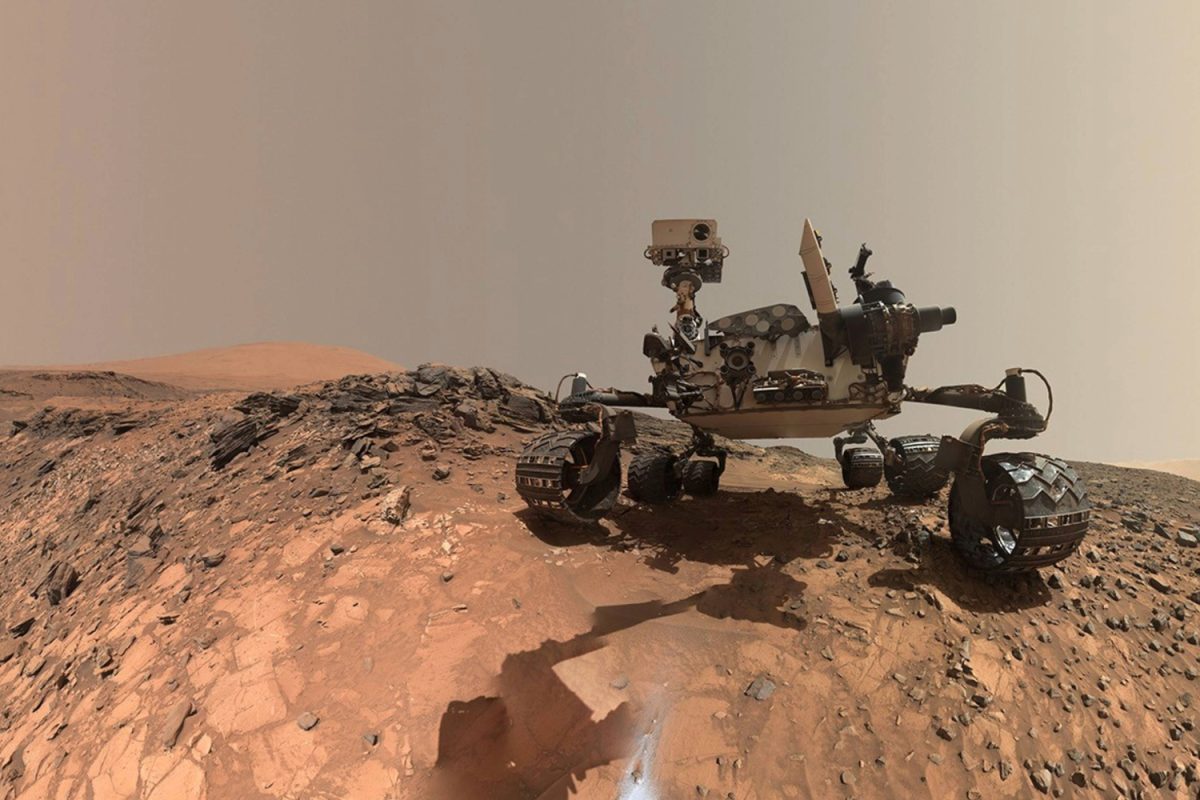
Recent discoveries by NASA’s Mars rovers are reshaping the ongoing research into ancient Martian life, offering some of the strongest evidence yet that the Red Planet once hosted the complex chemical conditions necessary for life.
In early 2026, scientists analyzing data from NASA’s Curiosity rover reported the detection of unusually large organic molecules embedded in ancient Martian rock.
These long-chain carbon compounds are a significant discovery because of their close resemblance to fatty acid fragments, a key component of cell membranes and the most promising complex organic chemical discovery on Mars, according to The Planetary Society.
While it is possible for such molecules to form through non-biological processes as well, scientists’ struggle to explain their size and abundance has all but ruled out purely chemical processes, suggesting the possibility of ancient microbial life.
This newly unearthed information is one of many breakthroughs resulting from multiple missions. NASA’s Perseverance rover, exploring Jezero Crater, has identified rock formations containing organic carbon and mineral patterns that on Earth are commonly attributed to microbial activity. Although it is important to stay speculative, the signs look promising to scientists.
TJ Rodriguez, an astronomy and astrobiology student at the College of San Mateo, emphasizes the importance of such discoveries within NASA’s broader research programs.
“Not a lot of people realize that a lot of this extraterrestrial research, the projects we do, still positively benefit our understanding of our planet, our resources, and how to sustain us,” Rodriguez said.
Together, these findings point to the broader conclusion that ancient Mars once hosted life, according to NASA. Billions of years ago, it was almost certainly covered in rivers, lake beds, and chemical ingredients necessary for the life we know today.
However, even as these findings continue to propel the fields of astrobiology and organic chemistry, steep budget cuts to the NASA program have stalled significant breakthroughs, as evidenced by the cancellation of the Mars Sample Return (MSR) mission.
Aditi Chaudhary, a sophomore at Carlmont High School, agrees with the need to prolong the funding of these missions.
“There is definitely a public interest in space exploration. However, I feel like that is not necessarily translated the best in terms of government funding, especially with all the budget cuts affecting NASA,” Chaudhary said.
According to NASA, this critical program was canceled from this year’s final budget due to unfeasible costs and an unrealistic timeline.
“In general, research right now is suffering quite a bit from funding cuts. I do prefer research in fundamental theory and things on Earth more; they’re more applicable than what can be found on Mars,” said like-minded Carlmont junior Grace Liu.
This, however, is devastating to the mission because advanced laboratory analysis is crucial to confirming the possibility of life. Although sophisticated, the instruments on rovers are not sufficient to match the precision of Earth-based testing or to distinguish between biological and non-biological origins.
Scientists warn that without stable funding, the very samples that may contain definitive evidence of past life could remain stranded on Mars indefinitely, according to Scientific American.
With the stakes extending from a single discovery to a multifaceted, years-long mission, it becomes all the more crucial for the sustained investment that drives the search for life outside our own.
“It’s a really major step, especially for astrobiology,” Rodriguez said.
For now, the discovery of complex organic chemistry on Mars stands as both a scientific milestone and a reminder of what remains unresolved. Although promising, this evidence cannot be conclusive without the critical support and political decisions made closer to home.