
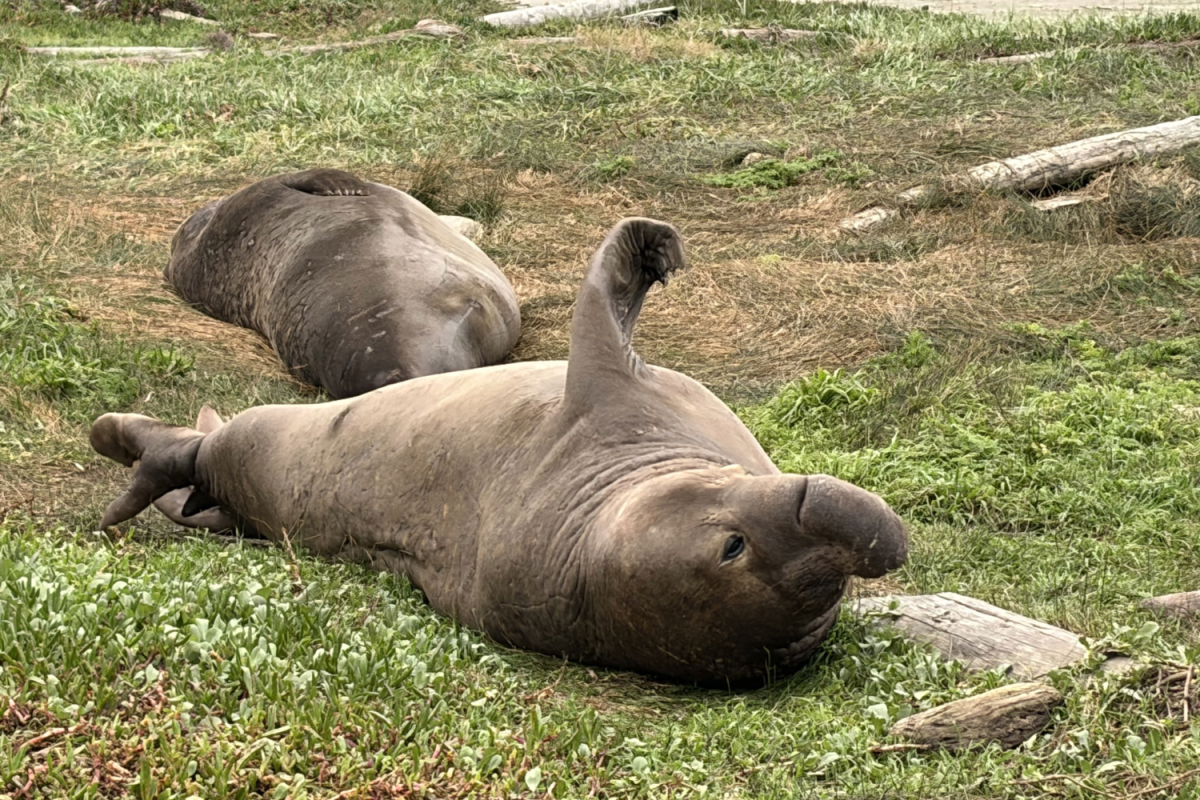
A deadly avian flu outbreak has struck northern elephant seals for the first time in California history, killing at least 30 seals in San Mateo County.
On Feb. 24, the U.S. Department of Agriculture (USDA) National Veterinary Services Laboratories confirmed seven weaned elephant seal pups at Año Nuevo State Park tested positive for Highly Pathogenic Avian Influenza H5N1, commonly known as bird flu, according to a report from the University of California (UC), Davis.
“The current focus is on addressing the immediacy of the situation and preventing the outbreak from spreading,” said Adeline Yee, California State Parks communications manager.
This unprecedented H5N1 outbreak threatens northern elephant seals, a species once on the brink of extinction. A similar 2023 outbreak decimated 97% of Argentina’s southern elephant seal pups, foreshadowing the potential ecological crisis at Año Nuevo and the ripple effects on the local community.
According to a study of northern elephant seals, they have limited genetic diversity, given that the current population of over 220,000 rebounded from only 20 survivors in 1892. A study on juvenile northern elephant seal survivorship, combined with a low average first-year survival rate of 36.8%, suggests that the species is uniquely vulnerable to the H5N1 outbreak. About 1,350 seals were at Año Nuevo when the outbreak began, according to the UC Davis report.
Experts remain optimistic because most reproductive females had migrated before the virus was detected.
“Most of the adult females had already departed the beach for their routine migrations before the outbreak began, and most seals on the colony seem healthy,” said Roxanne Beltran, an assistant professor of ecology at UC Santa Cruz, in the UC Davis report.
Researchers are monitoring the colony at Año Nuevo to assess the impact.
“At this point, efforts are still underway to understand the specific sequence of the virus that is impacting the elephant seals, and there is an outstanding question of transmission potential,” Yee said.
In contrast, neighboring rookeries at Point Reyes and San Simeon report no illness and remain open to the public.
Despite these parks staying open, officials are urging caution, as H5N1 is a zoonotic disease that can spread between animals and humans.
“The risk to the general public remains very low, but Californians can protect themselves and their pets by avoiding contact with sick or dead marine mammals or birds, keeping pets on a leash near beaches, and respecting area closures,” said Dr. Erica Pan, California Department of Public Health director and state public officer, in a March 6 news release.
Some students are concerned about their pets tracking the virus from the beach.
“It makes me a bit concerned that my dog could get this disease, especially if she’s not on a leash, because I can’t watch over her everywhere she goes and make sure that she’s not doing anything that could put her in danger,” said Carlmont sophomore Ella Needleman.
Following the H5N1 outbreak, officials closed public access to the Año Nuevo elephant seal viewing area to give wildlife space and for ongoing monitoring, canceling all 2026 docent-guided tours.
“The decision to cancel tours was based on the best available science,” Yee said.
Northern elephant seals are currently in the midst of their breeding season, the peak time for visitors at Año Nuevo. California State Parks Deputy District Superintendent Jordan Burgess confirmed a total of 4,363 tickets have been canceled during a Feb. 25 press conference hosted by UC Davis. These cancellations at $11 per ticket amount to an estimated revenue loss of approximately $48,000 for the park.
Nearby coastal businesses will also suffer earnings decline due to a sharp drop in foot traffic during their typically busiest quarter.
Beyond the economic losses, the tour closures affected multiple schools. This included Carlmont, whose AP Research students pivoted from field observation to classroom analysis after their March 20 tour was canceled.
“Prior to going on the field trip, they would have learned about behavioral patterns of elephant seals, identification of the different varieties of seals that would have been there, and the general biodiversity of the area,” said Andrea Struve, an AP Research teacher at Carlmont. “While there, they would have dived deeper and have activities that would have enriched their understanding of how research is being done in those environments.”
Struve leveraged the outbreak as a real-world case study, substituting the intended fieldwork with classroom discussions.
“We had a discussion about disease progression and spread,” Struve said.
California State Parks also recognizes the importance of the tours as an educational resource.
“These tours are definitely important. We will be doing everything we can to ensure we find ways to provide high-quality opportunities for recreation, inspiration, and education into the future,” Yee said.
Past U.S. H5N1 outbreaks among seals have been devastating. The National Oceanic and Atmospheric Administration (NOAA) Fisheries reported that Maine’s gray and harbor seal death rate tripled in 2022. Additionally, the Washington State University Office of Research reported 15 harbor seals died in Washington in 2023, compared to the typical one or two annually.
“In those events, the infected birds spilled the virus over into the seals. We had no seal-to-seal transmissions, so those events were short-lived,” said Deborah Fauquier, NOAA Fisheries veterinary medical officer, during the press conference. “We are going to be optimistic and hope that pattern repeats in our elephant seals at Año Nuevo.”
In July 2025, The Marine Mammal Center tested an H5N1 vaccine developed for cattle on northern elephant seals. The trial demonstrated that it safely induced antibody production, but widespread use remains restricted.
“USDA would have to approve it, and currently, they are only approving it for endangered species,” Fauquier said.
While the seals cannot benefit from the vaccine in the short term, it may protect the species in the future.
“We are hopeful that these impacts will be short-term but will be actively following the situation and leaning on available science and public-health guidance in future decision-making,” Yee said.