
Over 1,600 plaintiffs — including minors, school districts, and state attorneys general — are suing Meta and Google, accusing them of designing their social media apps to prioritize engagement over individual safety.
The lawsuit, according to The Guardian, began Feb. 9, 2026, and includes plaintiffs from across the United States. Many of these individuals have been significantly impacted by social media apps such as Instagram, Facebook, and YouTube, which, according to the lawsuit, are purposefully creating apps with addictive features, such as infinite scroll and autoplay.
“Common features like infinite scroll, pull-to-refresh, autoplay, and even likes leverage a young user’s innate drive to seek gratification, resolve uncertainty, and escape discomfort,” said Ashley Shea, a graduate student in the department of communication at Cornell University.
These features, which some have even compared to a slot-machine-like mechanism, are designed to keep users on the app, seeking rewards in the form of instant gratification, such as new likes, comments, and followers, causing dopamine surges.
“By delivering variable yet easily obtainable rewards through an endless stream of scrollable and auto-playing content — along with the social responses attached to it — these features enable effortless and frequent checking,” Shea said. “In turn, users prolong their engagement to stave off uncertainties, alleviate discomfort such as boredom, and continuously access quick hits of dopamine. Over time, this can become a habit.”
While social media addiction can happen to anyone, according to the National Library of Medicine, it is excessive daily usage that affects a user’s well-being and functioning. It is especially prevalent among younger individuals, particularly teenagers, not only because of the app’s design but also because of their developing brains.
“Teens have brains that are still developing and are therefore more sensitive to the very gratifications that these features enable. The reward center in a teen’s brain develops at a faster rate than the prefrontal cortex, which is responsible for executive control and impulse management,” Shea said. “Until the prefrontal cortex matures to ‘catch up’ with the reward system, the teen’s clicks, shares, and engagement will continue to be used to personalize recommendations and notifications based on prior behaviors that were executed while lacking the sufficient cognitive resources required for self-control.”
This lack of self-control is especially prevalent among teenagers during their free time, as many often resort to screen time rather than interacting with others.
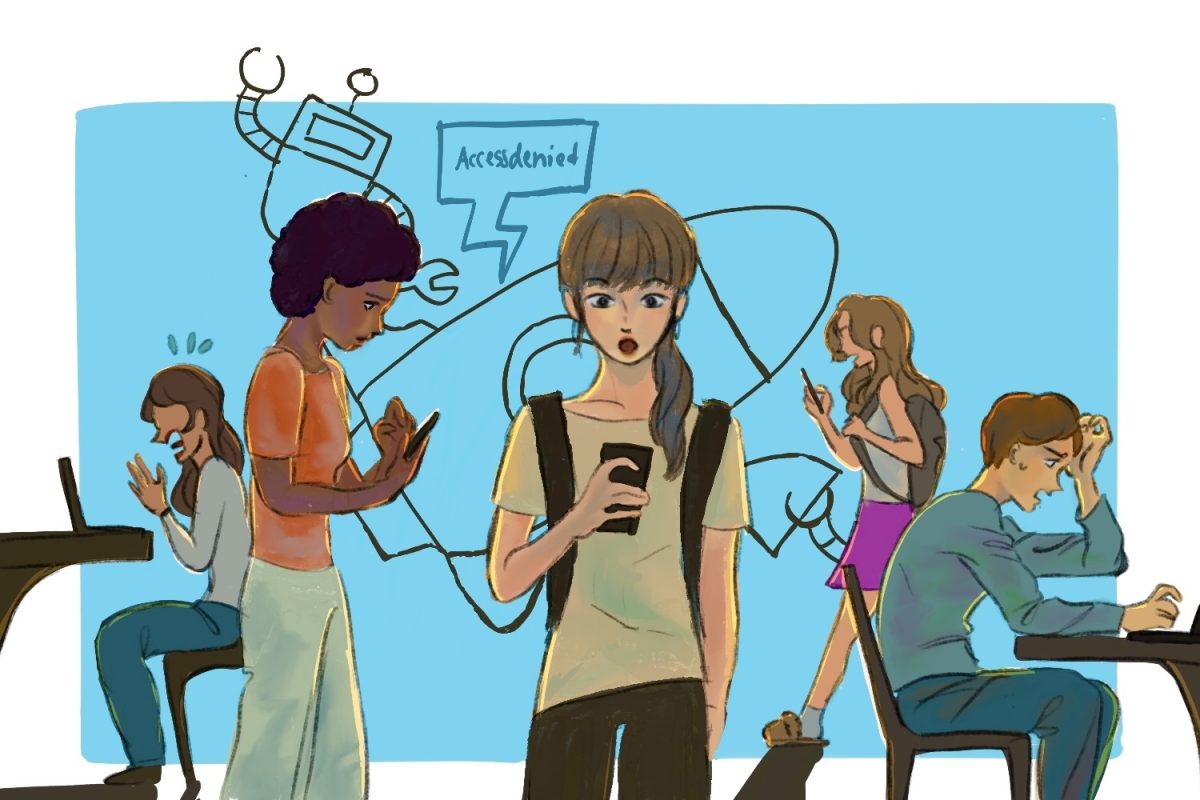
“When I give students a break in class, or even leading up to the bell, the instinct from too many students is, rather than just turning to each other and having a one on one conversation, immediately burying their faces in their cell phones and are scrolling through social media,” said Greer Stone, an Advanced Placement (AP) U.S. Government and Politics teacher at Carlmont High School.
While this habit of immediately checking social media is common, and provides a new way for individuals to communicate with each other — via the internet — it has also caused many detriments, one of which is the loss of the ability to communicate with others.
“We’re losing the ability to interact with one another and have those face-to-face conversations and to create those more meaningful human connections,” Stone said.
Having meaningful connections and face-to-face interactions is only one of the many drawbacks of socializing through social media; the others are the loss of the ability to pick up on social cues and the comfort of knowing that your words and intended meanings are not distorted.
“When you are texting somebody, a lot can be misconstrued,” said Shelley Bustamante, a mental health specialist and the Students Offering Support coordinator for Carlmont. “When you’re not seeing the facial expressions and hearing the intonation of voices, you may miss some cues that are important. You may interpret something the wrong way or miss something that could bring you closer to another person or actually help them.”
This lack of social connectivity and the constant need to feel “connected” via social media, whether that means sending messages to friends, interacting with posts, or scrolling through endless videos across numerous platforms, can have many side effects.
“Anxiety and depression can come from too much time on social media, especially after sleep deprivation and looking at other people’s lives through Instagram and TikTok,” Bustamante said. “Screen time in general and the actual light of the screen can cause people who have addictive personalities or a predisposition to addiction to be impacted in a negative way.”
According to Shea, it is crucial for individuals who use social media to approach it carefully, focusing on maintaining balance and using it for limited periods. With friction — a roadblock to excessive use that can look like anything from pushing a button to prevent another video from playing to automatically logging out users — never being encountered on these apps, it is essential for individuals to practice safe behaviors.
“It is very important to balance the use of mobile apps with other rewarding experiences,” Shea said. “Introducing some friction and opportunities for boredom, reflection, and downtime are considered important aspects of developing overall well-being and resilience. I encourage parents and teenagers to talk together about their personal values and how the use of mobile apps can be recalibrated to better support those values.”