
California hospitals are laying off thousands of workers as changes to Medi-Cal and reduced funding strain the healthcare system, raising concerns about patient care and access.
Since mid-March, more than 3,400 healthcare workers have lost their jobs across the state. Hospitals, including Children’s Hospital Los Angeles, have started cutting staff as they deal with less funding. These changes are tied to new policies that reduce Medicaid support, which affects Medi-Cal, the program that provides health coverage for more than 15 million Californians.
As some patients lose insurance, hospitals are bringing in less revenue, leaving their small staff and limited resources to manage more challenges. At the same time, many people still need care. More than 22% of Californians live in areas without enough primary care doctors.
Experts say this could change how patients get care and increase demand in some areas, especially emergency rooms (ERs). According to Robert Wachter, professor and chair of the Department of Medicine at the University of California, San Francisco, these changes may lead to fewer services and more people turning to emergency care.
“As Medi-Cal cuts hit, hospitals will have less money overall, and as patients lose insurance, they will be forced to forego necessary care, which might mean less demand in primary care clinics but more use of the emergency room when they get very sick,” Wachter said. “I don’t think you’ll see staffing changes quickly, but if hospitals have less money overall, they will need to cut their staffing ratios.”
The situation is expected to worsen as the “One Big Beautiful Bill Act,” or H.R. 1, continues to reshape healthcare financing. The law includes major cuts to Medicaid, which is leading to financial instability and even bankruptcy for some providers.
The effects of these cuts are already showing. CalOptima, a health insurance agency in Orange County, has seen about an 8% drop in members since the new law passed.
In Los Angeles County, L.A. Care Health Plan recently laid off 225 workers, about 3% of its staff. Many hospitals are trying to reduce administrative roles first, but some hospitals are still making larger cuts. For example, Pomona Valley Hospital Medical Center is planning to lay off 265 workers.
At the same time, a new rule that stopped new Medi-Cal enrollment for undocumented adults starting Jan. 1, 2026, is adding more pressure. Experts estimate that about 289,000 people could lose coverage by June 2026, rising to 400,000 by 2029-2030.
“The biggest staffing shortages I see are in primary care and in ERs,” Wachter said. “In primary care, it is very hard to get into a primary care practice these days. There is a large national shortage of primary care providers. Payment cuts will make that worse, but it’s already a problem. ERs are just short-staffed for the volume of patients, so we see many patients in hallways, just like on The Pitt. That’ll also get worse as Medi-Cal is cut.”
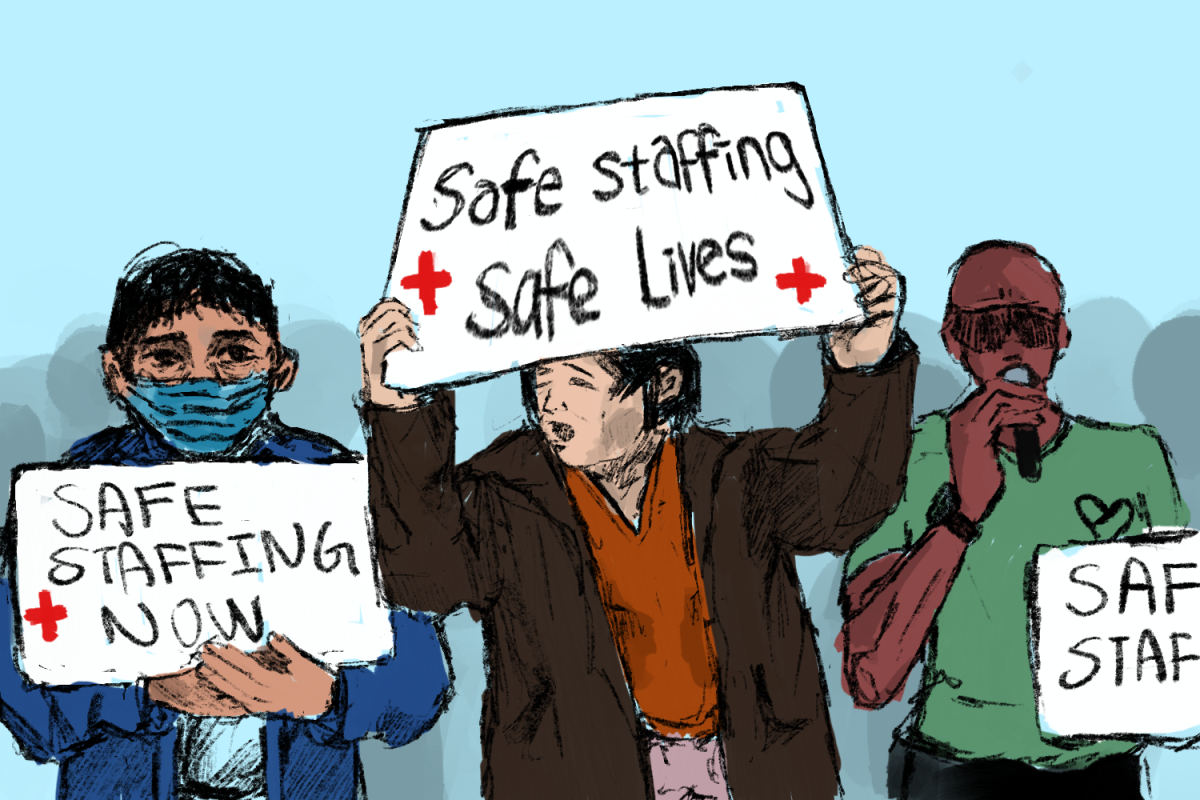
Staffing issues are not new. In 2022, more than 8,000 nurses and healthcare professionals went on strike at hospitals like Sutter Health across San Francisco, Sacramento, Oakland, and the East Bay, calling for safer staffing conditions. Similar strikes also took place at Kaiser Permanente.
Looking ahead, the shortage is expected to continue. According to CalMatters, California could face a shortage of about 8,000 primary care clinicians by 2030, which may lead to longer wait times and make it harder for people in rural and low-income communities to get care.
Inside hospitals, workers say the effects are already clear.
Alyssa Jauregui, an Intensive Care Unit (ICU) registered charge nurse at Mills-Peninsula Sutter Health in Burlingame, said that when there are not enough staff, support roles are often removed, which leaves the remaining nurses with more responsibilities.
“When the ICU experiences staffing shortages, it makes it very difficult to adequately care for patients,” Jauregui said. “With staffing shortages, they take away our breaks and resource nurses to take care of patients. Overall, staffing shortages in the ICU can lead to unsafe situations for patients.”
Even when hospitals try to keep the level of care the same, delays can happen.
“The level of care should never be affected during staffing shortages, but it certainly makes it more difficult,” Jauregui said. “If there are staffing shortages in other areas of the hospital, like imaging, it can be difficult for us to get patients their scans in a timely manner.”
These challenges can slow down the entire hospital system.
“If we do not have adequate nurse staffing in our units, it can be difficult for the ER to move their patients out so that they can address new patients,” Jauregui said. “At times in the ICU, we might need to move a patient to another unit, like step down, just to have enough staffing to take an ER patient.”
The strain is also affecting healthcare workers themselves.
“In the ICU, nurses who have to take care of four or more different patients just to accommodate staffing needs are at high risk for burning out,” Jauregui said. “Consistent patient turnover can be very challenging and demanding for the nurses.”
To fix the problem, Jauregui said hospitals need to keep enough nurses on staff, even when budgets are tight.
“Nurses in the hospital should always have job security. When budget cuts occur, they should never cut down on nurse staffing,” Jauregui said. “While this is not a perfect system, it does offer a temporary solution during peak seasons.”
Seeing these struggles is shaping how some students view their opportunities. Carlmont junior Annika Pisokar said she wants to work in healthcare to make a difference.
“I have always been interested in pursuing a career that has a measurable impact on the lives of others, and I realized this through multiple volunteer experiences,” Pisokar said. “I found medicine really interesting, and it fulfilled my goal of tangibly impacting the lives of others.”
Pisokar stated she is aware of staffing shortages and what they mean for the future.
“I have heard about shortages of nursing staff, particularly, and I am aware that certain demographics have a lack of representation within medical careers,” Pisokar said. “This news encourages me to pursue a career in medicine because it assures me that careers in clinical medicine are needed.”
At the same time, Pisokar is concerned that burnout and long hours may impact her future career, but hopes her passion for medicine and helping others will help her push through.
“An increase in pay, especially for nurses, would make healthcare careers more sustainable,” Pisokar said. “It can be a challenging career mentally and physically.”
As these challenges grow, the future of California’s healthcare system may depend on whether hospitals can balance funding cuts with the need to provide safe, timely care.
“I think the healthcare system is strapped, and the future is likely to see increased demand and more cuts in funding and thus staff,” Wachter said. “Our best hope is that AI can begin to help the systems be more efficient. To do more for patients with fewer humans. We’ll see.”