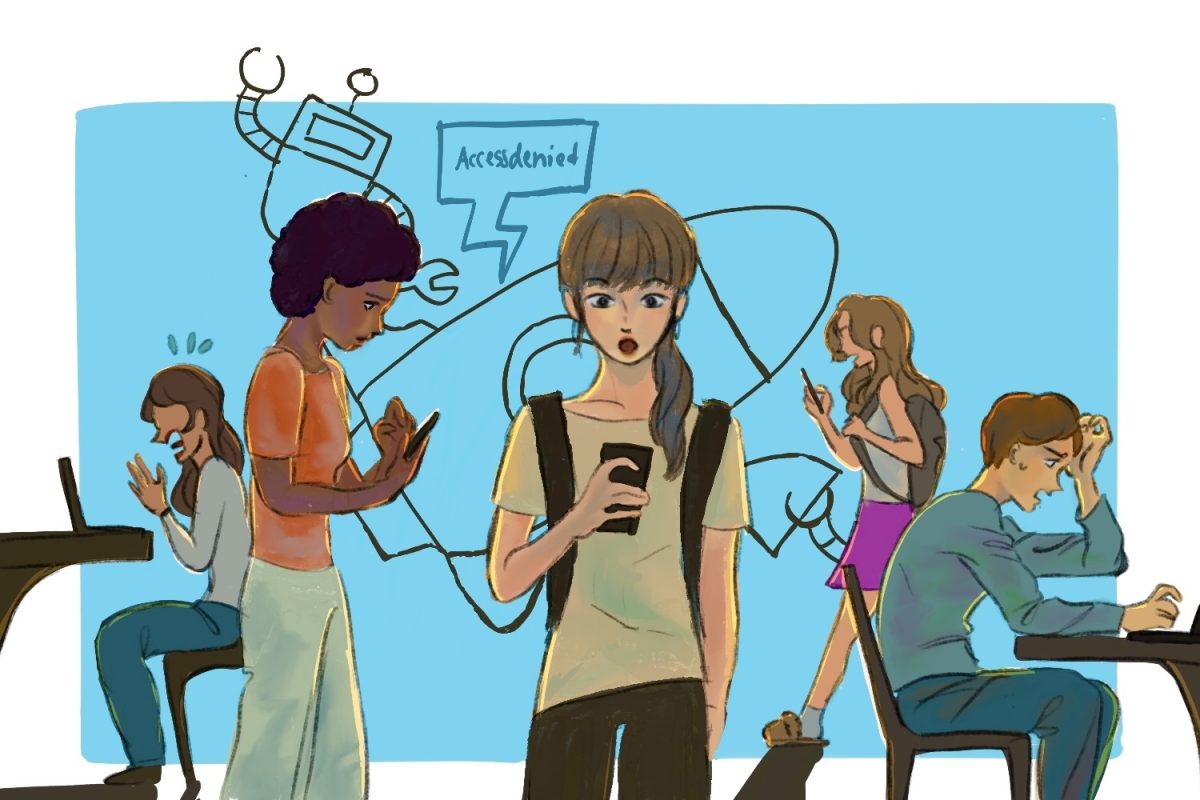

Headlines focused on the ongoing trade war between the United States and China following the announcement of new tariffs earlier this month. However, for Bay Area students and educators, the ripple effects may soon reach their classrooms.
On Oct. 10, 2025, President Donald Trump revealed plans to double import costs on Chinese goods starting Nov. 1 as a result of Beijing’s new restriction on exporting rare-earth materials. These minerals are essential for producing electronic components and technology parts.
“In the short term, it’s going to have a huge effect on some industries because we don’t have access to the materials that we need in these rare earth minerals,” said John Rowe, an Introduction to Business teacher at Carlmont.
Understanding the policy
The 100% tariff is part of a broader response by the United States to China’s export controls on high-tech materials used in devices such as semiconductors and electric batteries.
“This is just a sort of knee-jerk reaction to the withholding of the rare earth minerals,” said David Weyant, an Introduction to Business teacher at Carlmont.
Weyant says that raising tariffs could slow imports, increase consumer prices, and make it more difficult for American companies to access the parts they need to produce or sell goods. For consumers, this may mean higher prices on most technology-based products.
“People are going to be purchasing fewer things. I’m thinking of the holidays coming up, so depending on which holiday you celebrate, this means fewer stockings and fewer or smaller gifts,” Weyant said.
Impact on the Bay Area
With the Bay Area being the hub of technology and innovation, changes in prices for those who rely on these imported materials could prove to have unexpected consequences. It’s not just jobs and classrooms; student organizations that focus on STEM, such as robotics, have also been experiencing negative effects.
“Recently, especially this year, it’s been a lot more expensive to buy aluminum, which is one of the big parts on our robot,” said Eric Zhang, a leader of the robotics team, Dry Ice.
In a region where innovation is central to learning and career aspirations, shifts in the global market can impact the accessibility of tools that support innovation.
“It could slow down the adoption and production of electrical vehicles, electronic devices, and screens. So I think it affects all of us in some way as consumers,” Weyant said.
Looking to the future
The White House has indicated that the tariffs could be delayed or lifted if China relaxes its export restrictions, but for now, both sides appear unwilling to compromise.
“It’s more of a fight rather than trying to find something that’s helping both countries succeed,” Rowe said.
For Bay Area programs, that uncertainty may mean rethinking how they plan their budget and source essential technology in the months ahead.
“Advisors and teachers and educators are going to have a harder time finding the same products that they found previously to educate students,” Zhang said, referring specifically to STEM materials.
Tariffs and trade wars often seem like distant political issues, but their impact can extend to local communities.
“We might see some higher prices this holiday season for the technology that we’re used to,” Rowe said.
As the 100% tariff approaches, students and educators are learning more about how the global economy can affect its surroundings. Beyond the spreadsheets, analytics, and price tags, there’s a shared feeling that no one knows exactly how far this will go.
“I think it’s hard for anybody to predict how things are going to be in the future, just because we’ve never seen changes like this before,” Rowe said.